
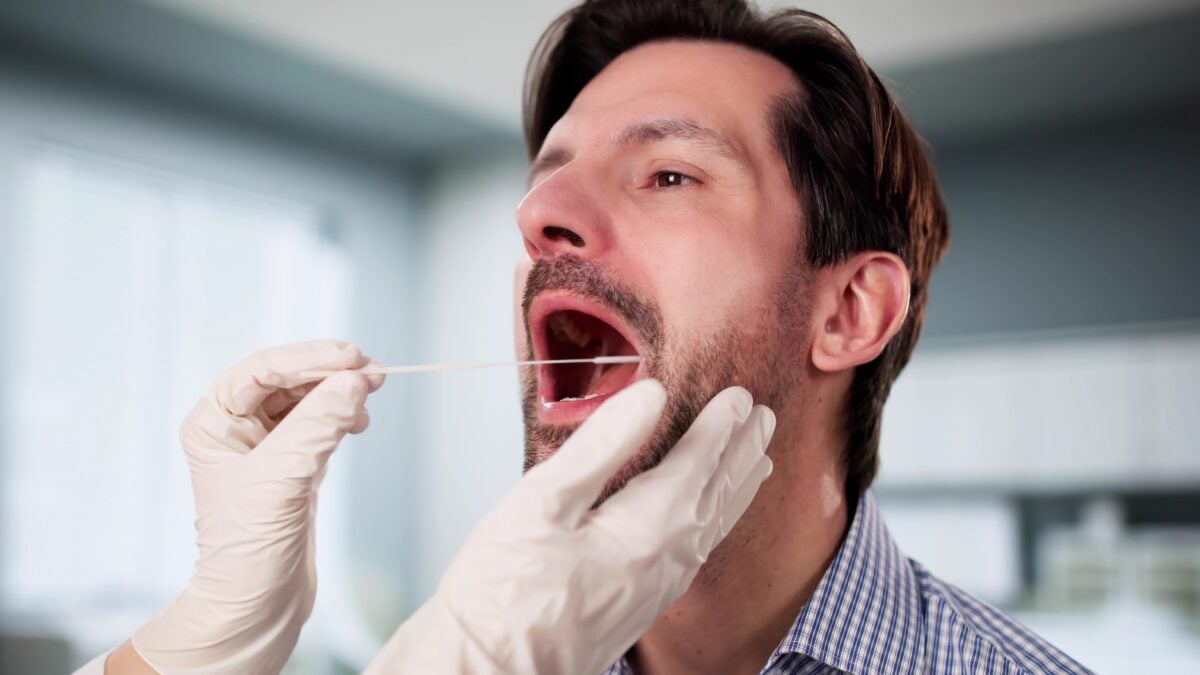
A simple swab from the inside of the cheek, taken in a minute, could one day help detect schizophrenia, where today months of clinical observation are required. This perspective is intriguing, because this psychiatric disorder remains one of the most difficult diagnoses to make with certainty.
A team from Rutgers University (United States) showed, in a study published in Science Advancesthat biological markers measured on oral cells differ markedly between schizophrenic people and healthy volunteers. A trivial gesture of collection could become the gateway to a future
mouth test.
Schizophrenia: a diagnosis that is still long and uncertain
The diagnosis of schizophrenia is today based on the DSM-5, interviews and the observation of very variable symptoms: hallucinations, delusions, social withdrawal, memory or attention problems. Confirming the disease often takes several months, and finding an effective treatment sometimes requires a year of successive trials.
For Bonnie Firestein, neuroscientist and co-author of the study, “Schizophrenia is a heterogeneous illness. The genes involved in each case may differ, even if there are common molecular pathways“, she explained to Technology Networks. Hence the race for biomarkers, these measurable signals which would provide objective support for the psychiatrist’s judgment.
“Other potential biomarkers for schizophrenia have been identified through brain imaging, analysis of cerebrospinal fluid, blood, fibroblasts, liver and urine“, indicated the authors. Although these methods are valuable in the laboratory, they are complicated to apply in a traditional medical office. This has pushed researchers to look at cells that are much more accessible.
A diagnosis made from cheek cells
The researchers recruited 54 adults: 27 patients with schizophrenia and 27 controls, matched on age, sex and origin. They took two oral swabs per person: collecting a few cells from inside the cheek, an examination that lasts around 60 seconds per cheek. Why cheek cells? Because they share a common developmental origin with the brain, both originate from the same embryonic tissue, the ectoderm.
The samples were analyzed: the RNA of the cells by RT-qPCR (a technique to detect and measure the quantity of RNA of a gene in a biological sample) and several proteins by targeted mass spectrometry (a technique to detect and very precisely measure certain specific molecules in a sample).
Major result: the messenger RNA of the gene Sp4already known as a risk gene, is significantly more abundant in patients (highly significant difference), while two other genes tested do not vary. The protein
HSP60linked to mitochondrial stress and inflammation, is on average multiplied by 1.77 in patient samples. Sp4 levels are associated with greater hallucinations and delusions, as well as poorer performance on a verbal memory test, while HSP60 is linked to slowing and more errors on a working memory task. “Our data suggest that mRNA expression of Sp4 and its downstream target, HSP60, are potential biomarkers of schizophrenia“, the researchers wrote in Science Advances.
A promising test, but which will have to confirm its real usefulness
The sample remains non-invasive, without taking blood, an advantage for patients who are sometimes reluctant to undergo medical examinations. The authors ultimately imagine a test capable of helping with early diagnosis, monitoring the progression of the disease or identifying biological subgroups of patients. The picture, however, remains partial: approximately half of the patients have Sp4 levels comparable to controls, and the study remains a pilot investigation on a small sample, all under antipsychotic treatment.
Several questions remain unanswered: are these biomarkers detectable from the start of the disease and therefore will they allow early diagnosis tomorrow? Will this discovery teach us more about the pathophysiology of the disease and open up new avenues of treatment? Are the biomarkers found characteristic of the disease or of the patients already under treatment?… Although a patent has been filed by Rutgers for these oral biomarkers, we are still far from a potential clinical application.