
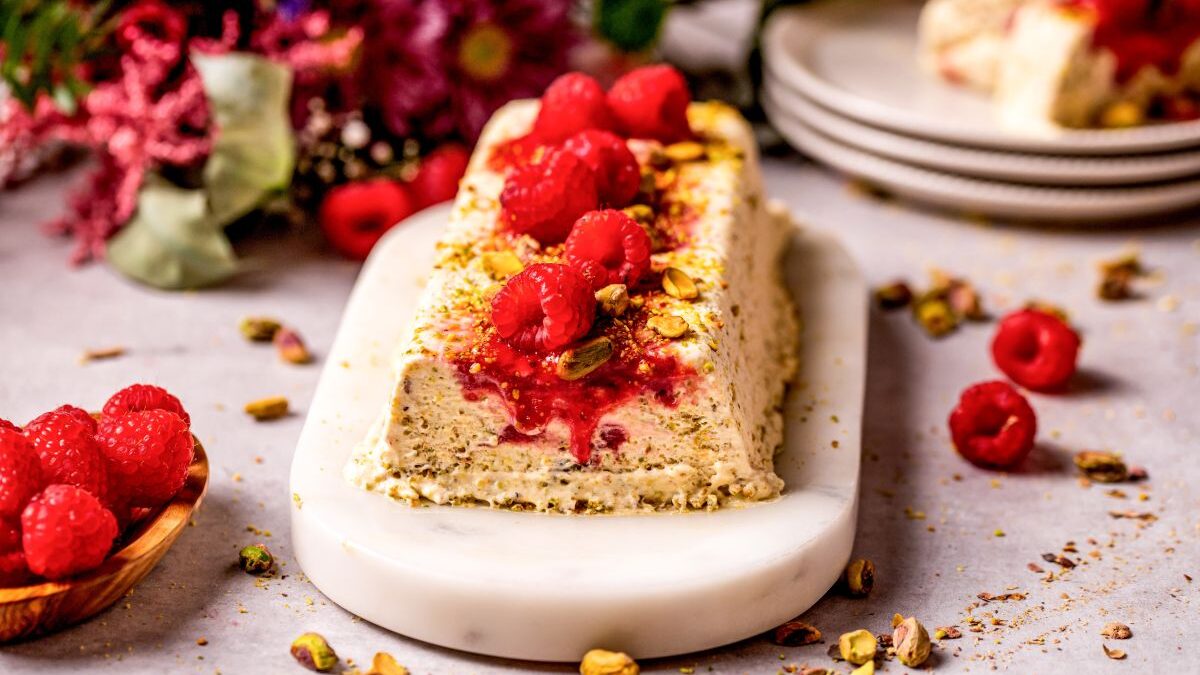
In Italy, the semifreddo is a great summer classic. Halfway between ice cream and mousse, this dessert seduces with its airy texture and accessible preparation.
Available in fruit, chocolate or even dried fruit, it offers a refreshing alternative to traditional ice creams. However, behind its lightness in the mouth lies a much richer nutritional reality.
What is semifreddo, this jewel of Italian gastronomy?
Its name literally means “half-cold” in Italian, a name that perfectly sums up its identity. Semifreddo is neither a classic ice cream nor a mousse. It lies between the two, offering a melting and particularly light texture.
Unlike ice cream, it has the major advantage of not requiring an ice cream maker. Once the preparation is made, simply place it in the freezer for a few hours to obtain a creamy consistency.
This manufacturing method allows it to maintain a foamy side which distinguishes it from denser ice creams. It also shares many similarities with the French parfait, a specialty which is however distinguished by a traditionally richer recipe, made from egg yolks, sugar and whipped cream.
A summer pleasure that hides its game on the scales
The traditional semifreddo recipe is based on a few simple ingredients: we prepare a meringue, Italian or Swiss, which we delicately incorporate into whipped cream or mascarpone, before flavoring the whole thing as desired (red fruits, chocolate, praline).
Under its cloud-like appearance, however, this dessert remains a calorie bomb. Asked about its composition, dietitian-nutritionist Alexandra Murcier warns us.
“It is a relatively high-calorie dessert which has a fairly high sugar content. Cream and mascarpone are quite rich in lipids, particularly saturated fatty acids which are bad for the cardiovascular system if consumed in excess.”
The slimming tip: replace the mascarpone with skyr
Fortunately, it is entirely possible to revisit this great classic to integrate it into a balanced diet without giving up indulgence. The key lies in the choice of creamy base.
To combine pleasure and lightness, Alexandra Murcier offers a very simple alternative that is accessible to all.
“To prepare a lower-calorie and less fatty version, you can replace the mascarpone with skyr or fromage blanc..
By making this change, we drastically reduce the fat intake while increasing the protein content of the recipe. Which makes the dessert much more filling.
How to reduce sugar without losing texture?
The other lever to lighten the semifreddo concerns its carbohydrate content. Often overdosed in traditional recipes to ensure good cold setting, the sugar can however be reduced by half without altering the final result.
The dietitian says: “The proportion of sugar in recipes can be reduced by 50%, without changing the taste or texture.“. To compensate and maximize the flavors, we rely on the natural sugar of mixed seasonal fruits. Like peaches, apricots or strawberries, which will naturally bring sweetness and an irresistible tangy touch.
In summary, the semifreddo has it all: elegant, customizable and terribly refreshing. If it is initially rich in fats and sugars, its revisited version with skyr and reduced in sugar proves that you can indulge all summer long without feeling guilty or compromising on creaminess.