
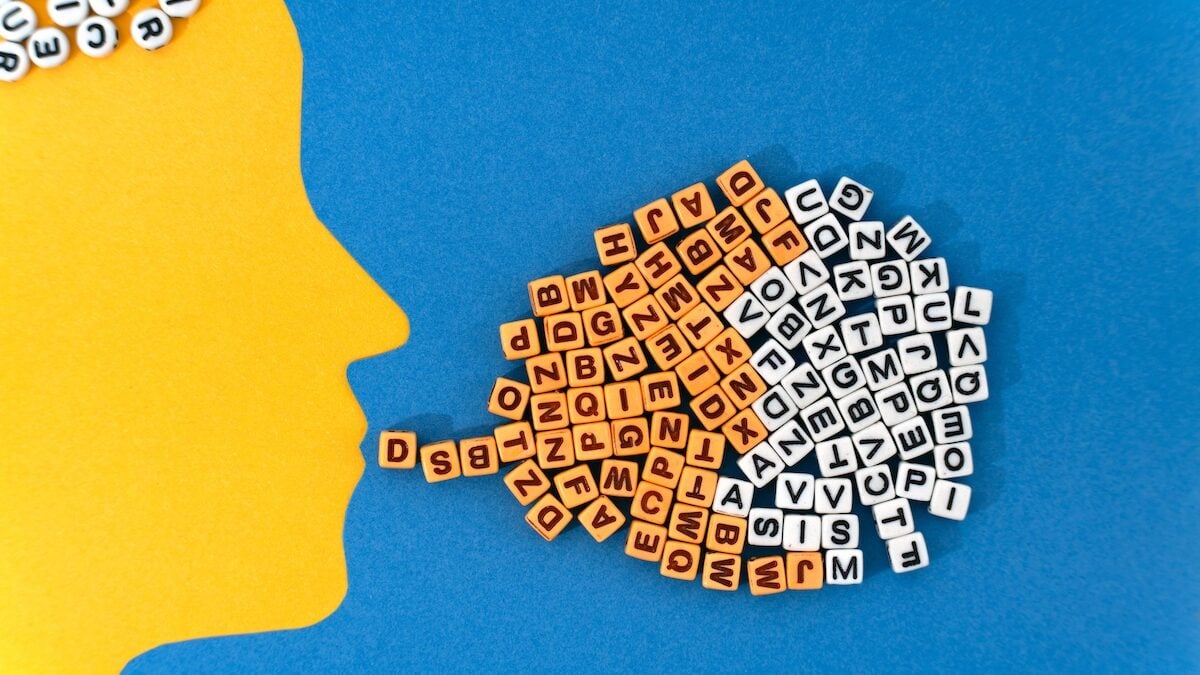
Hearing a voice, and simultaneously seeing the words appear. Not imagined, but readable, structured. And in color, please. Sometimes even colorful. For some individuals, this experience is not fiction: it is part of everyday life. As if the entire world was covered in a projected subtitling system. This phenomenon has a name that is still little-known: subtitle synesthesia.
Every word we say to him materializes
One of the most disturbing cases recently described by two French neurologists is that of a 25-year-old young woman. Without any particular history, she was hospitalized for an acute psychotic episode. As his treatment progresses, an unexpected experience arises: each word he hears transforms into text in his mind. The sentences scroll with precision, as if on an interior screen. Sometimes even one’s own thoughts become visible. And these words are not neutral: they appear tinged with colors.
The phenomenon, initially invasive, especially when several voices overlap, gradually diminishes as his condition improves. Two years later, these “mental subtitles” only occur occasionally. The episode will not have created this ability, but seems to have revealed it.
Synesthesia: when the senses mix
Synesthesia, of which this unique experience is a part, designates a form of crossed perception. The term comes from the Greek
syn (together) and aesthesia (sensation): perceiving one thing triggers another.
Some people see colors when reading, others associate sounds with shapes or textures. In this case, the language heard becomes immediately visible.
This particular type, called ticker-tape synesthesiais not completely new. As early as the 19th century, Francis Galton already described individuals capable of mentally “reading” words as if they were written on an imaginary tape. But it is only recently that science has begun to explore its mechanisms in detail.
A reverse reading mechanism in some people
In France, the work of neurologists Laurent Cohen and Fabien Hauw, at the Brain Institute in Paris, has provided decisive insight. By studying several dozen people concerned, they highlighted a common point: most describe a real mental “text strip”, which unfolds automatically with each word heard.
Their research suggests that this synesthesia corresponds to a kind of reverse reading. Where traditional learning consists of transforming letters into sounds, these individuals seem to perform the opposite operation, instantly and involuntarily: they translate sounds into written words.
Data from brain imaging reinforce this hypothesis. In these synesthetes, the brain regions involved in oral language and those linked to visual word recognition are strongly connected. In other words, the reading circuit would be particularly active, to the point of imposing itself even outside of any real reading.
A phenomenon that begins in childhood
Another fascinating aspect is the origin of this phenomenon. In the majority of cases studied by French researchers, subtitle synesthesia appears in childhood, when learning to read. It could thus reflect an atypical, but not pathological, development of this fundamental skill.
In the young patient, however, the phenomenon remained latent. She already had grapheme-color synesthesia, associating letters and colors since always. The psychotic episode would then have played the role of a revealer, by lowering the threshold of consciousness and allowing a second form of synesthesia, hitherto silent, to emerge.
Writing your life: power or handicap?
An essential question remains: is this an advantage or a burden? The testimonies collected by Laurent Cohen and Fabien Hauw show that the answer is nuanced. This ability can make it easier to remember and understand language. But it also becomes invasive in noisy environments, where streams of “subtitles” multiply and saturate attention.
Beyond its spectacular nature, the synesthesia of subtitles opens a valuable window on the functioning of the brain. It questions the way in which our perceptions are constructed, combined and, sometimes, go beyond the usual boundaries between the senses.
Above all, it reminds us of one essential thing: our mental reality is much richer, and more malleable, than it appears. For some, the world is not content to be heard. It is written.