
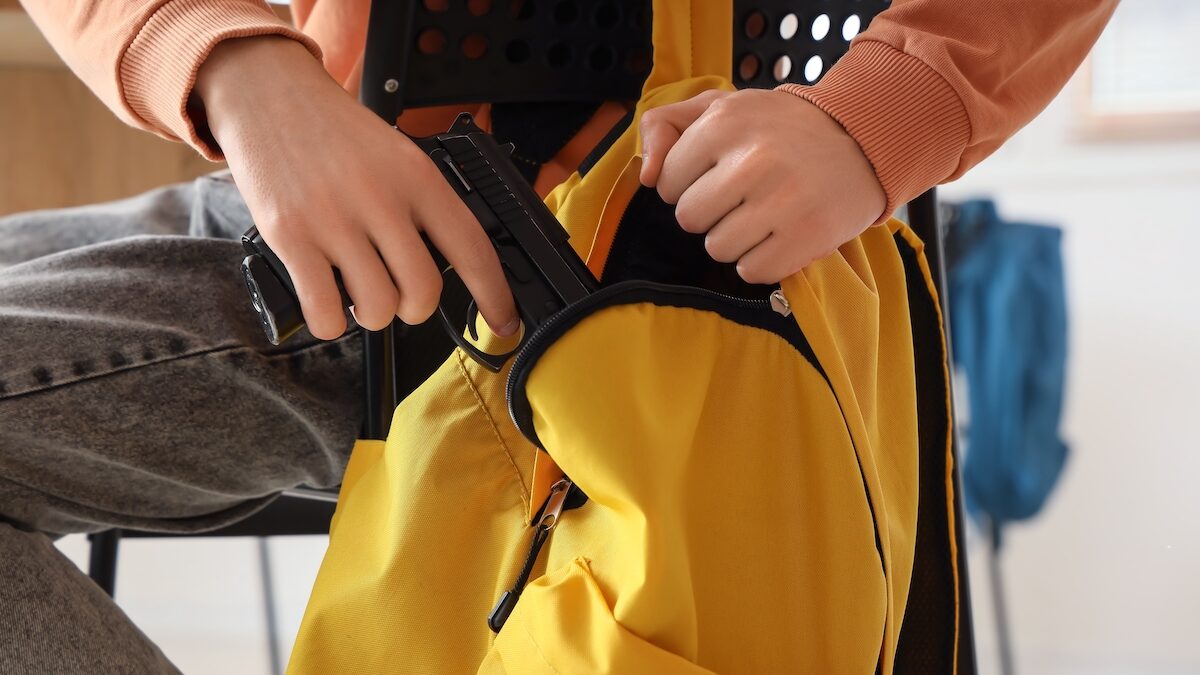
The shock is still palpable. Monday October 12, around 9:25 a.m., at Joseph-Lakanal college, in Aubagne, in Bouches-du-Rhône, a 14-year-old teenager opened fire several times within the establishment. An act which notably injured the principal as well as a teacher. Controlled by the principal education advisor (CPE), the schoolboy was immediately arrested and imprisoned today. But since then, investigators have sought to understand what could have pushed him to commit such a serious act. And one element appears to be worrying today.
Membership in an ultra violent movement
The National Anti-Terrorism Prosecutor’s Office has taken up the investigation, opened in particular for “attempted assassinations in relation to a terrorist enterprise” and “terrorist criminal association”.
According to a source close to the case cited by the press, the teenager explained that he had acted out of a spirit of revenge. But the exploitation of the schoolboy’s digital media led investigators to another avenue: his “probable membership” in the True Crime Community (TCC). According to the PNAT (National Anti-Terrorist Prosecutor’s Office), this ideology “glorifies the perpetrators of mass killings and incites, in certain forms, the use of extreme violence.”
The precise motivations of the schoolboy and the nature of his links with this movement, however, remain to be established. But its proximity to the movement raises questions.
True Crime Community: when killers become role models
The True Crime Community brings together Internet users fascinated by real crimes, killers and massacres. But this name covers very different profiles: being interested in news items does not mean adhering to a violent ideology.
Political science researcher Stephanie Lamy describes to BFMTV a movement “born from a rather morbid interest around mass killings in the United States”.
The Columbine massacre, which occurred in 1999 in a Colorado high school, in particular occupies an important place in this imagination. Two teenagers killed twelve students and a teacher before committing suicide. In certain digital spaces, the perpetrators of this massacre are glorified, as are other criminals, including Anders Breivik and Elliot Rodger.
“Some members are there purely out of morbid fascination and others will act out”specifies Stephanie Lamy.
Some Internet users are interested in investigations or unsolved cases. Others share macabre images, compare violent acts or admire the killers to the point of holding them up as role models. It is this glorification of violence that is alerting the authorities today.
Why can this movement appeal to certain young people?
The profiles are varied, but remarkably young. The intelligence services mention in particular minors or young adults in a situation of uneasiness, isolation or academic and social disruption.
These communities can give some people the feeling of belonging to a group, of finding recognition or of symbolically regaining control of an existence experienced as unjust. Anger and the desire for revenge can then take center stage.
However, academic difficulties, harassment or isolation do not automatically lead to violence. The majority of young people in distress do not take action. What is worrying is the association between resentment, fascination with massacres and glorification of their perpetrators.
Violent images that blur the boundaries of reality?
Within certain spaces of the True Crime Community, Internet users exchange videos of deaths or particularly shocking images. By watching this content, some people can end up trivializing violence, especially when it becomes an object of fascination or competition.
The psychiatrist and child psychiatrist Serge Hefez, already interviewed by True Medical on youth violence, then alerted us to the influence of digital worlds: “Sustained by screens, social networks, video games… and now artificial intelligence, young people evolve in a world cut off from reality. Their relationship with reality is increasingly disrupted.”
According to him, some young people can fall into a world where violence seems disconnected from its real consequences. He then described a loss of bearings. “This very lack of understanding of what death, mourning, suffering are is linked to this “derealization”. Many young people no longer differentiate between the virtual world and the real world.”
This analysis sheds light on the concerns linked to communities which glorify killers, without necessarily explaining the Aubagne attack alone or establishing a direct link between exposure to screens and the act.
Obviously not all adolescents exposed to violent images become dangerous. The risk is especially worrying when this exposure is accompanied by threats, admiration for the perpetrators of massacres or concrete signs of preparation for an attack.
Bridges with masculinist and ultra-right movements
CBT is not a centralized movement with a single doctrine. Some of its spaces nevertheless maintain links with extremist communities.
In a report published in June 2026 on masculinist movements, three senators report that the General Directorate of Internal Security (DGSI) notes “a real proximity” between masculinist movements, certain ultra-right circles and the True Crime Community.
These gateways can notably rely on the glorification of violent figures, racism, anti-Semitism or hatred of feminists and LGBT+ people. Links also exist with certain incel communities, without these trends merging.
However, researcher Stephanie Lamy recalls that “anti-feminism is not the driving force” of the whole of CBT.
Preventing acts of violence: a collective issue
But the threat is taken seriously by the intelligence services. In a report published on October 2, 2025, the Institute for Strategic Dialogue, a British research organization, identified at least 15 school shootings or foiled attack plans linked to the True Crime Community.
In France, this movement has also appeared in violent ultra-right cases. Certain members of the neo-Nazi group WaffenKraft, tried in 2023 for planned attacks, frequented spaces dedicated to the Columbine killers.
For Serge Hefez, prevention cannot rest on families alone. “Because it’s not just a question of education. A true educational and health alliance must be created. And everyone should get involved: school, family, mental health professionals, businesses. We must build a shield to protect our young people.”
The challenge is to identify worrying signals, take threats seriously and better support young people in difficulty, without equating their discomfort with systematic danger. The Aubagne affair above all reminds us of the need to understand how, in certain cases, the fascination with violence can be transformed into the desire to reproduce it. A real current case. According to Laurent Nuñez, Minister of the Interior
“Several dozen young people are being monitored in this capacity today”.