
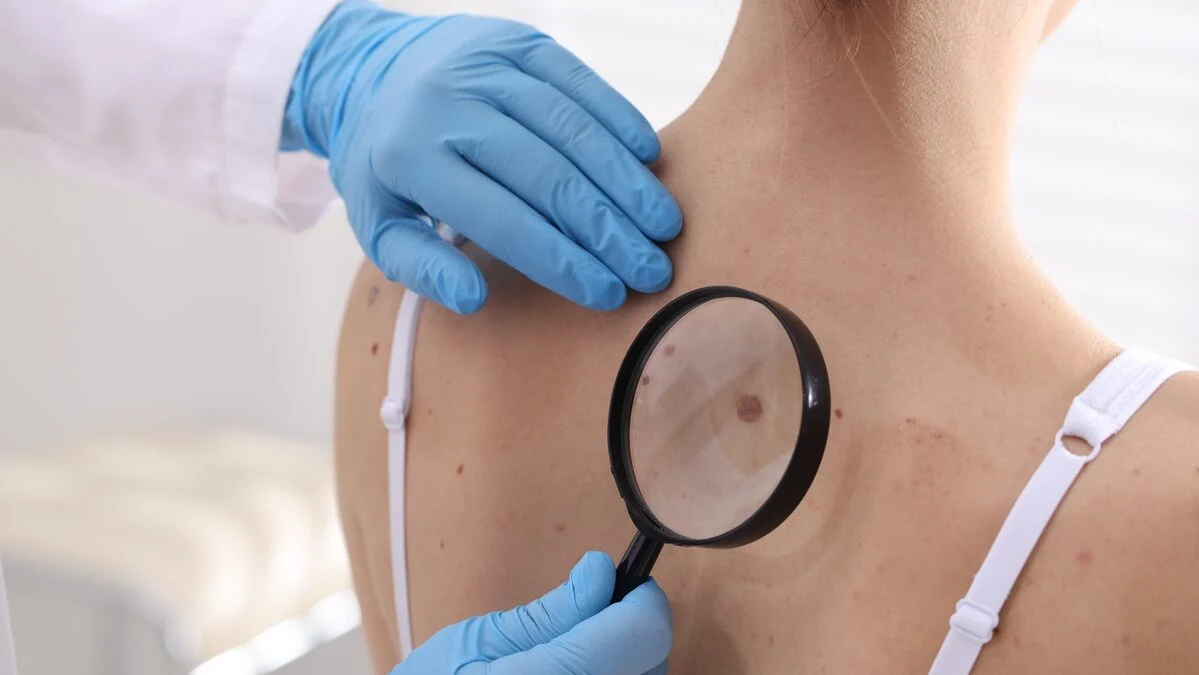
A mole that changes. A spot that appears in a fold of skin. A small wound that doesn’t heal. These signs can sometimes go unnoticed, especially when you do not consult regularly. Due to the lack of available dermatologists, certain health professionals are now required to identify suspicious lesions. A good idea? Dr. Any Cohen Letessier, dermatologist-venerologist, and Philippe Fournier, Executive Director of the French Society of Dermatology, enlighten us.
The role of the physiotherapist or nurse: identify, not diagnose
If the National Cancer Institute already recognizes the role of several health professionals (including nurses and physiotherapists) in the early detection of skin cancers, their role is not to make a diagnosis.
When they are trained, as is the case in Occitanie (where the URPS MK d’Occitanie has trained one physiotherapist per department, i.e. 13 in total, in the detection of these questionable lesions, and 100 by the end of the year), physiotherapists are simply authorized to examine the patient’s skin. Then, the images are transmitted, via a secure platform, to a general practitioner trained in dermatology or directly to a dermatologist, in order to obtain a precise opinion.
The problem ? Identifying an anomaly (a lesion that evolves, a mole that changes shape or color, a crust that persists, etc.) does not allow us to know how dangerous it is. A suspicious lesion may be benign. Conversely, skin cancer is not always spectacular to the naked eye. This is the whole limit of the exercise.
Dermatologist-venerologist Any Cohen Letessier emphasizes precisely this limit.
“Skin cancers are very difficult to diagnose. Even after seven years of medicine, three or four years of specialization and several years of experience in dermatology, it seems inappropriate to me to give this heavy responsibility to physiotherapists and nurses. On the other hand, they have the advantage, during their care (especially physiotherapists), of undressing patients and being able to report to them a lesion that seems suspicious to them, which will allow referral to the specialist. And even if there are few dermatologists, there will always be a place, in case of doubt about a lesion, for this reason for medical consultation. she explains to us.
Philippe Fournier, Executive Director of the French Society of Dermatology shares the same opinion: “From what we know at this stage, this is a false good idea. All paramedical professionals likely to identify lesions should be properly trained. However, currently, only dermatologists know how to do this.”
A dermatoscope is not enough
To better observe these lesions, some professionals are trained in dermoscopy. This examination makes it possible to magnify the lesion and observe details that are not visible simply to the naked eye. But the tool does not make the expert.
“Putting a dermatoscope in the hands of a nurse or physiotherapist is not enough to detect a suspicious lesion. Furthermore, it is not this measure that will solve the shortage of dermatologists. Because, as soon as a lesion is suspicious, the patient must in any case be referred to a dermatologist”underlines Philippe Fournier, Executive Director of the French Society of Dermatology.
The message is clear: a dermatoscope can be an aid in identification, but it does not replace the training or expertise of a dermatologist.
And for the patient, this distinction is essential. When a lesion seems suspicious, the specialist must be able to examine it, but also look for other abnormalities on the rest of the body. If melanoma is suspected, the definitive diagnosis is then based on laboratory analysis of the removed lesion.
An additional link in the face of the lack of dermatologists
So, should we rule out this avenue? Not necessarily. Physiotherapists and nurses are in regular contact with patients. A session or treatment can therefore be an opportunity to notice an anomaly. For some patients, this additional check-up can make the difference (because for skin cancers, particularly melanoma, early detection considerably improves the chances of cure). During the experimental phase in Occitanie, the 35 procedures carried out by physiotherapists led to the identification of 6 cancers: four carcinomas and two melanomas.
The National Cancer Institute also points out that in the absence of organized screening, detection relies in particular on the vigilance of patients and health professionals.
But the course still needs to work behind it. A lesion identified by a nurse or physiotherapist must be able to be assessed quickly by a doctor or dermatologist. Without this, this “spotting” risks being just another step in an already stressful journey.
For the patient, the good reflex therefore remains not to wait for a professional to notice an anomaly. A lesion that changes, a wound that does not heal or a mole that appears different from the others should prompt you to seek medical advice.
Ultimately, local professionals could therefore become a real relay in the detection of skin cancers. But their role must remain clearly defined: see, alert and guide. Not diagnose.