
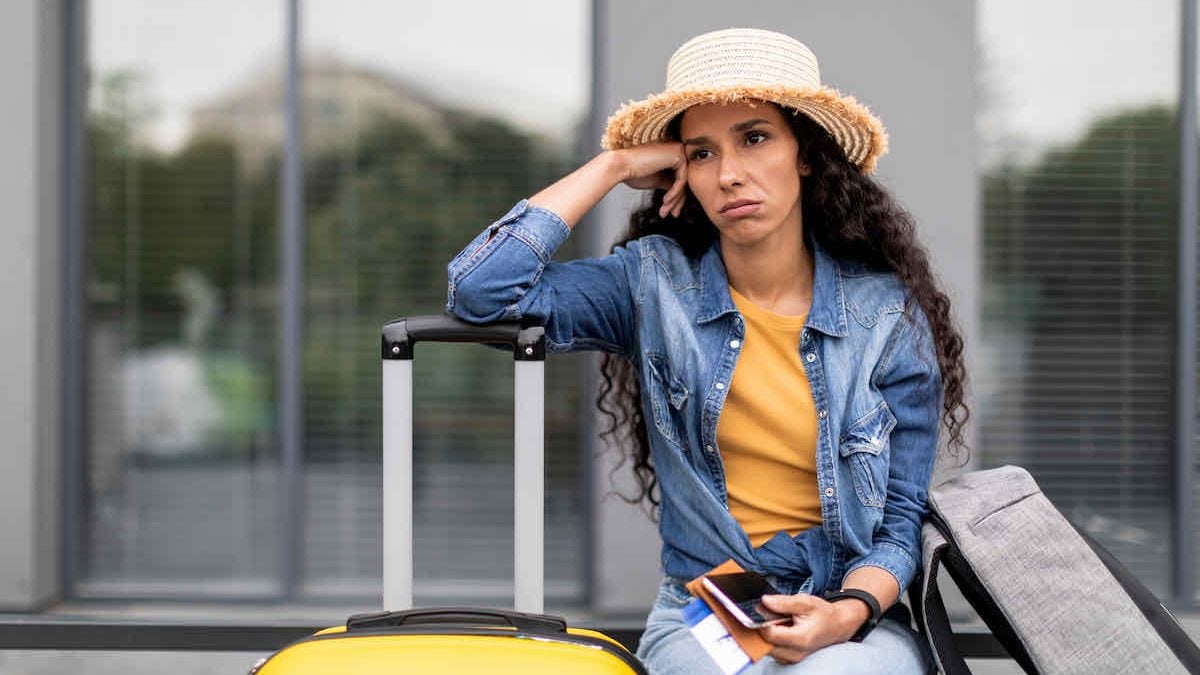
While you had meticulously orchestrated your leave (children deposited at the grandparents, sea view hotel, comfortable budget for your activities …), here you are “anxious” once installed on your deckchair. These holidays, however expected and deserved, do not produce the expected effect. How to explain this gap? Amélie Boukhobza, clinical psychologist, tells us why it can be so much difficult to disconnect.
A forced disconnection?
Since the 1960s, leisure activities have developed widely. To have fun on your free time is not only encouraged, but also (largely) valued. Exit the work value, make way for the heavenly photos posted on Instagram. However, when you only think of your files all year round, it can be difficult to decompress D -Day.
“We are always sold the holidays like a salutary break, a moment to blow, release the pressure, recharge the batteries. But for many, it can be quite the opposite. Stress does not necessarily disappear with professional emails. It moves. Change shape”, Relates Amélie Boukhobza.
Some people even feel more tense at rest. “As if not” doing “activates an internal alarm: that of emptiness, loss of control, uselessness. Delegating becomes unbearable. Slowing makes you dizzy. And without the reassuring structure of everyday life, everything seems vague, unstable. Some people even fall sick, that is to say!” continues the expert.
In this context, some even go so far as to speak of “anxiety -provoking holidays”.
“For those who stand up thanks to a millimeter organization, which regulate their stress by checking boxes, anticipating, managing everything … Inactivity leads to a loss of bearings. Far from bringing rest, it causes almost mini-decompensation”, warns the psychologist.
This break, far from being saving, can then cause various anxious, emotional or behavioral disorders (we end up cracking … and the mind flickers).
Holidays: is it ultimately necessary to cut everything (SMS, files, emails)?
It all depends on what we mean by “disconnect”.
“If it is a question of suddenly tearing a hyper-structured daily life, without transition, without development, there is something to panic. The real rest cannot be decreed. It is preparing. Affirms Amélie Boukhobza.
It is not a question of feeling guilty those who have trouble letting go. “But rather to invent their way of blowing. Keeping a little frame, a little rhythm, some benchmarks that reassure. And by learning to tolerate that everything is not perfect, useful or mastered”.
The secret of relaxation, ultimately?
“We can allow ourselves progressive breaks. Respirations during the day. A time for ourselves without obligation of performance. We can learn to rest without collapsing. This is perhaps that, real decompression, real disconnection …”, concludes the psychologist.