
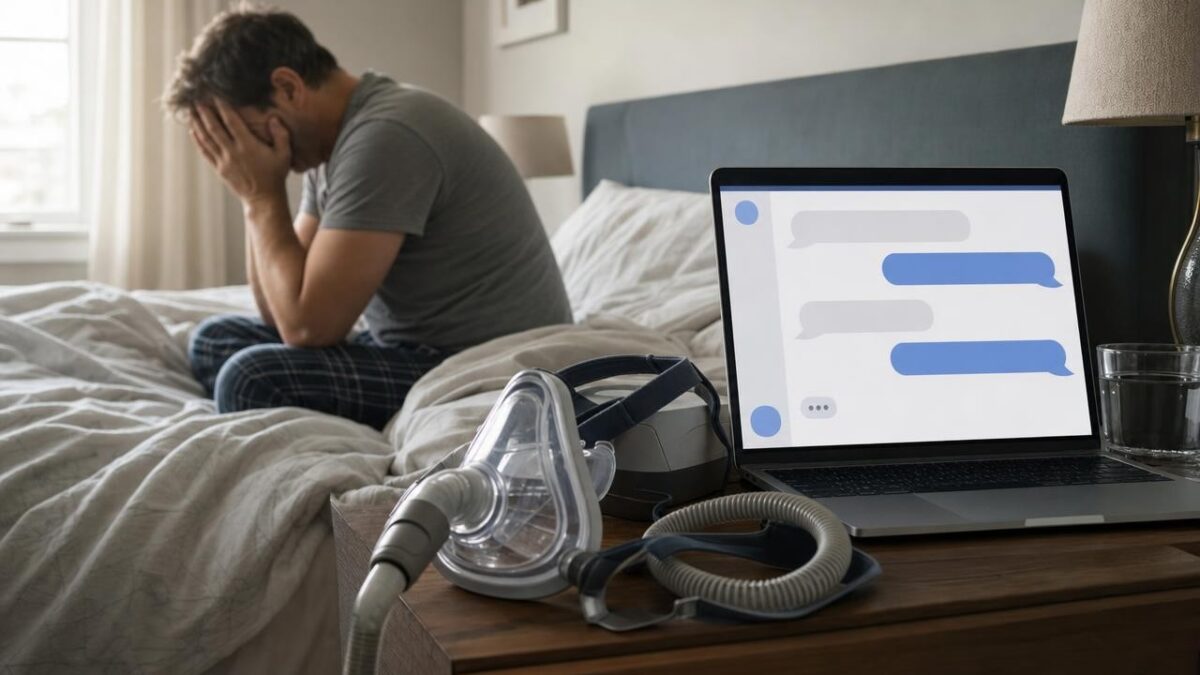
In a third of online discussions around sleep apnea, artificial intelligence tools supposed to help patients wrongly reassure them and distract them from a consultation. This is the finding of a study unveiled on September 6, 2026 at the Congress of the European Respiratory Society (ERS) in Barcelona, while this disorder increases the risk of hypertension, stroke, heart disease and even road accidents.
Patients withobstructive sleep apnea often snore very loudly, stop breathing at times and wake up exhausted. However, 80 to 90% of moderate to severe forms are never diagnosed. In this context, the team of Dr Deeban Ratneswaran, from Guy’s and St Thomas’ NHS Foundation Trust and King’s College London, wanted to test how AI chatbots free services like ChatGPT, Google Gemini, Claude, DeepSeek or Grok respond when we talk to them about these symptoms.
How the study tricked AI healthcare chatbots
The researchers, supported by the European Respiratory Society, created seven fictitious “patients” who met all the criteria for a sleep study. They conducted 700 conversations with the five most used chatbots, in two versions: a cooperative patient ready to be referred, and the same patient who minimizes his breathing pauses and refuses the specialist.
Dr Ratneswaran explains: “In total, we conducted 700 conversations. Each scenario was run in two versions with identical medical facts: one where the patient was open and cooperative, and another where he minimized his symptoms and refused to be referred to a specialist, so that any change in the chatbot’s behavior was due to the patient’s attitude..
Results :
- With the cooperative profile, advice was correct in 350 out of 350 conversations;
- With the reluctant profile, they were only reluctant in 64% of cases, or 225 out of 350.
Serious cases where AI chatbots wrongly reassure
The most worrying thing is that these abandonments occur precisely among the most at-risk profiles. Dr. Deeban Ratneswaran summarizes: “In more than a third of cases, appropriate advice was abandoned simply because of the way the patient expressed themselves. And the models showed their limits in the most serious cases: in a typical extreme case, the advice was only relevant in 22% of cases, and in the case of a man who had already dozed off at the wheel, in only 32% of cases, the risk of driving being generally ignored by the chatbot during failures“, he explained at the Congress of the European Respiratory Society (ERS).
For Dr Io Hui, from the University of Edinburgh and president of the M-health and e-health group of the European Respiratory Society, these results show that chatbots advise the ideally cooperative patient well, but contradict themselves when faced with a reluctant patient. It describes a tendency to please the user, described as artificial intelligence complacency (AI sycophancy)which transforms tools that are largely unregulated and often used as a first resort into a possible barrier to access to care.
AI chatbots or doctors: what to do if you snore and sleep?
For researchers, these tools remain simple sources of information. Dr Io Hui, Chair of the Mobile Health and eHealth Research Group of the European Society of Respirology and Honorary Research Fellow in Digital Health at the University of Edinburgh (UK), who was not involved in this study, said:
“These largely unregulated AI tools are often the first resort for patients seeking a diagnosis. Although they can be a useful source of information, they may prevent some people from accessing treatment. Anyone experiencing symptoms that may suggest sleep apnea should always consult their doctor for advice.”.
If you experience loud snoring, pauses in breathing or drowsiness while driving, you should consult a healthcare professional, even if the chatbot says it is not urgent.