
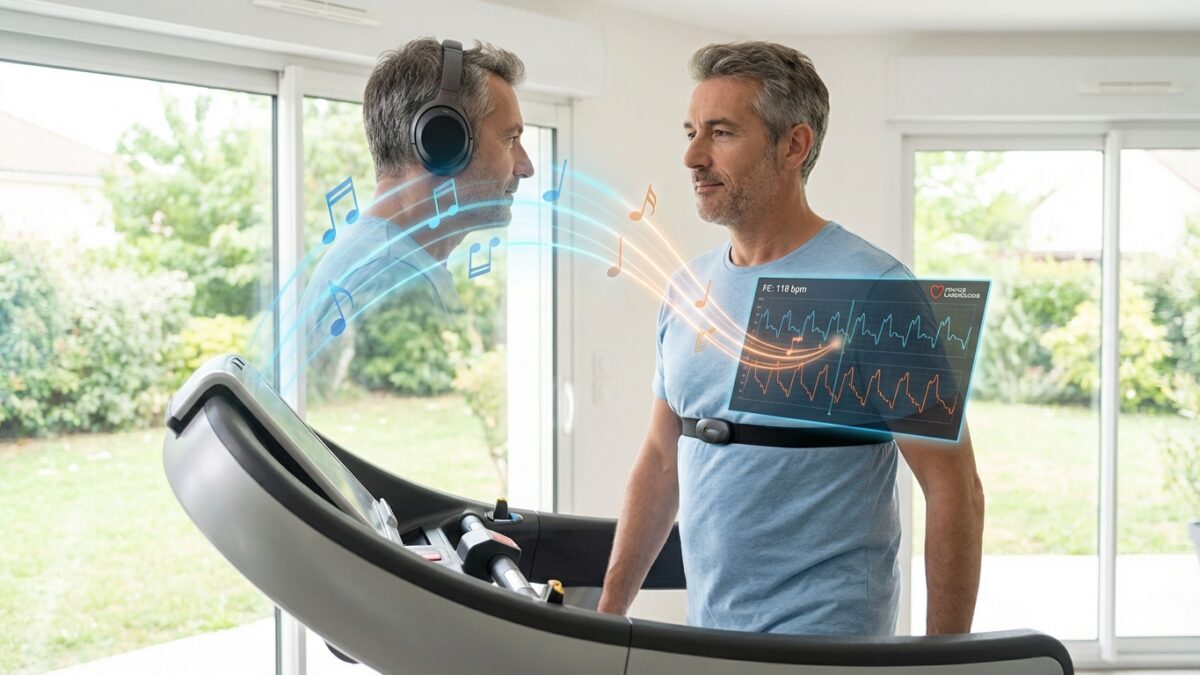
In a cardiac rehabilitation room, some patients pedal in silence, others advance on a mat with headphones on their ears. For the moment, the music they listen to mainly serves to motivate themselves and to forget the effort. What if, tomorrow, each song was chosen as a real training program for the heart, in the same way as a physiotherapy session?
The latest studies carried out by teams from King’s College London, published in the European Heart Journal: Imaging Methods and Practicesuggest that our heartbeat, our breathing and even our blood pressure spontaneously align with the
musical structure of a piece, particularly on its predictable “phrases” (part of a naturally delineated melodic line). Enough to imagine, in the long term, real
workout playlists for the heart for patients with limited mobility or in rehabilitation at home?
How Music Moves the Heart During Cardiac Rehabilitation
To test this link, doctoral student Natalia Cotic and her colleagues had volunteers listen to excerpts from Verdi’s opera, while continuously recording their heart rate, breathing and blood pressure. “Building on this, in the future we might select or create music that encourages your heart muscles to contract, promoting cardiac fitness. This could provide a gentle cardiovascular workout for people with mobility issues or recovering from surgery. Music could be used to keep their hearts flexible and elastic, supporting rehabilitation and heart health“, explained Natalia Cotic, doctoral student at King’s College London.
The data shows that the heart, breathing and blood pressure mostly align with well-drawn sentence arcs, as in the chorus of Nabuccowhose approximately ten-second segments follow the internal rhythms of the autonomic nervous system, more than what listeners say they perceive.
Why predictable musical phrases interest cardiologists
In another work by the same group, more than a hundred adults listened to piano pieces in which the performers subtly modified tempo, intensity or sound complexity. Researchers have shown that specific events – new melody, acceleration, increase in volume – cause micro-variations in breathing, heart rate and blood pressure, but that the direction of this response depends on each person’s basic autonomic profile:
- In certain rather parasympathetic profiles, these musical changes lengthen the intervals between beats and promote relaxation;
- In more “nervous” profiles, dominated by the sympathetic, the same sequence acts like a little boost, close to a positive stress useful for getting back in motion.
Tomorrow, tailor-made cardiac rehabilitation playlists?
Concretely, a training playlist for the heart would not be limited to choosing “calm” or “dynamic” pieces. The studies rather suggest an assembly of well-defined musical bricks, the duration and predictability of which would be thought of as an exercise session for the autonomic nervous system with musical phrases of approximately ten seconds, repeated regularly; volume variations in gentle arcs rather than sudden breaks and a tempo adapted to the effort prescribed in cardiac rehabilitation.
Professor Elaine Chew, Director of the Digital Music Theranostics Laboratory at King’s College London and lead author of the study, concludes: “The human body is complex, just like music, and until now it has been difficult to determine with certainty which musical elements provoke these types of bodily reactions. This work proposes objective biomarkers, based on music and physiology, to study the interactions between music and the heart in an otherwise complex and often subjective field..