
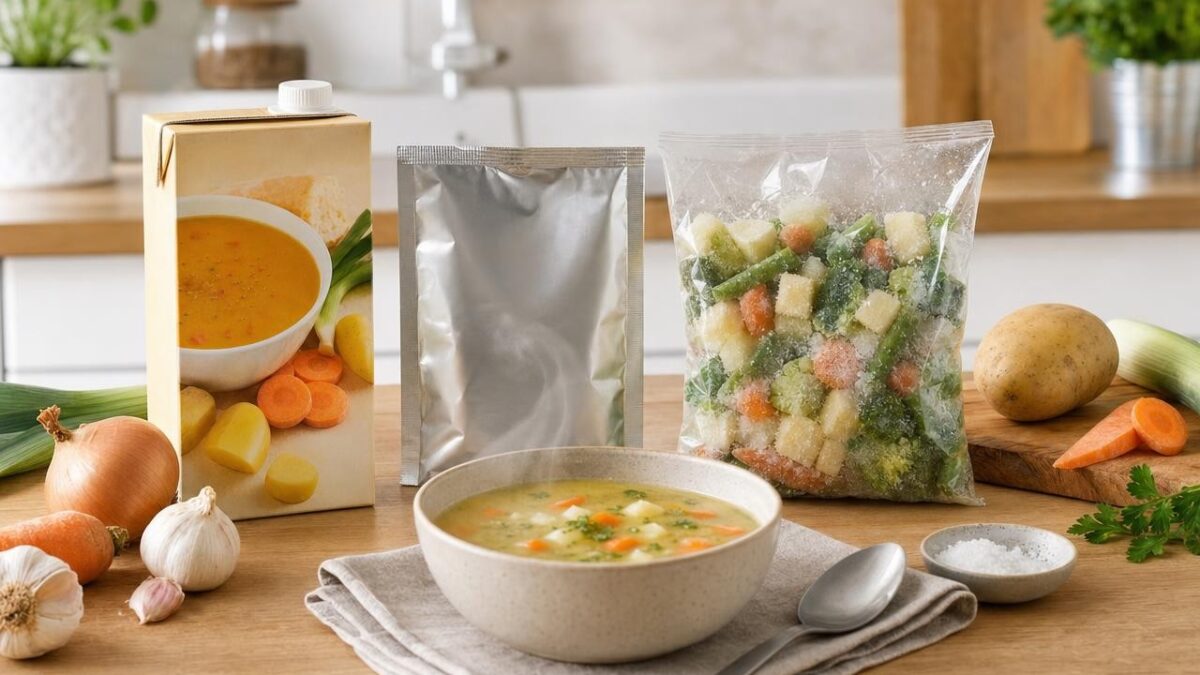
Between the fresh, frozen and grocery sections, ready-made soups are similar in appearance, but not on the plate. According to MGC Prévention Santé, a plate of 250ml of commercial soup already provides between 1.5 and 2 g of salt, or almost a third of the 5 g recommended by the World Health Organization. When you hesitate between bricks, dehydrated or frozen bags, the question is not only the price or the time saved.
According to UFC-Que Choisir, the frozen soup
most often comes first in nutritional terms, ahead of
brick soup and the dehydrated soup in sachet. Surveys show that frozen recipes frequently contain more than 50% vegetables, while other formats are around 30%. At the same time, it is advisable to aim as much as possible 0.5 g of salt / 100 ml for a soup. In other words, format and method of storage really weigh on vegetables, vitamins, salt and additives.
Frozen soup, in a brick or in a bag: the nutritional match
Frozen soup is often the closest to homemade. UFC-Que Choisir notes that it generally displays a high proportion of vegetables, well over 50%, which increases fiber and satiety. Rapid freezing better preserves vitamin C and antioxidants, for these generally good quality products. With 250 ml, you can easily reach one or two servings of vegetables.
Brick soup, sterilized at high temperature, compares less well, with a strong loss of vitamin C. UFC-Que Choisir often reports more salt, less fiber and the presence of modified starch, flavors or added sugar. Approximately, the salt indicated for 100 ml should be multiplied by the volume served in centiliters, then divided by 10 gives the salt per bowl. With 0.6 g of salt per 100 ml, a 1 liter brick already reaches 6 g over the day.
Dehydrated soup: practical, but a lot of compromises
The bags of dehydrated soup require even more caution. This format should be a choice of last resort, with very few vitamins remaining and a low density of vegetables and fiber. To compensate for dehydration, manufacturers often resort to flavor enhancers, modified starch, fats and sometimes glucose-fructose syrup. A reconstituted bowl can then approach the salt intake of a standard plate of liquid soup, without the micronutrient benefits.
Taken together, these elements explain why two bowls of industrial soup are sometimes enough to exceed the WHO benchmarks. Remember, however, that a 250 ml bowl counts for at least one serving of vegetables, or even two for more than 30% vegetables. The format therefore mainly changes the quality of this portion, not just the quantity.
Store-bought soup: good reflexes on the shelf
When only the sodium content is indicated, you just need to apply a simple rule: salt corresponds to sodium multiplied by 2.5. Aiming for less than 0.5g of salt per 100ml helps you stay on track. Then look at the percentage of vegetables, the absence of serial additives, the Nutri-Score and the mentions regulated by Regulation (EC) n°1924/2006 as “reduced in salt”.
Once the soup has been chosen, a few simple actions make it more interesting: add a carton of water to reduce the salt per portion, add plain frozen vegetables, legumes or a little cottage cheese to the bowl. Even if frozen soup remains the most favorable compromise, all soups contribute to hydration and vegetable intake when they are well chosen.