
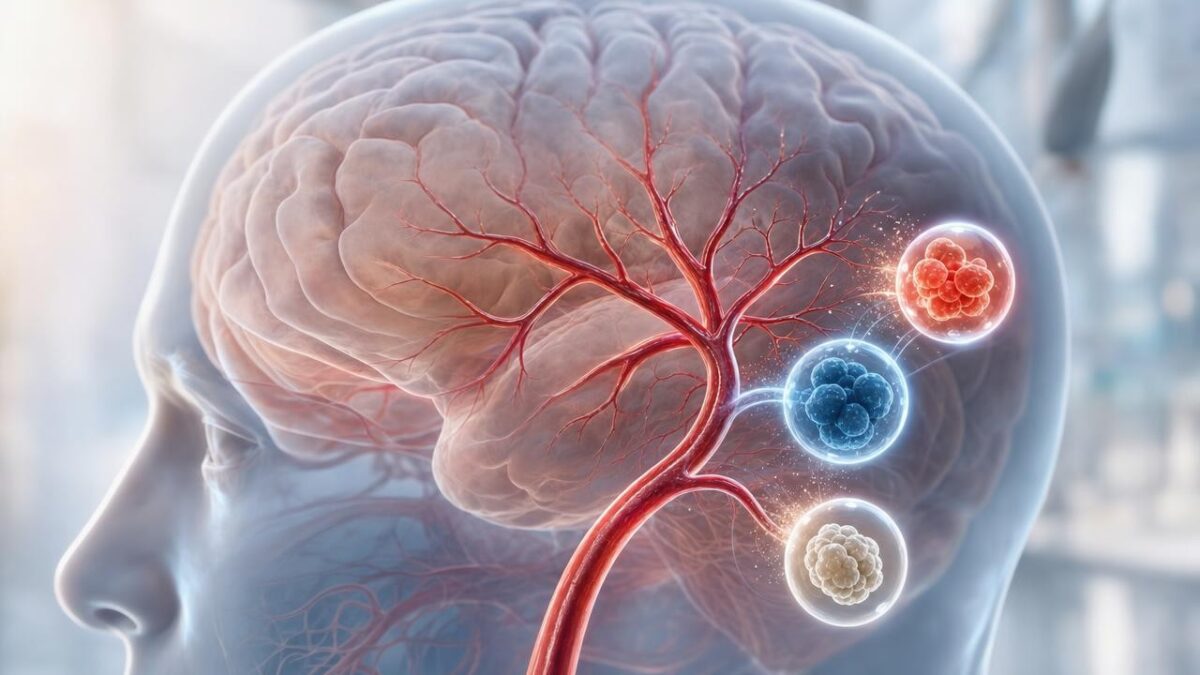
Every day, approximately 21,000 people worldwide suffer from an ischemic stroke. A clot blocks an artery, deprives neurons of oxygen and sets off a race against time.
Thanks to medications and
thrombectomywhich allows the clot to be mechanically removed, doctors can now save many more brains than in the past.
But an enigma persists: why do some patients recover well while others have significant after-effects, even though the main artery has been reopened?
A new study provides a possible answer. It involves a phenomenon called “no-reflow” : the blood returns to the large artery, but fails to properly irrigate part of the small vessels of the brain.
The clot disappears… but the small vessels may remain blocked
Researchers from the University of Antwerp and the University of Colorado wanted to observe what happens immediately after a thrombectomy. To do this, they induced a stroke in mice before removing the clot endovascularly. Thanks to the
intravital microscopythey were able to observe blood circulation in real time during the hour following the intervention.
The result surprised them. The blood began to circulate again, but its path sometimes became chaotic, with stops and even changes of direction.
“We saw it happen with our own eyes. The blood that was flowing to the left suddenly started to flow to the right and vice versa.says Frederik Denorme, from the University of Antwerp.
This phenomenon could help explain why
up to 50% of patients do not recover completely neurologicallydespite successful reperfusion of the large artery.
As the researcher summarizes:
“The dogma was that you just had to get rid of that blood clot and then all the problems should be resolved. We now know that this is not the case.”.
An unexpected mechanism involving a protein that normally stops bleeding
By observing the small vessels, researchers discovered that micro-clots could form where blood flows meet. They then identified a key actor: the von Willebrand factora protein essential for clotting.
Normally, this protein remains folded inside the vessels. When an injury occurs, it expands and helps platelets form a clot to stop bleeding.
But after a stroke and the clot is removed, this mechanism could turn against the brain.
“If there is some sort of induced fluid movement after the clot is removed, this can stretch that ball into an extended thread that attracts platelets, forms new clots, and blocks flow even after the original culprit clot is gone.”explains Debanjan Mukherjee of the University of Colorado.
The problem wouldn’t end there.
Inflammation could turn this reaction into a “storm” in the brain
The study also shows a role of interleukin-6 (IL-6)a molecule involved in the inflammatory response. After the stroke, inflammation disrupts the mechanisms that normally control the activity of von Willebrand factor. Among them is notably
ADAMTS13an enzyme capable of cutting this protein when it becomes too active.
The imbalance between these different actors could then promote the formation of micro-clots in small vessels.
Researchers found evidence pointing in the same direction in stroke patients: the higher their blood level of interleukin-6, the greater the activity of von Willebrand factor and the worse their long-term recovery.
Among survivors, the differences are considerable: approximately
one in ten recovers completelywhile 25% have mild after-effects and half have moderate to severe disabilities.
Towards treatment after thrombectomy?
These results could open a new therapeutic avenue.
Until now, the urgency was essentially to
reopen the artery and remove the clot. The study suggests that it may also be necessary to prevent the microvessels from becoming clogged in the minutes and hours that follow.
Researchers are particularly considering treatments capable of targeting the von Willebrand factor or certain inflammatory molecules such as interleukin-6.
Some drugs acting on these mechanisms already exist and are used in other diseases. But their effectiveness and safety in the very specific context of stroke must be demonstrated.
“It’s still the beginning. But now that we have a lead on what causes these micro-clots, we have a promising new avenue to explore to improve recovery.”estimates Frederik Denorme.
The stakes are high: successfully removing the clot could no longer be considered as the end of the emergency, but as the beginning of a new phase where it is also necessary to protect the microcirculation of the brain.
Because in the immediate aftermath of a stroke, the danger could continue to play out on an invisible scale: that of the tiny vessels which irrigate each part of the brain.