
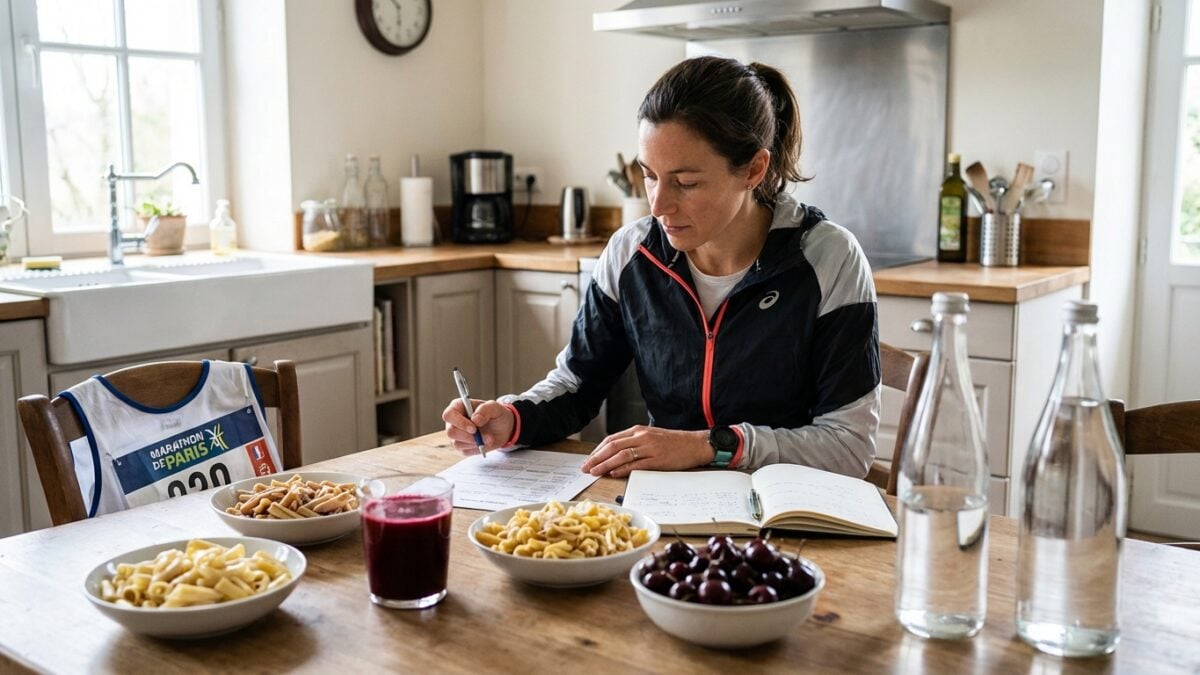
There are these runners who give everything in training, then who explode at the 30th kilometer, stomach in knots, legs empty. Often, the problem does not come from the kilometers swallowed. But rather what was put on the plate the previous days. The week before a
marathon then looks like a trapped area.
A nutritionist, herself a marathon runner, has made it her area of expertise with a method she calls
pre-covery. Prepare for recovery even before departure. His protocol begins one month before the race. It tightens up over the last few days to arrive at the line with full reserves and a calm gut. It’s all in the details.
Pre-covery: preparation that begins four weeks before the marathon
Within 30 days before the raceshe takes a postbiotic every day based onAkkermansia muciniphila.
This bacteria intestinal microbiota is linked to a better intestinal barrier and less inflammation.
Preliminary studies in endurance athletes suggest a reduction in digestive disorders during running, although these data still require confirmation.
At the same time, she adds concentrated beet juice for the four weeks before the race. She drinks it about two hours before workouts. The nitrates in beets turn into nitric oxide. This improves blood circulation and muscle efficiency during exercise.
From the Thursday before the race, she switches to a beetroot + Montmorency cherry mixture. This beverage is rich in antioxidant polyphenols. Ideal for arriving at the starting line with batteries full of energy.
She also tested a broccoli sprout juice, interesting for sulforaphane. This substance is involved in the management of oxidative stress and lactate tolerance.
From D-7 to D-1: what to eat before a marathon without upsetting your stomach
- As D-Day approaches, no dietary changes: the intestine is very sensitive to the stress of running. The objective is to maximize the glycogen
muscular and hepatic, this “sugar reservoir” which allows you to sustain a long effort. Carbohydrate loading occurs gradually. It is important not to suddenly change your habits, to avoid bloating and unpleasant surprises on the morning of the race; - Two days beforeshe relies on a breakfast full of energy. For example: 0% Greek yogurt with oatmeal, lots of jam, some nuts and red fruits;
- The day beforethe plan becomes almost military: at lunchtime and in the evening, 250 to 300 g of white pasta or white rice with tomato sauce and a small portion of proteins, without vegetables. On the go, she prepares sweet or savory white bread sandwiches. And also carry 15g sachets of raisins and 30g of salty crackers every 3 to 4 hours, plus 100g fruit purees.
In the 24 hours preceding the race, it greatly reduces, or even eliminates, vegetables and whole foods to limit fiber, which is often responsible for fermentation and discomfort.
Hydration and trained intestine: the final adjustments before the big day
- L’ hydration accompanies all the preparation, with approximately 3 liters of water per day, even more important in the event of a long-haul flight. Meals are salted if necessary and, in the four hours before departure, she drinks approximately 7 mL of fluid per kilo of weight, adjusting according to the color of the urine, adding 300 mL if it is dark.
- The morning of the racehis breakfast remains simple and very carbohydrate-rich: around 3 g of carbohydrates per kilo in the four hours before departure, via 250 mL of fruit juice and 250 mL of apple juice, white bread with jam, honey and a little peanut butter, plus a gel of 40 g of carbohydrates.
- Two hours beforeshe adds a snack of white bread + jam + another 40 g gel to achieve around 1.5 g of carbohydrates per kilo, keeping fats and proteins to a minimum for a light stomach.
This work only makes sense if the intestine is also trained to withstand the effort: over the months, it has accustomed it to absorbing around 90 g of carbohydrates per hour while running, via gels combining glucose and fructose in a 2:1 ratio, with a little amino acids and always beet juice.
Studies show that well-trained athletes can go up to 90 to 120 g per hour, proof that a dietary strategy for a marathon is built long before the gun is fired.