
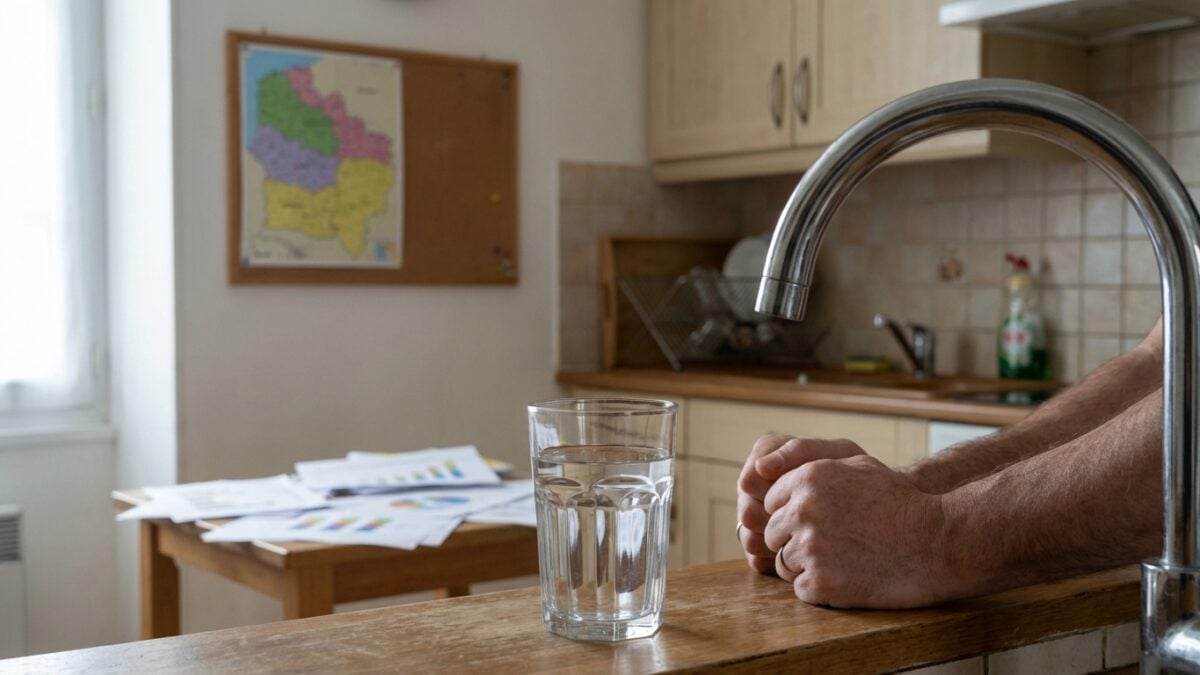
An agricultural fungicide in tap water: the worrying scenario in part of Hauts-de-France. The NGO Générations Futures affirms that several drinking water networks exceed standards for fluopyrama product used against fungi on different crops. The Hauts-de-France Regional Health Agency, however, considers that the water remains consumable, which adds an element of doubt and confusion for residents.
In a press release, Générations Futures warns that “83,000 people are supplied with water that does not comply with fluopyram, a dangerous fungicide, in Hauts-de-France“. The NGO relies on the public database analyzed by its tool “in my water” to support this figure. Behind this administrative formula, the problem has lasted for several months: what exactly does this notion ofnon-compliant water for the households concerned?
Hauts-de-France: water non-compliant with fluopyram in 46 municipalities
According to data collected via the “in my water” tool, 17 drinking water distribution units supplying 46 municipalities are concerned, including 24 in Pas-de-Calais, 19 in the Somme and 3 in the North. Fluopyram excesses were detected at the beginning of 2025 in most of these networks and confirmed by numerous successive analyses.
For some municipalities, these excesses have already lasted for many months. Exceedances of the quality limit are sometimes significant, with concentrations being on average 4 to 5 times higher than the quality limit and reaching in two municipalities more than 10 times the regulatory quality limit. The maximum concentration was found in Inchy-en-Artois in Pas-de-Calais, with a rate of 1.778 µg/L measured on August 13, 2025, or more than 17 times the quality limit. The quality limit for each pesticide is set at 0.1 µg/L in drinking water.
The association specifies in its press release: ““Reinforced monitoring” has in fact been put in place by the ARS to monitor the evolution of concentrations. However, we note with concern that this monitoring seems to have stopped in October for several drinking water distribution units (UDI), while the fluopyram concentrations still largely exceeded the quality limit.e”.
Fluopyram, a widely used fungicide, at the heart of a drinking water alert
THE fluopyram is a fungicide from the SDHI family, still authorized in France and present in 37 commercial products. In 2023, 127 tonnes were spread on crops such as cereals, potatoes, beets and fruit trees. This molecule also belongs to the PFAS chemical family and slowly degrades into TFA, a very persistent compound whose monitoring will become mandatory in drinking water from 2027.
For the European agency Echa, fluopyram is not classified as dangerous for human health, even if its carcinogenic potential is debated and a proposal from Austria aimed at classifying it as a suspected carcinogen (category 2) is under study. ANSES revised downwards its toxicological reference values for this substance in 2023, which fuels the calls from Générations Futures for a reassessment of marketing authorizations.
Non-compliant water, uncertain risks: confused messages for residents
The ARS Hauts-de-France writes in its bulletins that these non-compliances “do not prevent the consumption of water”. Conversely, Générations Futures points out that in the absence of a maximum health value for fluopyram, the instructions from the Ministry of Health provide for recommending against the consumption of water as soon as the regulatory limit of 0.1 µg/L per pesticide is exceeded, as a precautionary principle.
Générations Futures claims to have alerted ANSES on December 12, 2025, by calling on deputies to adopt a law in February strengthening the protection of catchments. “This pollution of drinking water by fluopyram is yet another illustration of the consequences of the intensive use of pesticides and the inaction of public authorities to protect catchment areas.”declares Pauline Cervan. “This inaction once again leads to exposing populations to dangerous substances and putting communities and producers of drinking water in very difficult situations, the techniques in place being most often insufficient to treat pesticides. It is urgent to take strong decisions aimed at finally protecting water resources.