
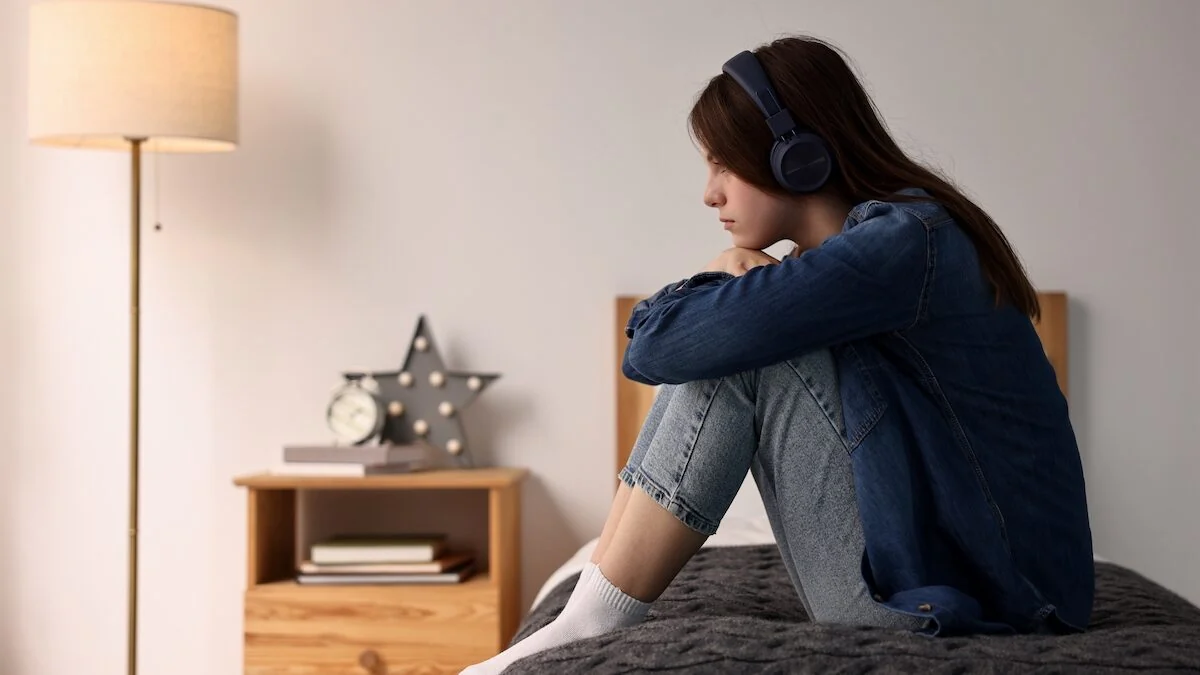
A teenager who isolates himself, sleeps poorly, is particularly irritable or gradually loses the taste for his activities does not always spontaneously express his discomfort. Even when he identifies his difficulties, he may have difficulty talking about them or considering a consultation.
This discrepancy is at the heart of the latest national consultation by UNICEF France. His teaching is of particular interest to parents: Recognizing that we need help does not necessarily mean knowing how to get it.
Mental health: what does the UNICEF France consultation reveal?
Presented on November 17, 2026, the 7th National Consultation of UNICEF France is based on the responses of more than 23,000 children and adolescents aged 6 to 18. A separate pilot study was also conducted among children aged 3 to 5 years.
Among the respondents of the main consultation, 22% declared at least one psychological difficulty having a negative impact on their daily life. This proportion reaches 41% among children and adolescents who declare a disability or chronic illness.
These results provide an overview of the difficulties reported by the young people interviewed. However, they constitute neither a medical diagnosis nor a representative estimate of all children and adolescents living in France. UNICEF specifies that participation in this consultation was voluntary, anonymous and confidential.
Another lesson deserves the attention of parents: young people whose difficulties affect daily life are more likely to recognize that a consultation with a professional could be useful to them, without declaring that they would actually go for a consultation.
This gap shows that awareness of discomfort is not always enough. The young person still needs to know where to turn, be able to access help and feel confident enough to take the plunge.
Why don’t teenagers always dare to ask for help?
Obstacles are not necessarily linked to a refusal to seek help. The UNICEF summary highlights very concrete difficulties: 90% of respondents report at least one obstacle to consulting a professional in the event of difficulties. Among them, 53% cite practical obstacles, such as cost or distance.
Young people who encounter the most difficulties also more often report lacking support around them.
For parents, these findings suggest that they should not be too quick to interpret silence or refusal to consult as a rejection of any form of help. A teenager may have difficulty verbalizing what he feels, not know which professional to contact or not wish to confide his difficulties to his parents.
Certain changes in behavior may nevertheless attract attention: sleep problems, unusual irritability, isolation, loss of interest in usual activities, drop in school results or risky behavior.
These manifestations alone do not allow us to conclude that there is a psychological disorder. However, they can constitute signals inviting you to initiate dialogue and, if necessary, to seek professional advice. In particular, it is possible to spot the signs that a teenager is unwell without trying to make a diagnosis yourself.
“Who could you talk to about this?” : a question to open the dialogue
Faced with a teenager who systematically answers “yes” when asked if everything is okay, insisting on obtaining confidences is not necessarily the best approach.
Another question may help open the discussion: “If you didn’t want to talk to me, who could you talk to?”
This formulation is of interest: it does not place the young person under the obligation to immediately confide in his parents. She also recognizes that it may be easier to talk to another person.
This contact person can be a family member, a teacher, a principal educational advisor (CPE), a school nurse, a doctor or even an educator.
The idea is to help him identify people he trusts and places where he could find support, without waiting for the situation to become too difficult to manage.
This approach is similar to the ideas proposed to help your teenager talk about his or her feelings. Respecting their pace and accepting that they choose someone other than their parents can make it easier to speak.
What professionals and places to listen to a teenager?
In France, several systems allow adolescents to find listening and support adapted to their difficulties.
Health Insurance cites in particular:
-
The general practitioner or attending physicianwho can welcome the young person’s words, assess their difficulties and direct them to a suitable professional;
-
The school nursewho can constitute an accessible first contact within the establishment;
-
Teenagers’ Houseswhich offer reception and support spaces intended for young people and, depending on the structure, for those around them;
-
Youth listening reception points and youth health spaceswhich offer listening and orientation opportunities;
-
Medical-psychological centers (CMP) and medical-psycho-pedagogical centers (CMPP)who can offer support adapted to the needs of the young person.
Depending on the structures and territories, certain receptions are free, anonymous and accessible without an appointment.
Parents can start by researching the devices available near their home and asking their teenager to find out together. Having an address, telephone number or professional name sometimes makes the process less intimidating.
There is no need to wait until the discomfort becomes particularly severe to seek advice. A general practitioner can be a first point of contact to take stock of the situation and consider referral.
Suicidal thoughts: when should you act without delay?
Some situations require an immediate reaction. Suicidal comments, threats of taking action, a recent attempt or endangerment must never be trivialized.
The High Authority for Health reminds that suicidal ideas in children and adolescents must be taken seriously and subject to an appropriate evaluation.
In the event of immediate danger or imminent risk of acting out, you must contact emergency services at 15 or 112, or accompany the young person to the emergency room.
In the event of suicidal thoughts without immediate vital danger, the
3114the national suicide prevention number, is accessible free of charge 24 hours a day, 7 days a week.
The challenge is therefore also to identify the resources available before a situation becomes urgent. For a teenager who does not know how to ask for help, knowing that there are several possible contacts can be a first step.