
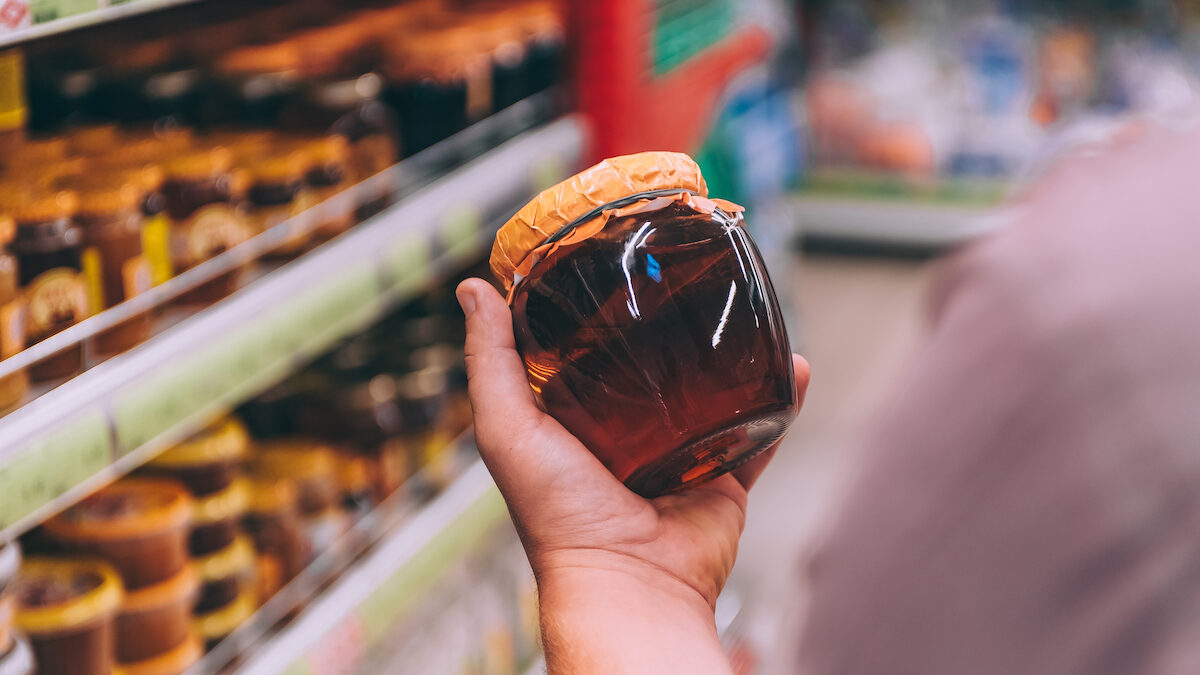
On the shelves, jars of honey compete with promises: acacia, mountain, wild flowers… However, an often overlooked detail allows you to distinguish real French honey from imported products. Journalist and activist Hugo Clément invites consumers to carefully observe the cap of the jar to know the real origin of the honey they buy.
Honey, a product sometimes tampered with
Behind its natural and artisanal image, honey sometimes hides a much less golden reality. As early as 2013, the Directorate General for Competition, Consumer Affairs and Fraud Prevention warned of the presence of “fake honey” containing the addition “exogenous sugars from cane or corn (up to a content of 44%), or water“. Since then, fraud has only increased. An investigation carried out in 2023 by the European Commission on 320 samples of honey imported into the European Union revealed that 46% of them were “strongly suspected of deviating from European rules“. These products are often extended with sugar syrups from beets, rice or wheat, which significantly reduces production costs.
Éric Jamin, head of the authenticity unit within the Eurofins group, confirms that “adding sugar syrup is the most classic fraud, because it is the most profitable“. These adulterated honeys, often of Chinese origin, are then colored and packaged before being marketed under ambiguous labels mentioning a “mixture of honeys from the EU and outside the EU”. Products at low prices, but whose traceability remains unclear.
The cap, the clue that changes everything
For Hugo Clément, vigilance must focus on a specific element: the lid. “Buying a French brand does not always guarantee that the honey really comes from France“, he recalls on France Inter. On the cap of the pot, abbreviations such as “ROU”, “UKR” or “RPC” indicate respectively a provenance from Romania, Ukraine or the People’s Republic of China. Conversely, the mention “100% French origin” certifies that the honey was harvested in the territory.
Good reflexes for choosing your honey
$To avoid unpleasant surprises, it is advisable to read the labels carefully, particularly on “organic” products: this designation does not guarantee French origin. Other clues can guide the buyer:
- Favor the words “harvested and potted by the beekeeper”;
- Look for AOC or IGP labels, guarantees of origin and quality;
- Examine the area near the use-by date, where the original codes are often found.
A simple look at the lid can therefore be enough to tell the difference between a truly French honey and an imported product. A simple, but essential, gesture to support local beekeepers and preserve the quality of this treasure of our countryside.