

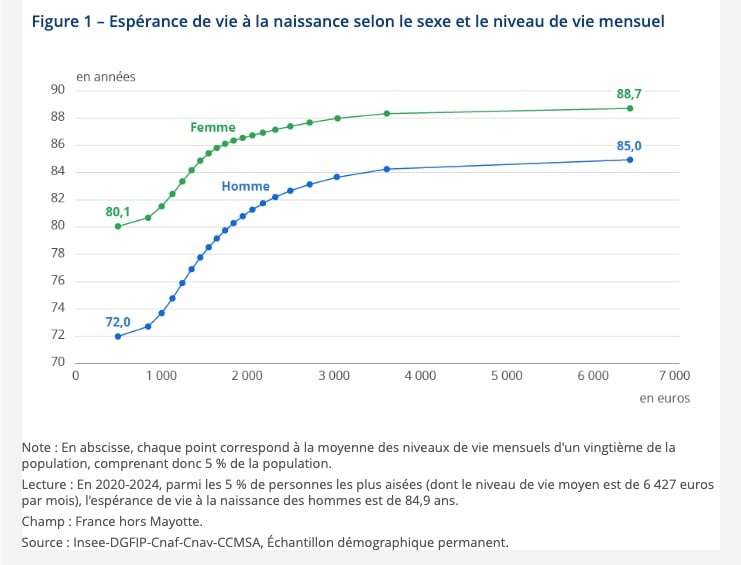
The higher the standard of living, the longer life expectancy. This sad observation is nothing new. What is more significant, however, are the figures recently published by INSEE. According to this report carried out between 2020 and 2024, the gap in life expectancy at birth between the lowest 5% and the wealthiest 5% reaches 9 years for women and 13 years for men! A considerable gap, which has widened further in recent years.
The wealthier you are, the higher your life expectancy.
It is a brutal and disturbing reality, which was confirmed this Monday, December 15 by INSEE investigators: the gap in life expectancy between modest and well-off French people has widened. In fact, that of the poorest 25% is falling, except for the poorest 5%, while that of the wealthiest French people continues to increase.
- In detail, among the wealthiest 5% of men, life expectancy at birth reaches 85 years, compared to 72 years for the poorest 5%, a difference of 13 years;
- Among women, the gap is smaller but remains significant: 88.7 years for the wealthiest, compared to 80.1 years for the poorest, i.e. 9 years difference.
At fifty, “the risk of death within a year for men is 7 times greater among the poorest than among the wealthiest. In women, this risk ratio is from 6 to 55 years, the age when it reaches its maximum. specifies the National Institute of Statistics and Economic Studies.
 © insee
Another interesting observation highlighted by the investigators: if life expectancy increases with the standard of living, this progression slows down as income increases. Thus, around €1,200 per month, you need to earn €100 more to increase your life expectancy by around 0.8 years, as a woman, and 1 year as a man. At €3,000 per month, the same effort only brings 0.1 year for women and 0.2 year for men.
Why do the poorest people live shorter lives?
Several factors can explain this reduced longevity. Firstly, financial difficulties limit access to care.
3.2% of people belonging to the lowest 20% also declare having given up on medical examinations for financial reasons (excluding dental care), compared to 1.8% of the entire population.
Managers, in particular, often have a high standard of living and are less exposed to professional risks (accidents, illnesses) than workers.
Then, the social category or the diploma of each person has a significant impact on the state of health. Following studies allows you to better access and understand information.
Certain risky behaviors are more common among non-graduates.
“21% of adults without a diploma or with a diploma below the baccalaureate smoke daily, compared to only 13% of higher education graduates”, specify the investigators.
Finally, a low standard of living can result from poor health rather than the opposite: poor health limits the pursuit of studies, access to employment or qualified positions.
Women have an ever-longer life expectancy
Latest observation noted by experts: women, even with low incomes, still live longer than men.
“From 1,500 euros of standard of living per month, the life expectancy at birth of women exceeds that of men among the wealthiest 5%. In other words, only women among the wealthiest 35% live on average less long than men among the wealthiest 5%,” reveals the study.
As for the wealthiest women, they live on average 17 years longer than the most modest men. A record difference, which could be explained in particular by the lifestyle habits of women: they consume less alcohol, benefit from better medical monitoring, and they work less (which, for the same position, reduces their exposure to professional risks).
“Finally, women may have genetic advantages that partly explain their longer life expectancy,”
the report states.
Enough to imitate the good practices of the fairer sex from now on.