
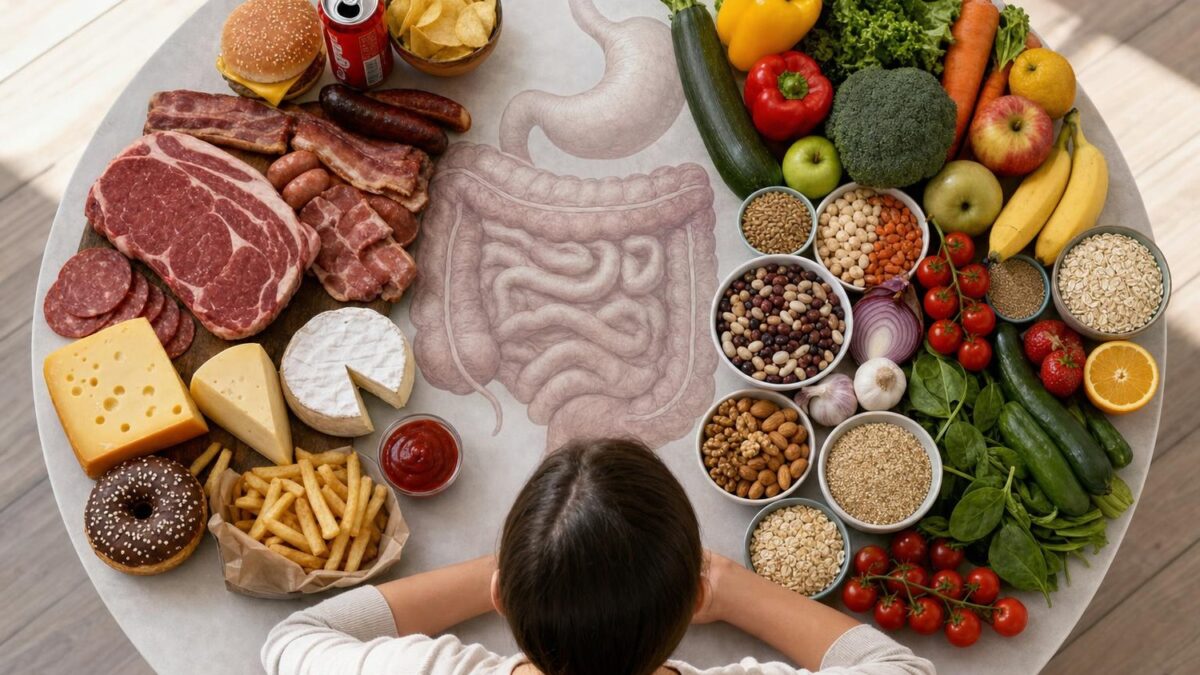
Between Sunday steak, cold cuts at aperitif and sugary sodas, certain everyday foods could weigh more heavily than we thought on the risk of digestive cancers. A Korean cohort study, carried out on adults followed for several years, has just linked a very specific dietary profile to the appearance of gastrointestinal cancers such as those of the colon, stomach, pancreas or liver.
Looking at the acid load of foods
Published in 2025 in the European Journal of Clinical Nutritionthis research looked at the
acid-forming foodsthat is to say an acidifying diet which increases the food acid filler (Or dietary acid load) measured by PRAL, NEAP and NAE scores in the Cancer Screenee Cohort.
Among 10,741 adults followed for several years, 208 of whom developed gastrointestinal cancer, men with the highest acid load had a risk of digestive cancers 1.5 to 1.7 times higher than men with the lowest score. These high scores mainly corresponded to a Western-style diet rich in red and processed meats, cheeses and sweet products.
What the study changes on acidogenic foods and digestive cancers
This association does not prove that acidogenic foods directly cause digestive cancers, but it reinforces an observed signal.
A diet is said to be acidogenic when it provides animal proteins and refined cereals, and few fruits, vegetables and legumes rich in potassium.
The PRAL score estimates the quantity of acids to be eliminated and the NEAP the internal acid production.
Without changing the pH of the blood, a slightly higher acidity in the tissues and the digestive tract could maintain inflammation and facilitate the growth of tumor cells.
Acid-forming diet, red meats and official recommendations
The new Korean cohort is part of a larger data set. A meta-analysis involving 227,253 participants, published in 2022 in the journal Frontiers in Nutritionshows that the most acidogenic diets are associated with a 58% increase in the overall risk of cancer and poorer survival in patients already affected. There
food acid fillercalculated via PRAL or NEAP, appears to be a good statistical summary of a diet rich in animal products and poor in plants.
According to theInternational Agency for Research on Cancerin the World Cancer Report 2020processed meats are carcinogenic to humans (group 1) and red meats probably carcinogenic (group 2A) for colorectal cancer, with a risk that increases as the quantities consumed each day increase.
THE World Cancer Research Fund advises limiting red meat to around 500 g cooked per week and consuming as little processed meat as possible. THE
acid-forming foods therefore largely overlap with those that these organizations are already calling for to be reduced to prevent digestive cancers.
Reduce your dietary acid load without falling into the myth of the alkaline diet
No need to aim for an “alkaline diet” supposed to change the pH of the blood, which the body already keeps stable. The challenge is to reduce an acidifying diet: less red meat and cold meats, ultra-processed products and sodas, more fruits, vegetables, whole grains and legumes. A Mediterranean-type model helps to lower the dietary acid load and part of the risk of digestive cancers.