
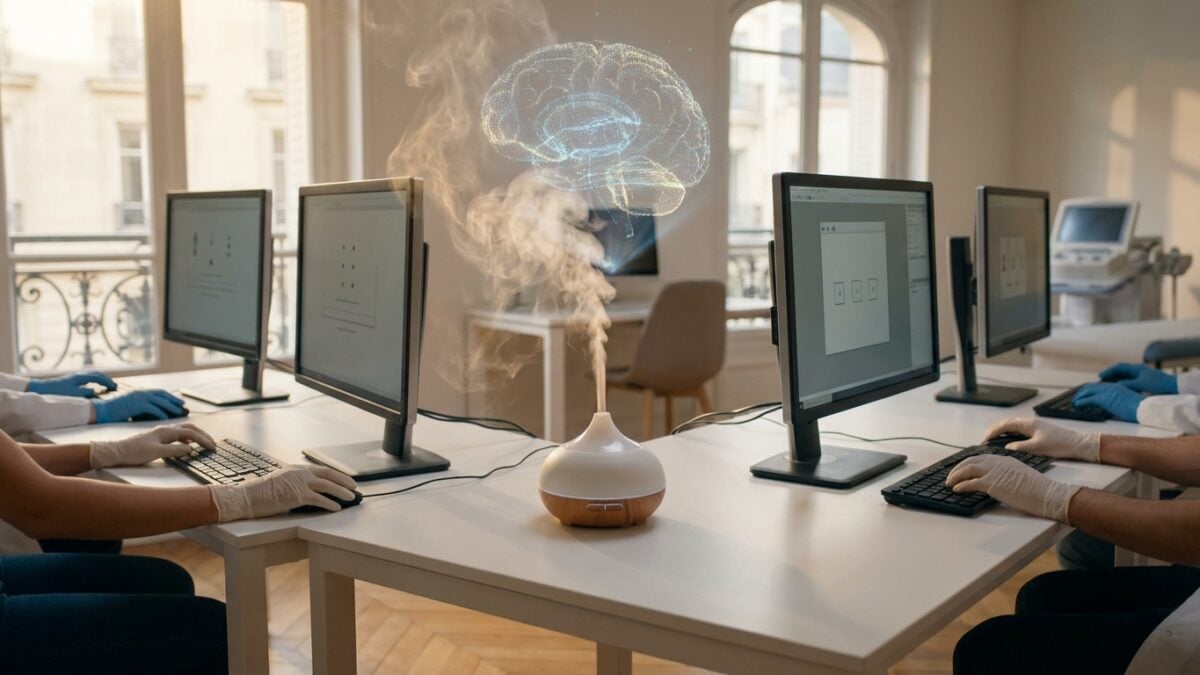
We are seeing an ever-increasing number of broadcasters presented as allies for strengthening memory before an exam or staying focused at the office. But can a scent really help you remember better or stay awake during intense mental effort? British researchers wanted to verify it with a new
essential oil blend.
Published in 2025 in the journal Human Psychopharmacology: Clinical and Experimentaltheir trial recruited 90 healthy young adults. The team compared a blend of essential oils for memory and concentrationcalled Genius, with sage alone – already studied for cognition – and the total absence of aroma, while monitoring the activity of the prefrontal cortex. The results hold some surprises.
Genius, a fragrant cocktail put to the test of cognitive tests
The volunteers were randomly divided into three groups, in a double-blind protocol: no one knew which aroma was diffusing the small device hidden in the test booth. For about 25 minutes, they completed tasks of word recall, number memory, mental arithmetic (successive subtractions) and a sustained attention test, while wearing a near-infrared spectroscopy headband to measure the use of oxygen by the brain.
The Genius blend combines several extracts known individually for their possible effects on cognition or mood:
-
Patchouli
-
Neroli
-
Grapefruit
-
Cardamom (rich in 1,8-cineole)
-
Incense
-
Nard
-
Rosemary
-
Lemongrass
The creators hoped that together these oils would produce a combined effect greater than each component alone.
Slightly better performance and reduced mental fatigue
Compared to the group without aroma, the Genius group performed better on several tasks linked to memory and information processing: more words recalled, better precision in digit memory, better score on the visual block test, more correct responses during subtraction by 3 and by 7, and more targets detected in the attention test. For immediate word recall, Genius also does better than Sage. The authors speak of statistically significant improvements of small to medium magnitude.
In terms of feelings, those who breathed the mixture declared themselves more alert and less tired at the end of the session than the control group, and less tired than the sage group. The aroma therefore seems to help maintain a certain mental tone during sustained cognitive effort, even if most of the links between mood and performance remain weak.
In the brain, more oxygen consumed but a mechanism still unclear
Brain measurements show that, in all groups, blood flow and oxygenation increase during tasks, a sign of a “firing” brain. With Genius, deoxyhemoglobin levels are higher than without flavoring, suggesting somewhat greater oxygen extraction. However, the participants who consume the most oxygen are not necessarily those who perform the best in the tests, which suggests that simple energy intake is not enough to explain the gains in
vigilance and memory.
Researchers are considering other avenues: absorption of active molecules by the lungs then passage into the brain, direct stimulation of olfactory circuits linked to the hippocampus and emotional areas, or even the role of expectations. Professor Mark Moss remains cautious: “The effects of flavorings are generally relatively weak, but beneficial. Do not overinterpret flavor research results“.”Flavors are not a panacea. They can be beneficial, usually as part of an overall healthy lifestyle. They can be useful in health care as part of an integrated health system“. The authors also point out that the study concerns a single session, with a distribution whose exact dose remains to be better standardized.