
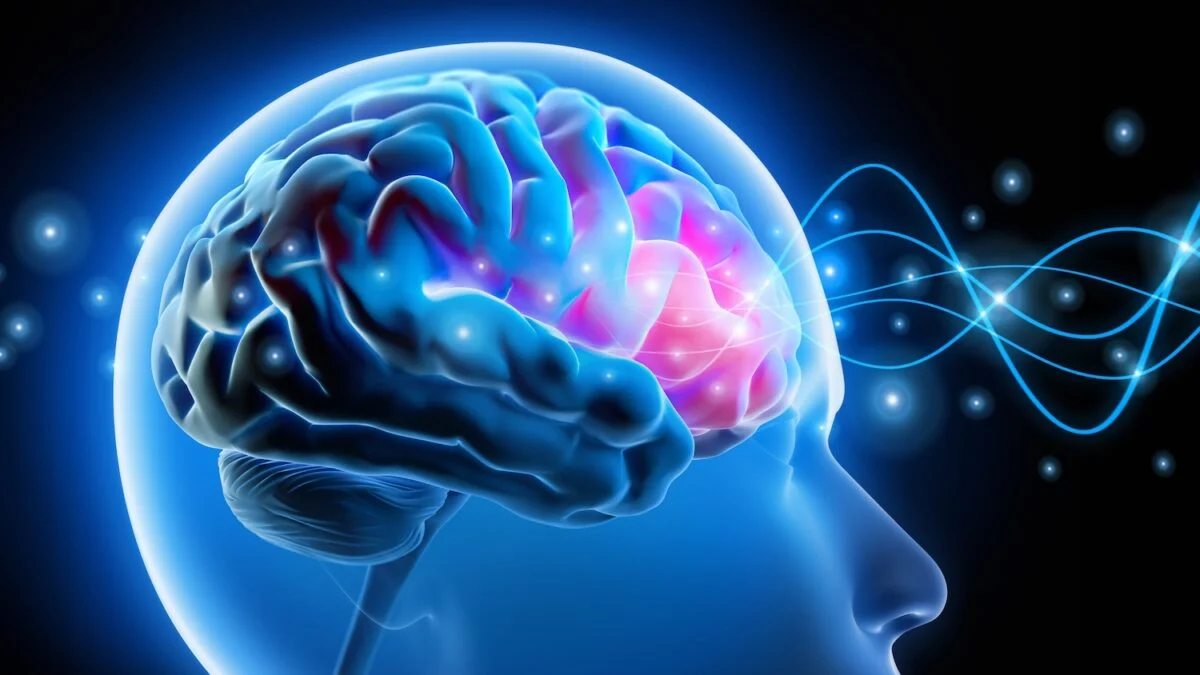
Imagine yourself asleep in an MRI scanner. Then, for just 50 milliseconds, a soft sound, comparable to steady rain, is played in your ears. You don’t wake up. However, in your brain, something has just changed.
This is the experiment carried out by a team from the Massachusetts Institute of Technology (MIT), the results of which are published in
Science Translational Medicine. Researchers have shown that very brief pulses of pink noisedelivered at the precise moment when certain brain waves reach their peak, can amplify these waves but also the waves of cerebrospinal fluid that circulate in the brain.
When the brain takes advantage of sleep to clean up
During the day, brain cell activity produces various waste products, including lactic acid and “used” proteins. During deep sleep, the cerebrospinal fluidwhich surrounds and protects the brain, circulates more and contributes to their evacuation.
This phenomenon is linked to slow wavescharacteristics of deep non-paradoxical sleep. When these waves appear, blood vessels in the brain contract and then expand, helping to circulate fluid like a pump.
In 2019, Laura Lewis, a researcher at MIT and lead author of the new study, had already shown that the movements of this liquid were closely synchronized with the slow waves. This time, his team wanted to know if it was possible to strengthen this mechanism.
The secret: sending the sound at exactly the right time
For this experiment, 27 volunteers were placed in an MRI scanner while they slept. However, only 14 managed to sleep sufficiently without being awakened by the stimulations to be able to be analyzed.
The researchers used pink noise pulses of
50 millisecondsa sound softer in the treble than white noise, close to that of regular rain.
But it is not the nature of the sound that constitutes the essence of the experience: It’s his timing..
The researchers had to broadcast it exactly when the slow wave reached its maximum. They therefore combined an electroencephalogram and MRI, then developed a system capable of removing the disturbances caused by the MRI in less than 100 milliseconds. An algorithm could then predict the peak of the wave about 70 milliseconds in advance.
“You can produce more of these slow electrical waves through an auditory stimulus, if it comes at exactly the right time. Like a child on a swing, if you push him at the right moment in his movement, you can make the swing go further.”explains Laura Lewis. “The difficulty is: how to find exactly the right moment?
And the result is particularly interesting: in the 14 participants studied, impulses increased
the amplitude of slow brain waves and that of cerebrospinal fluid waves.
A link to Alzheimer’s, but no promise of treatment
It is this observation that opens the door to the most ambitious questions. Cerebrospinal fluid participates in a brain waste elimination system often called
glymphatic system. However, with age and in certain neurodegenerative diseases, this mechanism seems less effective. Among the proteins whose accumulation is of interest to researchers are amyloid beta and tau protein, which are associated with Alzheimer’s disease.
“Removing waste from the brain is really important for Alzheimer’s disease and other forms of dementia, which are caused in part by the buildup of molecules like amyloid and tau in the brain. If we can improve the removal of waste from the brain, we may be able to help prevent the buildup of these plaques that lead to disease.”estimates Joshua Levitt, first author of the study.
But we must resist the temptation to go too quickly.
The study does not show that pink noise improves memory, nor that it prevents Alzheimer’s, nor even that it actually improves the quality of sleep. Researchers observed a biological mechanism in healthy young adults, under extremely controlled conditions.
In other words, listening to pink noise with an app does not replicate the MIT experiment: here, the sound was triggered based on each sleeper’s brain activity.
The next step will therefore be to verify whether this increase in cerebrospinal fluid flow can actually make sleep more restful, particularly in people suffering from insomnia, and then to determine whether it could have an interest in neurodegenerative diseases.
For Laura Lewis and her team, the challenge now is to move from this experimental demonstration to possible clinical application. One thing is already certain: while we sleep, our brain is far from being inactive. And science is perhaps beginning to understand how to give it a little boost, at the right time.