
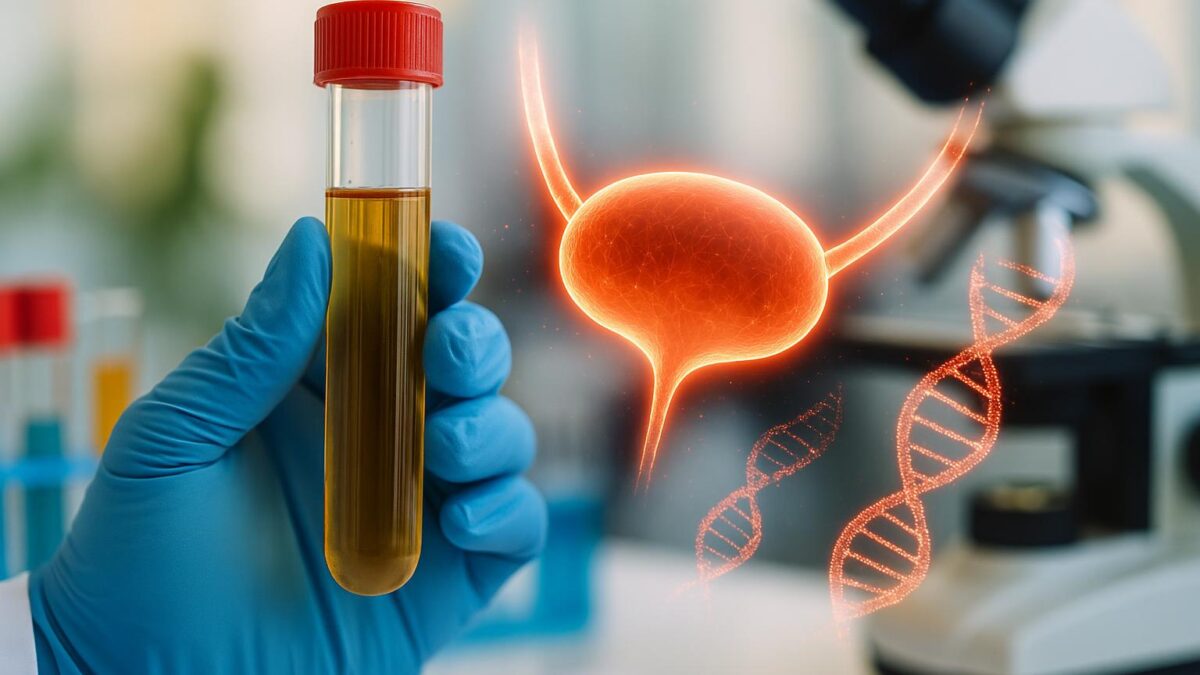
For people with bladder cancer, appointments follow one another and are too often the same: repeated cystoscopies, uncomfortable examinations, anxiety before each check. This urothelial cancer, one of the most common and deadliest of the urinary tract, is characterized by a high risk of recurrence, which requires very close monitoring.
A Spanish team offers a completely different track: a urine test based on DNA present in urine. Published in 2025 in the journal The Journal of Molecular Diagnosticstheir work suggests that a simple urine sample could ultimately help diagnose and monitor the disease.
Bladder cancer: why a reliable urine test is so eagerly awaited
Currently, diagnosis and monitoring are mainly based on cystoscopy, an examination where a thin tube equipped with a camera is inserted into the urethra to inspect the interior of the bladder. This procedure is invasive, expensive, often requires local anesthesia and must be repeated many times during the patients’ lives because of frequent recurrences.
Urine cytology, which looks for tumor cells in urine, is a noninvasive alternative, but it lacks sensitivity for low-grade tumors. Hence the considerable interest in urine tests capable of detecting the presence and severity of cancer more precisely, while remaining as simple as a urine sample taken in the morning in the laboratory.
A urine test to diagnose bladder cancer and follow-up
In this study carried out at La Fe hospital in Valencia, researchers analyzed the urine of 156 patients with bladder cancer and 79 controls without urothelial tumors. They were interested in circulating free DNA (cell-free DNA or cfDNA) present in urine, by measuring the quantity and size of DNA fragments from five target genes: ACTB,
AR, MYC, BCAS1 And STOX1. The idea is that the way this DNA fragments reflects the type of cell death (apoptosis or necrosis) and, thus, the aggressiveness of the tumor.
The results draw particular attention to the gene
MYCa key player in cell proliferation. “Our most important result is that the small fragment of the MYC gene could represent a valuable tool for diagnosing bladder cancer, as it showed excellent specificity (97%) and predictive value (88%) for identifying muscle-infiltrating bladder cancers.“, explains Fr. Pilar Medina, head of the study. MYC produces a transcription factor essential for the regulation of cell growth, proliferation and metabolism.
The authors also looked at what happened over time. In 11 patients followed with up to four urine samples between 2016 and 2020, 3 experienced recurrence and 8 experienced remission. In this small group, the ratio of fragmentsACTBas well as small fragments of AR and of MYCtended to increase in the event of relapse, and to remain lower in patients in remission.
These observations remain exploratory, but they suggest that a simple urine test could one day provide earlier warning of a return of the disease, without systematically requiring a cystoscopy. Pilar Medina sums up the issue: “Our results show that urine can tell us much more than we thought; it has the potential to transform the way we detect and manage bladder cancer“.
What this new urine test could change for monitoring bladder cancer
Researchers therefore hope that these urinary biomarkers will be able to:
- To contribute to the diagnosis of bladder cancer;
- To help distinguish less aggressive forms and forms infiltrating the muscle;
- To report a possible relapse during follow-up.
“With the growing interest in liquid biopsies and personalized medicine, our study offers a timely and practical alternative to invasive diagnostics. This study is one of the first to comprehensively assess the fragmentation and integrity of urinary free DNA across most stages of bladder cancer, bringing us closer to a future where bladder cancer can be diagnosed and monitored with a simple urine test, improving patient comfort and care.“, underlines Raquel Herranz, first author.
For the moment, this is a proof of concept, carried out in a single center, which will have to be confirmed on larger cohorts before entering routine practice or claiming to replace cystoscopy. Performance also remains to be compared with other urine tests already available for recurrence, based for example on DNA methylation.