
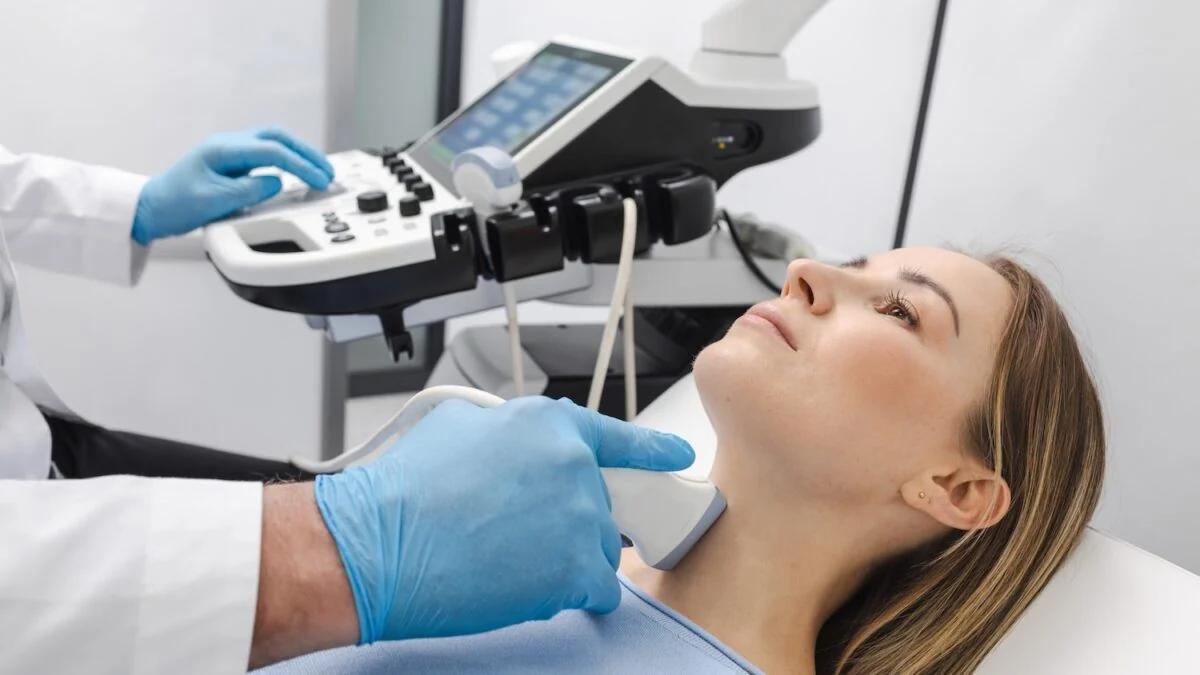
Can a benign thyroid nodule really warrant treatment if it is not cancerous? Yes, when it causes real discomfort. In certain specific cases, radiofrequency thermoablation can be discussed as a minimally invasive alternative to surgerybut only after a strict specialist assessment.
It is therefore not intended for all nodules and does not replace surgery in all situations.
A benign nodule can be annoying without being dangerous
Most thyroid nodules are discovered during a physical examination or ultrasound. Many simply remain under surveillance. To better understand this context, thyroid nodules are most often benign but require appropriate monitoring.
The situation changes when the thyroid nodule is judged to be benign but becomes large or visible. The press release from the Nantes University Hospital, which announces the development of a dedicated sector, cites very concrete constraints that could motivate a specialized discussion:
- Difficulty swallowing;
- Cough or feeling of compression in the neck;
- Respiratory discomfort or aspiration;
- Aesthetic discomfort linked to the volume of the nodule.
These symptoms alone do not allow you to choose a treatment. They are used to describe the impact of the nodule, then to decide, with the healthcare team, whether simple monitoring, surgery or another option can be considered. It is in this type of situation, when the discomfort is concrete and documented, that a less invasive option than an operation can be considered.
The High Authority of Health, however, regulates this indication: it concerns thyroid nodules. proven benign by two successive cytologiesresponsible for a clinical impact, with a decision validated in a multidisciplinary consultation meeting, in a center capable of offering all therapeutic options. In practice, several points must be clarified before any decision:
- Confirm the benign nature of the nodule, in particular by the necessary examinations;
- Evaluate the real discomfort, the evolution of the volume and the associated symptoms;
- Discuss the file as a specialist team, and not based on a simple wish to avoid surgery;
- Plan for follow-up after the procedure, because the result is not immediate.
In this course, cytopuncture makes it possible to characterize a thyroid nodule before discussing treatment.
Thermoablation treats the nodule without removing the thyroid
Radiofrequency thermoablation consists of destroying part of the nodular tissue using heat, under ultrasound control. The procedure is performed percutaneously: after identifying the nodule and local anesthesia, the interventional radiologist inserts a needle and gradually treats the nodule zone by zone.
The goal is not to remove the entire thyroidbut to reduce the volume of the nodule responsible for the discomfort. The Nantes University Hospital highlights a percutaneous procedure, in day hospitalization, without open surgery, with sought-after preservation of healthy thyroid tissue, thyroid function and without visible scarring on the neck.
The result is not immediate. The reduction in volume is done in the months following the intervention, with clinical and ultrasound monitoring. The concrete promise is therefore a gradual reduction in discomfort, not an instantaneous disappearance of the nodule.
At the Nantes University Hospital, the sector described brings together endocrinologists, surgeons and interventional radiologists. The files sent by a doctor are presented at a multidisciplinary consultation meeting, then the patient meets the interventional radiologist before programming the procedure. Treatment is provided as a day hospitalization, with approximately two hours of monitoring before returning home. This duration remains a local protocol: it may vary depending on the teams, anesthesia or sedation.
This option should not be presented as a universal solution. Dr Delphine Drui, endocrinologist at Nantes University Hospital, puts it this way:
“This technique allows us to expand the possibilities offered to patients. The objective is not to replace surgery, which remains essential in many situations, but to have an additional option for well-selected patients, whose nodule is benign but causes real discomfort on a daily basis.”
Surgery or other specialized treatment remains necessary or preferable in the event of suspected cancer, high-risk ultrasound signs, very large or compressive nodules, certain secreting nodules, or even failure or regrowth after treatment. The decision therefore never comes down to choosing between “operating” and “doing nothing”.
Follow-up verifies the reduction of the nodule over time
After a thermoablation, you should not wait for the discomfort or nodule to disappear immediately. The decrease in volume is gradual and varies depending on the patient, the characteristics of the nodule and the response to treatment.
At the Nantes University Hospital, clinical and ultrasound checks are planned at 6 months, 1 year then 2 years in order to assess the reduction in volume and the evolution of symptoms. Specialized recommendations place greater emphasis on prolonged clinical, ultrasound and sometimes biological monitoring, in particular to monitor possible regrowth. Ultrasound monitoring of a thyroid nodule therefore remains central before and after the procedure.
Like any medical procedure, thermoablation is not without risks. Pain, hematoma, infection, skin burn, damage to neighboring structures or voice disorder are among the possible complications, even if they are controlled by patient selection and the experience of the team.
In Nantes, the sector was set up at the end of April 2025, with a first patient treated in May. The University Hospital reports 35 patients treated and one to two patients treated each week at the time of its press release. These figures describe a local experience:
they are not enough to predict the benefit for a given personwhich must be evaluated on a case-by-case basis with the specialized team.