
When the sunny days return, the bites multiply and the same worry sets in: will this little black mosquito with white stripes that circles around the legs stay all summer? This tiger mosquito, Aedes albopictushas settled in France since 2004 and potentially transmits dengue, chikungunya or Zika. Information campaigns describe it as very invasive, giving the impression that it is long-lived, when its individual lifespan is surprisingly short.
According to Le Mag des Animaux d’Ouest France, the lifespan of adult tiger mosquito generally does not exceed a few weeks. A male lives between 1 and 2 weeks, a female between 2 and 3 weeks, with a maximum of around 1 month in a natural environment when the temperature is mild and humidity high. In the laboratory, some females reach 2 months, but outside most adults die as soon as the thermometer drops below 10°C. The key is his ultra-fast life cycle.
Lifespan of the adult tiger mosquito: male, female, conditions
In Aedes albopictus, the male devotes almost all his energy to reproduction and dies quickly. According to Le Mag des Animaux, it lives on average 1 to 2 weeks, compared to 2 to 3 weeks for the female who must also look for blood to make her eggs. When conditions are ideal, a female can reach 1 month, but each day its population decreases by 10 to 20%, while that of males drops by 20 to 30%.
This life expectancy depends a lot on the climate. In humid summers, with water sources and few predators, most tiger mosquitoes reach their maximum lifespan. As soon as the weather becomes very dry or cold, they disappear. Adults generally die when temperatures drop below 10°C, which explains why the species survives mainly as eggs during the winter.
Tiger mosquito life cycle: from egg to adult
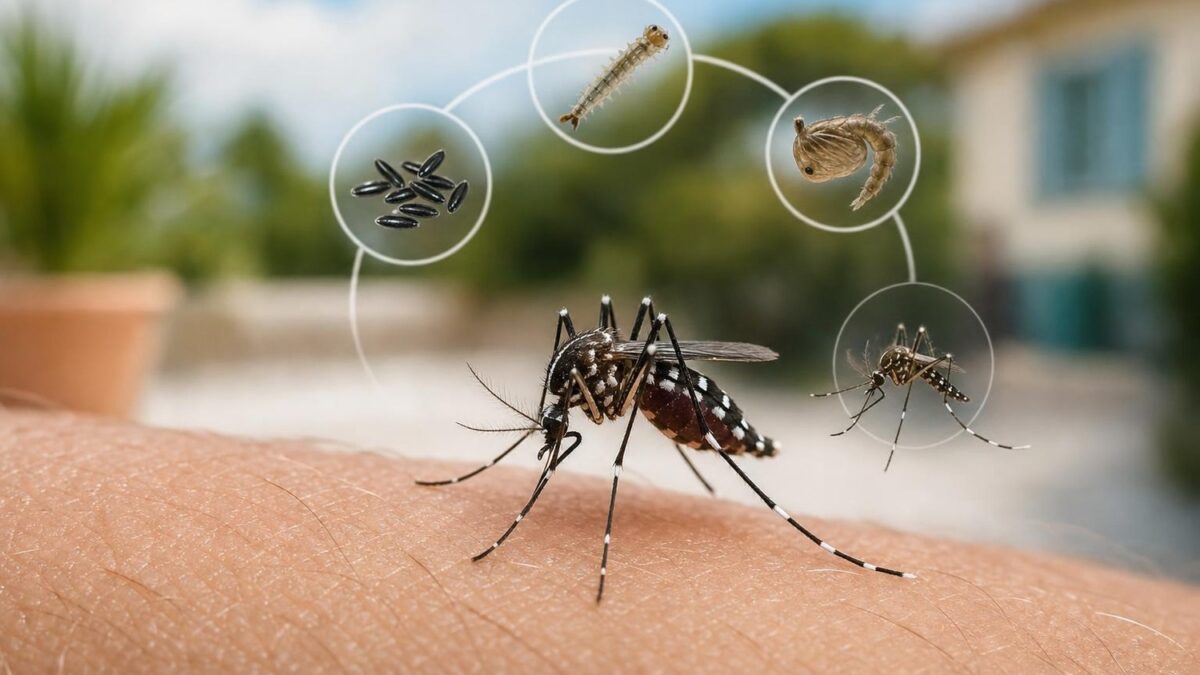
To understand why there are so many mosquitoes for so few long-lived individuals, we must look at the tiger mosquito life cycle. Eggs laid on damp walls can remain in diapause for several months, waiting for water. Once submerged and if the temperature exceeds 15°C, they hatch in 24 to 48 hours. The larval phase lasts 5 to 7 days, then the nymph stage 2 to 4 days before the emergence of the adult.
In total, the transition from egg to adult takes 7 to 15 days. The Modes et Travaux site mentions ten days in a rainwater collector left open. A week of mild weather after a storm is enough to see a new generation emerge.
Why the tiger mosquito proliferates despite its short lifespan
Despite this short life, each female lays around 200 eggs every 12 days as soon as the temperature exceeds 15°C, according to Modes et Travaux. Out of 100 eggs, only 1 to 5 reach adulthood, the others disappearing before.
Sources
- Fashions & Works