
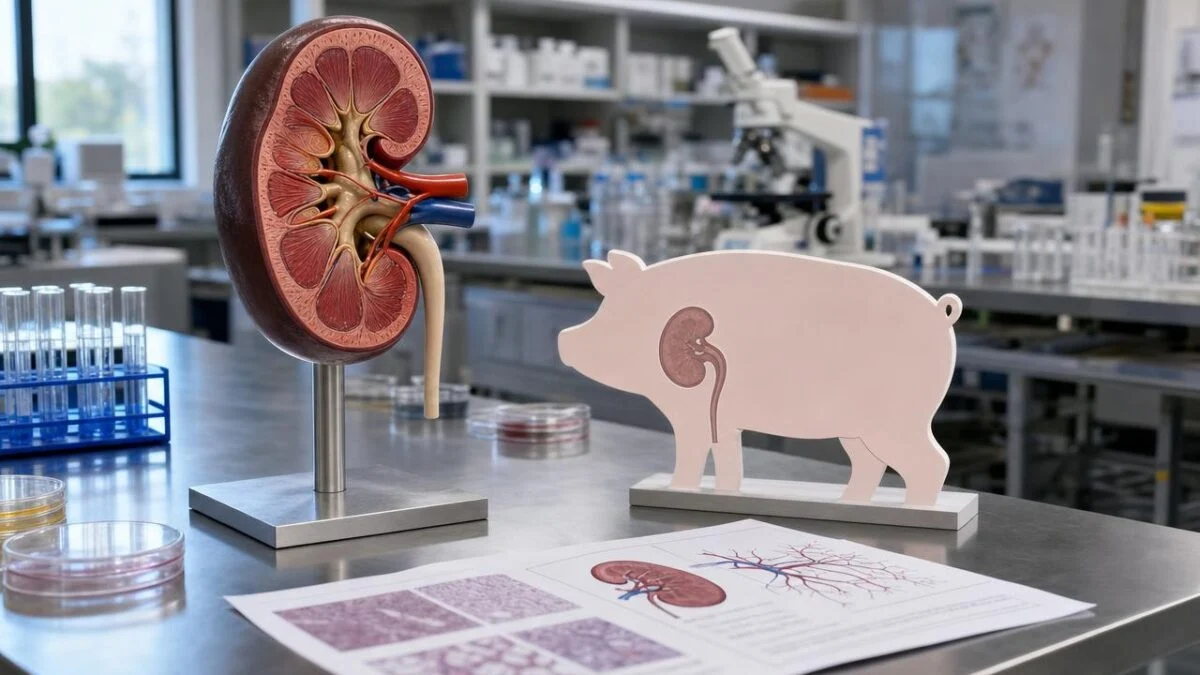
For people with end-stage kidney disease, the wait can last years. While waiting for a compatible donor, dialysis is often necessary several hours per week, with a heavy impact on daily life. But what if an animal organ could, temporarily, make the link to a human transplant?
This is precisely what Tim Andrews, a 66-year-old American, experienced. In January 2025, at Massachusetts General Hospital, he received a genetically modified pig kidney as part of an experimental protocol. The plugin worked immediately. During
271 days, he no longer needed dialysis.
His story, published on September 3, 2026 in The Lancetconstitutes a first: never before has a patient who received a pig kidney lived so long without dialysis before subsequently benefiting from a human kidney transplant.
For nine months, his pig kidney took over
Before this xenograft, Tim Andrews had been on hemodialysis for more than two years. According to the researchers, his theoretical wait to obtain a human kidney exceeded five years. His probability of receiving a transplant was estimated at only 9%, while his risk of death or removal from the list exceeded 40%.
On January 25, 2025, the surgeons therefore tried another route: implanting a genetically modified pig kidney provided by eGenesis.
The graft worked immediately. A first episode of acute rejection involving T lymphocytes could be treated. Importantly, no infectious agents originating from pigs were detected during monitoring. During 271 daysTim Andrews was thus able to live without dialysis.
But this parenthesis did not last indefinitely.
The kidney eventually fails, but another transplant becomes possible
About six months after the xenograft, doctors had to reduce his immunosuppressive treatment due to a bacterial infection. The porcine kidney then developed small vessel damage and thrombotic microangiopathy, accompanied by progressive inflammation. The graft eventually stopped working and was removed.
But this time, the story didn’t end there. 82 days later, Tim Andrews received a kidney from a deceased human donor. The new organ functioned immediately and no particular problems with immunological sensitization were observed during the reported follow-up.
It is this succession that makes his case particularly important: the pig kidney has not definitively replaced the human kidney. He served as bridgeallowing the patient to come off dialysis while he waited for a human solution.
“The organ shortage is the biggest crisis we are currently facing.”
For Leonardo Riella, medical director of kidney transplantation at Mass General Brigham and lead author of the study, the issue goes well beyond the case of Tim Andrews.
“The shortage of organs is the greatest crisis we currently face in transplantation”he emphasizes. Patients with end-stage renal disease need a transplant, considered the best treatment option, but available human kidneys are not enough to meet the demand.
In this situation, the xenograft could have a very different role than initially imagined. The idea would first be to
take patients off dialysis while they waitwith an animal kidney capable of temporarily ensuring renal function. In the longer term, if the safety and duration of operation of these organs are demonstrated, researchers even envisage that they could become a definitive solution.
“Our vision is that xenotransplantation can help fill this gap — initially as a transitional solution to allow patients to wean themselves off dialysis while waiting for a human donor kidney, and potentially, as we establish its long-term safety and durability, as a treatment in its own right.”says Leonardo Riella.
A success… which also shows what remains to be resolved
The kidney received by Tim Andrews had undergone 69 genetic modifications intended in particular to make it compatible with the human organism. No porcine pathogens were detected and the xenograft did not result in the appearance of new anti-HLA antibodies reported in the study.
But late graft failure also provides valuable information. The small vessel damage observed in the porcine kidney could help researchers better understand how to tailor immunosuppressive treatments, genetic modifications of organs and monitoring of future patients.
This step is all the more important as renal xenograft remains an experimental approach. The first patient to receive a genetically modified pig kidney at Mass General, in 2024, survived 52 days before dying of a heart problem unrelated to the transplant.
The case of Tim Andrews therefore marks a spectacular progression, but not yet the arrival of a new transplantation solution accessible to all.
For Leonardo Riella, this progress owes a lot to the patients who agreed to participate in these first experiments: “Patients are the real pioneers here. By volunteering and agreeing to participate in these early studies, they are moving science forward. Without their trust and courage, we could not do what we do.”.
For thousands of people who are now waiting for a human kidney, this experience nevertheless opens a new perspective: that of an animal organ which would no longer necessarily be the final destination, but the relay capable of saving time when a human kidney is waiting.