
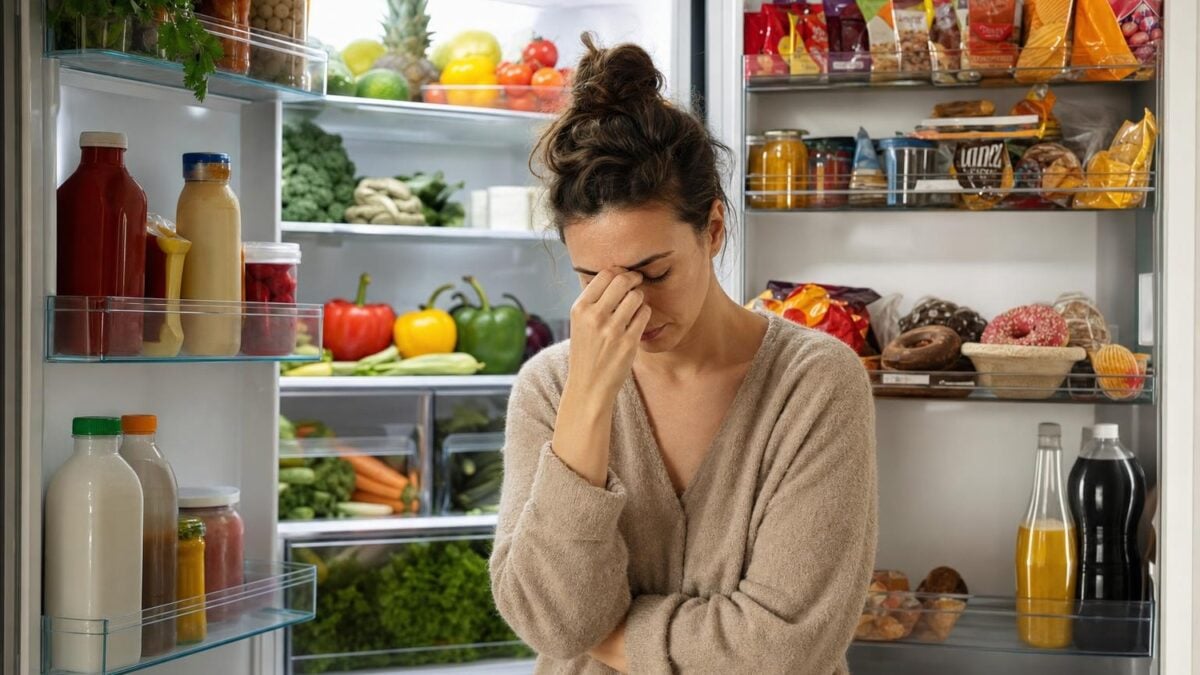
In front of the fridge or in the frozen food section, you hesitate between a prepared meal and vegetables to cook, even though you wanted to “eat better”. This banal scene, repeated every evening, ends up weighing on your energy and your health. Psychologists talk about
decision fatigue when the succession of choices exhausts the brain and makes us slide towards the easiest options.
Nutritionist Emma Beckett, senior lecturer in nutrition and food science, from the Australian Catholic University, +who writes for The Conversation, explains that every decision uses a bit of mental energy. When this reservoir drops, we plan less, we resist impulses less and our health goals take a back seat. But we make hundreds of food decisions a day, in a supermarket saturated with nutritional options and figures, a phenomenon sometimes called nutritionism.
How decision fatigue drives your food choices
According to Emma Beckett, decision fatigue, also called choice overload, corresponds to the moment when the multiplication of demanding decisions exhausts us. As mental energy wanes, we choose what is familiar, quick, comforting. A 2017 study she cites showed that between meals, especially in the afternoon, people more often opt for the default option rather than a truly considered choice.
Concretely, this translates into more fast food, high-calorie snacks or prepared meals eaten in front of a screen. For parents, the pressure is even greater. A 2022 study mentioned by Emma Beckett observed that those who combined high stress and strong decision-making fatigue cooked less at home and ate less often together as a family, two habits that were nevertheless protective for health.
Why this fatigue ends up harming your health
By giving in to the simplest solutions, everyday life is filled with ultra-processed foods, rich in salt, sugar and fat. Taken in isolation, a delivered meal does not pose a problem, but repeated regularly increases the risk of weight gain and lack of energy. Many then have the impression of having “zero willpower”, while their brain is above all short of resources.
Added to this is information overload. Between calorie-counting apps, complex labels, and conflicting advice, every meal feels like a little test. To alleviate this pressure, Emma Beckett advises rephrasing your goals and telling yourself that you want to “eat a colorful meal” rather than repeating that you need to “eat more vegetables”. This little nuance makes the decision simpler and more pleasant.
Four simple actions to simplify your daily decisions
Emma Beckett first recommends making healthy choices almost automatic: washed fruit, frozen vegetables, leftover balanced meals in the freezer, while ultra-processed products remain less visible in the cupboard. Then, deciding once for several days helps a lot: a little planning, a little batch cooking or meal kits reduce last minute decisions. For ideas, she reminds us that “you don’t need to reinvent the wheel” each time to find healthy and tasty recipes: MangerBouger sites and qualified dieticians or nutritionists can offer you ready-to-use ideas.