
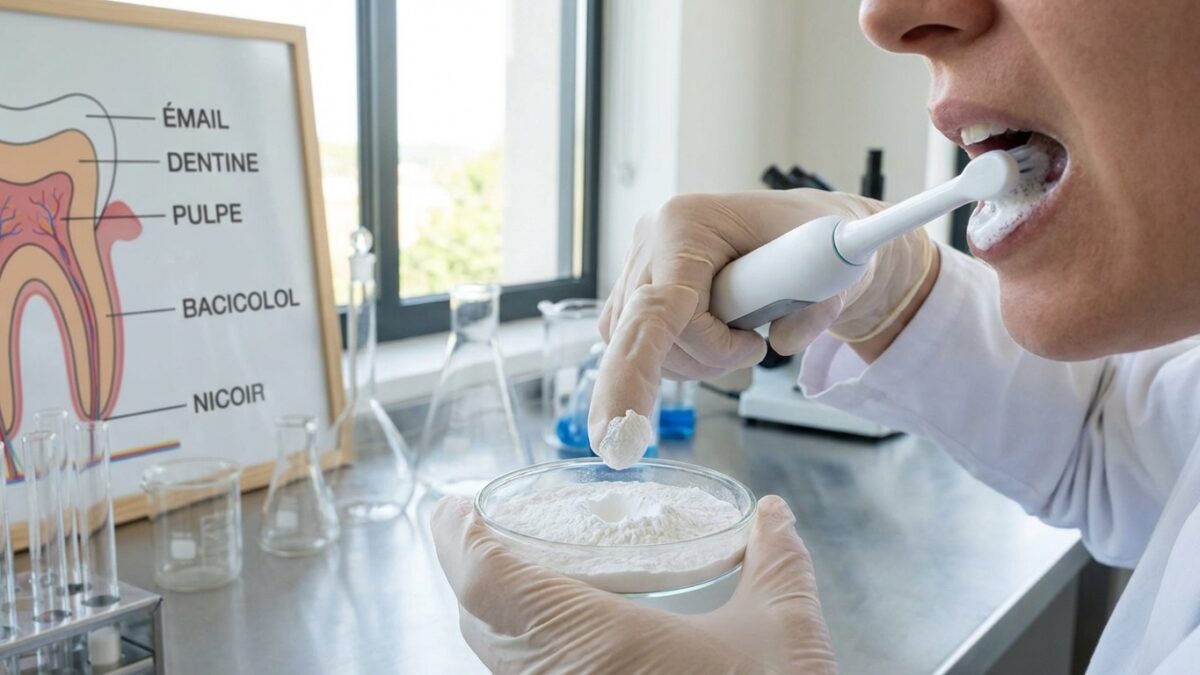
Having a whiter smile without seeing your teeth weaken remains the holy grail for many patients. The global tooth whitening market is worth more than $9 billion, or about €8.3 billion in 2026, but at-home kits and chairside sessions often leave behind increased sensitivity, thinned enamel and irritated gums.
Faced with this observation, a team of Chinese researchers has developed a tooth powder experimental which is only activated with the vibrations of a electric toothbrush. In the laboratory, this material whitened stained teeth while partially repairing thee-mail and by rebalancing certain bacteria in the mouth. An intriguing promise.
Products sometimes too aggressive
Teeth whitening using peroxide, in the form of strips, gels or mouthwashes, is a commonly used method for lightening stained teeth. This chemical process produces reactive oxygen species (ROS), which break down the molecules that cause stains. However, while effective in removing stains, these whitening techniques can also weaken tooth enamel, increasing the risk of new stains or other oral problems.
This is why researchers have developed a particularly promising new technique.
BSCT, dental powder that reacts to brush vibrations
At the heart of this new approach, a ceramic material called BSCT, for Ba0.9Sr0.05Ca0.05TiO3. The researchers combined strontium and calcium ions, already naturally present in the tooth, with barium titanate in solution, then heated everything to obtain a fine powder. When the electric brush vibrates, the BSCT surface creates a tiny electric field: a phenomenon known as the piezoelectric effect.
This field triggers chemical reactions on the surface of the tooth which form reactive oxygen species, capable of breaking down the molecules responsible for stains. Unlike peroxide gels used in the office or in kits, these reactions only occur during brushing and in direct contact with the powder, which limits prolonged exposure of the powder.e-mail to an aggressive agent.
Teeth up to 50% whiter, without eroding enamel
On human teeth stained with tea and coffee, four hours of cumulative brushing with BSCT and an electric brush already resulted in visible lightening. After 12 hours of brushing, the treated teeth were almost 50% whiter than those in the control group, simply brushed with saline. At the same time, on damaged teeth, calcium, strontium and barium ions were redeposited and began to regain enamel and dentin.
“This work offers a safe, at-home tooth whitening strategy, integrating whitening, enamel repair and microbiome balance for long-term oral health“, explains Min Xing, quoted by the magazine ACS Nano.
An effect also on bacteria in the mouth, but a powder still experimental
In rats fed a very sugary diet, just brushing for one minute a day for four weeks with this powder reduced bacteria associated with periodontitis, such as Porphyromonas gingivalis and
Staphylococcus aureusand reduced inflammation. The animals’ oral microbiome approached that of healthy rats.
Although BSCT powder has not yet been incorporated into a toothpaste in current trials, scientists argue that this research represents a step forward toward an innovative and safe home treatment for whitening teeth while promoting oral health.