
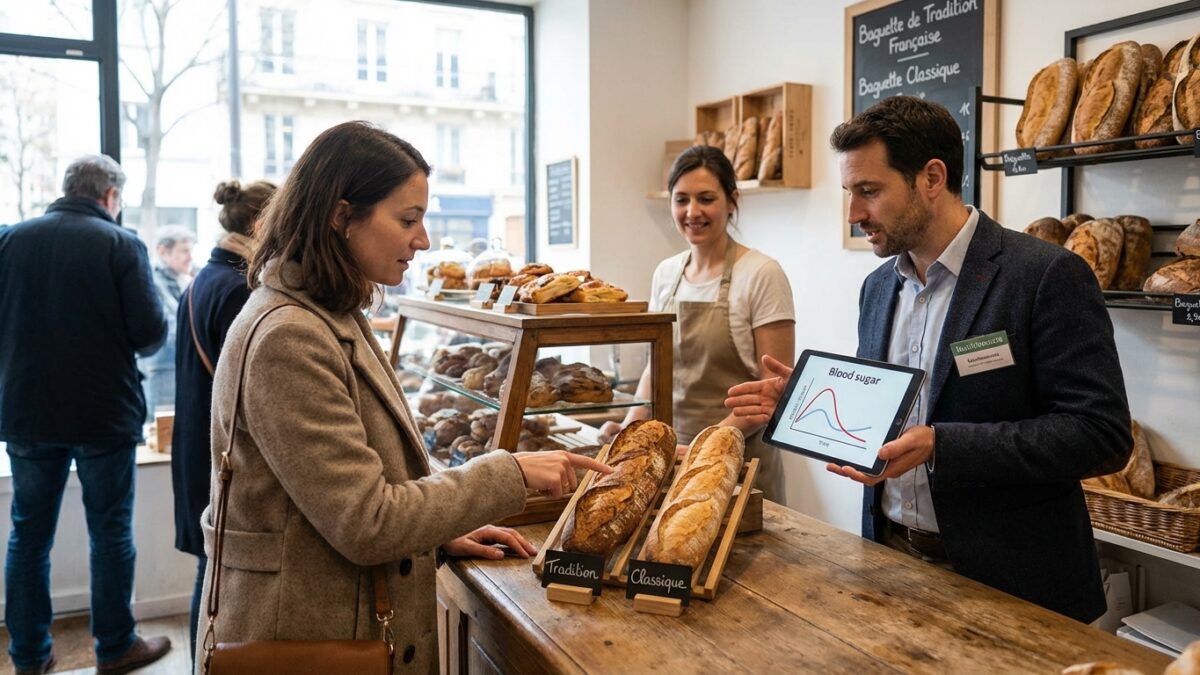
In front of the counter, the scene repeats itself: “A baguette, please”… and the saleswoman immediately asks if you want it classic or traditional baguette. Both look the same, the price varies by a few cents, so many choose at random, especially thinking about the crunchiness.
However, when it comes to health, these two breads do not have the same effect on your body at all. A nutrition specialist reminds us: half a baguette, whether traditional or classic, provides around 250 calories, but the reaction of the
blood sugar changes everything. This is where tradition takes a clear lead.
Traditional or classic baguette: same calories, not the same glycemic index
In both cases, we are talking about white bread made from wheat flour, water, salt and yeast or sourdough. On the scale, half a baguette is around 250 calories. The real issue is therefore not the calories, but the speed at which these carbohydrates are transformed into sugar in the blood, which is measured by theglycemic index.
The higher the glycemic index, the faster sugar enters the blood and the more abruptly blood sugar rises. The available figures speak for themselves: the classic baguette is around 78 to 80, while the traditional baguette
goes down to around 55 to 57. The same pleasure in the mouth, but a very different rush of sugar.
Classic baguette: when bread acts like quick sugar
There classic baguette is often made with very refined flour, improvers and express rising. Result: it is digested very quickly and its glycemic index is high, close to that of a fast sugar. “When you eat a classic baguette, it’s like eating sugar, and even faster in terms of blood sugar“, explains Laurence Plumey, nutrition specialist, quoted by Marmiton.
In the body, this gives a spike in blood sugar, then a strong secretion of insulin which causes sugar to drop just as quickly. At the moment, you feel full, then the dip and the cravings return a few hours later, especially if the bread was eaten almost alone, without fiber or protein to slow down this surge.
Traditional baguette: a bread regulated by law, more satisfying on a daily basis
The “traditional French baguette” is protected by decree no. 93-1074 of 1993: only wheat flour, water, salt, yeast and/or sourdough, no additives, no freezing, dough kneaded and cooked on site, with longer fermentation. This method gives a lower glycemic index, more stable blood sugar levels and longer-lasting satiety.
Another concrete bonus: its crispier crust, its more honeycombed crumb and its softness which holds up better over time limit waste. For a quick lunch, she makes a base of
sandwich more interesting, especially garnished with vegetables and proteins which further slow down the assimilation of carbohydrates:
- Traditional baguette, roast chicken, various raw vegetables, a drizzle of olive oil;
- Traditional baguette, hard-boiled eggs, tomatoes, green salad;
- Traditional baguette, tuna, cucumber and grated carrots.