
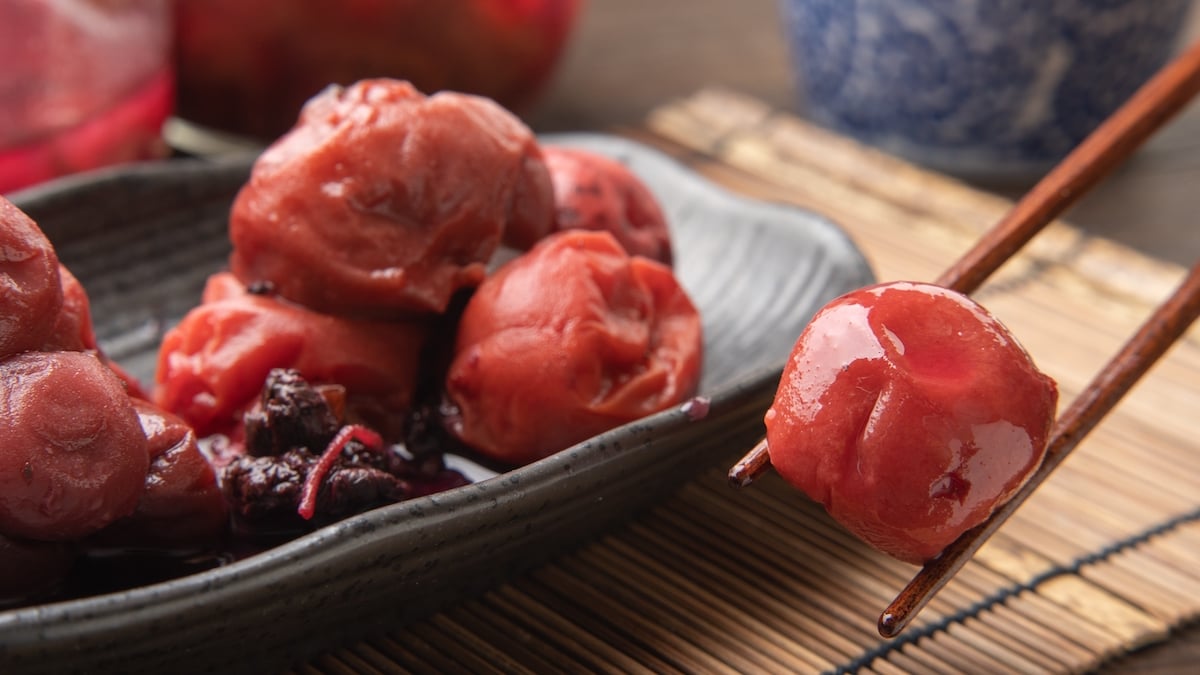
Niche yesterday, trendy today. Umeboshi — this small dried, salted and fermented ume plum — is gradually emerging from the shadows of Japanese grocery stores to establish itself in conversations around well-being. Consumed in Japan for centuries, particularly as a morning condiment or grandmother’s remedy, it is the subject of growing interest from nutritionists and integrative medicine practitioners. In question: a dense nutritional composition and supposed effects on digestion, the liver and even blood circulation. But what does science really say about it, and how can we integrate it into our daily lives?
An extraordinary nutritional profile, resulting from ancestral know-how
Umeboshi is the result of a long fermentation of the ume fruit, a variety of Japanese apricot often compared to a plum. The traditional process — maceration in salt, drying in the sun, sometimes flavoring with shiso leaves — gives rise to a product with a rare concentration of organic acids: citric, malic, succinic, tartaric. Added to these compounds are vitamins, minerals and molecules from the fermentation itself.
For Nina Voit, nutritionist and integrative Chinese medicine practitioner, umeboshi represents a textbook case: “a very interesting example of a traditional food that ticks all the boxes of modern nutrition: fermentation, nutrient density and impact on digestion.” A rare convergence between millennial tradition and contemporary demands.
Effects studied on digestion, liver and circulation
In traditional Japanese medicine, the ume plum has long been associated with a broad spectrum of beneficial effects. Contemporary research — particularly in Japan — is beginning to document certain mechanisms. The pyruvic acid present in umeboshi contributes to good liver function. A specific molecule resulting from cooking the fruit, mumefural, would be the subject of studies relating to blood thinning and the prevention of cardiovascular disorders.
On the digestive level, umeboshi is known to promote digestion and fight against fatigue. Its consumption combined with foods rich in calcium could also improve its assimilation, an asset that is particularly relevant in children and the elderly. Effects on muscle recovery and indirectly on the skin appearance are also mentioned, although these avenues remain less documented.
“Umeboshi is a very concentrated product: a small quantity is enough to benefit from its effects. I often include it in my morning routine, diluted in a hot drink like kukicha tea. It is not necessarily for taste pleasure, but to support the body from the start of the day”, reveals Nina Voit, nutritionist.
How to incorporate it into your daily life — and why moderation is essential
Umeboshi comes in several forms: whole fruit, puree or liquid (umesu, also called plum vinegar). It can be used as a seasoning for cereals, diluted in a hot drink, or integrated into various culinary preparations. The practitioner advises taking it in small regular doses rather than in large one-off quantities.
Because although umeboshi has many advantages, it remains a product with a high concentration of salt – a point which calls for caution. Specialists recommend moderate consumption, as part of a balanced diet. “Like all fermented savory products, balance is key: the interest lies in regularity and the right dose, not in excess.summarizes the expert. A universal principle of nutrition, which this fruit from Japan perfectly illustrates.