
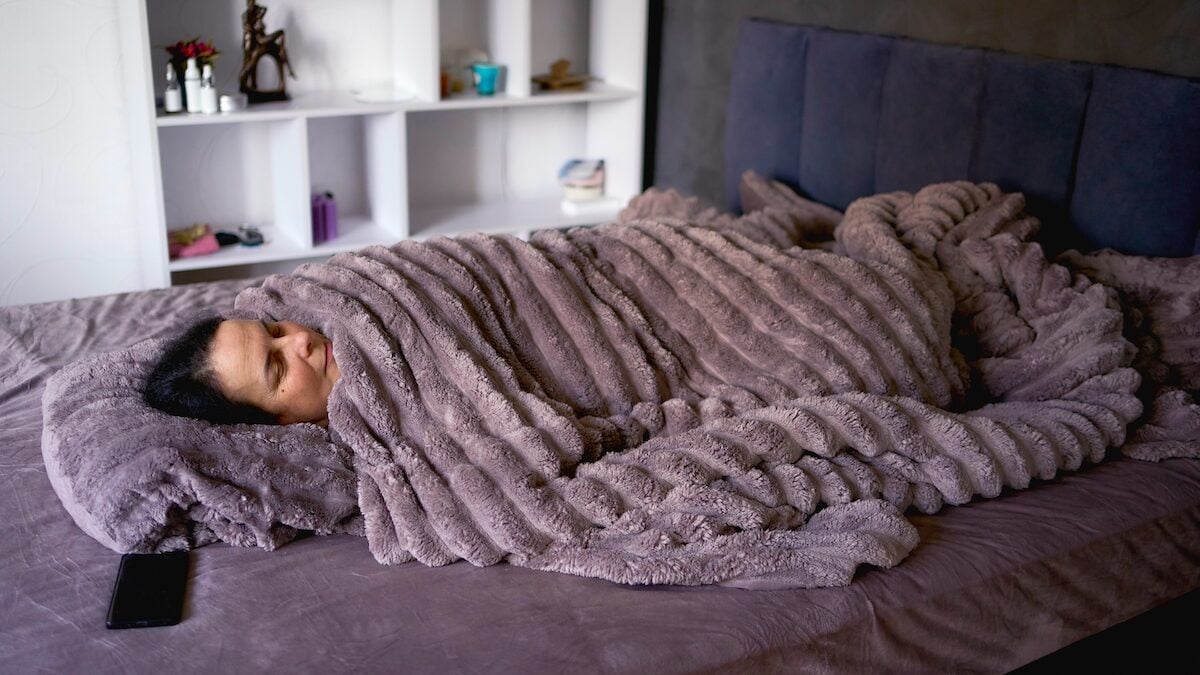
They appear in the rooms of influencers, are favored by celebrities and touted as the miracle solution against anxiety and insomnia. THE
weighted blanketsthese heavy blankets filled with glass or plastic beads, have established themselves as an essential well-being accessory.
But between marketing and scientific reality, their effectiveness remains to be qualified, as evidenced by an article in The Conversation.
A promise of comfort that has become a global phenomenon
Used since the 1970s by
occupational therapists To help children with autism or adults with sensory issues, weighted blankets have long been a discreet therapeutic tool. In the 1990s, they became accessible to the general public, before exploding on the wellness market from 2018, when the magazine Time ranks them among the 50 best “inventions” of the year.
Their principle? What specialists call “deep pressure stimulation”. This gentle and uniform pressure on the body reproduces the sensation of
hug or embrace. According to their promoters, it calms the nervous system and promotes relaxation.
In practice, these blankets weigh 2 to 13 kilos, with experts recommending a weight equivalent to 10% of body weight.
But does this simple and seductive promise stand up to the test of science?
What the studies say: promising, but limited results
“Weighted blankets have been shown to be a safe and effective intervention for insomnia in patients with certain mental disorders.”indicates a study carried out on 120 psychiatric patients suffering from
depression, bipolar disorder, anxiety or ADHD (The Conversation2025).
The results converge in other works: 63% of adults declared a reduced anxiety after just five minutes under a weighted blanket, while a study of psychiatric hospital patients noted that 60% of them had felt a
reduction in their anxiety during their stay.
But Craig Jackson, professor of occupational health psychology at the Birmingham City Universitytempers:
“These studies concern people with diagnosed mental disorders, not the general public that companies are targeting today.” (The Conversation2025)
Because for people without psychiatric pathology, the evidence remains fragile. Scientific journals conclude that
lack of solid data on the effectiveness of weighted blankets among “occasional users”.
Near the half of existing studies do not meet the quality criteria required to constitute robust scientific proof.
Possible help, but not a miracle cure
However, not everything has to be thrown away. According to the author, these covers could relieve some peoplenotably the shift workers — nurses, firefighters, pilots — who have to sleep at unusual hours.
“If a weighted blanket helps you feel calmer and sleep better, even if the mechanism is not what the manufacturers claim, that is still a positive outcome “, emphasizes Jackson.
But be careful: these covers are not not without risks. They are not recommended for young children, and people with diabetes, asthma, sleep apnea, circulatory disorders, hypertension or
claustrophobia.
It is better to talk to a doctor before adopting them.
The expert finally recalls: “You’re not buying a miracle cure for modern anxiety, but a comfort accessory that can help you feel more peaceful at bedtime.”. (The Conversation2025)
Ultimately, the question is not so much whether if weighted blankets workbut if they work for you. They will never replace psychological or medical care, but can offer tangible comfort, this reassuring feeling of being enveloped, protected. In a world saturated with tensions, perhaps this is already a form of care – even if science, for the moment, only validates its outlines.