
We swallow a coffee, a piece of bread or an ice cream without thinking about it, while for our immune system, each mouthful resembles an invasion of foreign bodies. If this sorting goes wrong, every meal could turn into a crisis.food allergy.
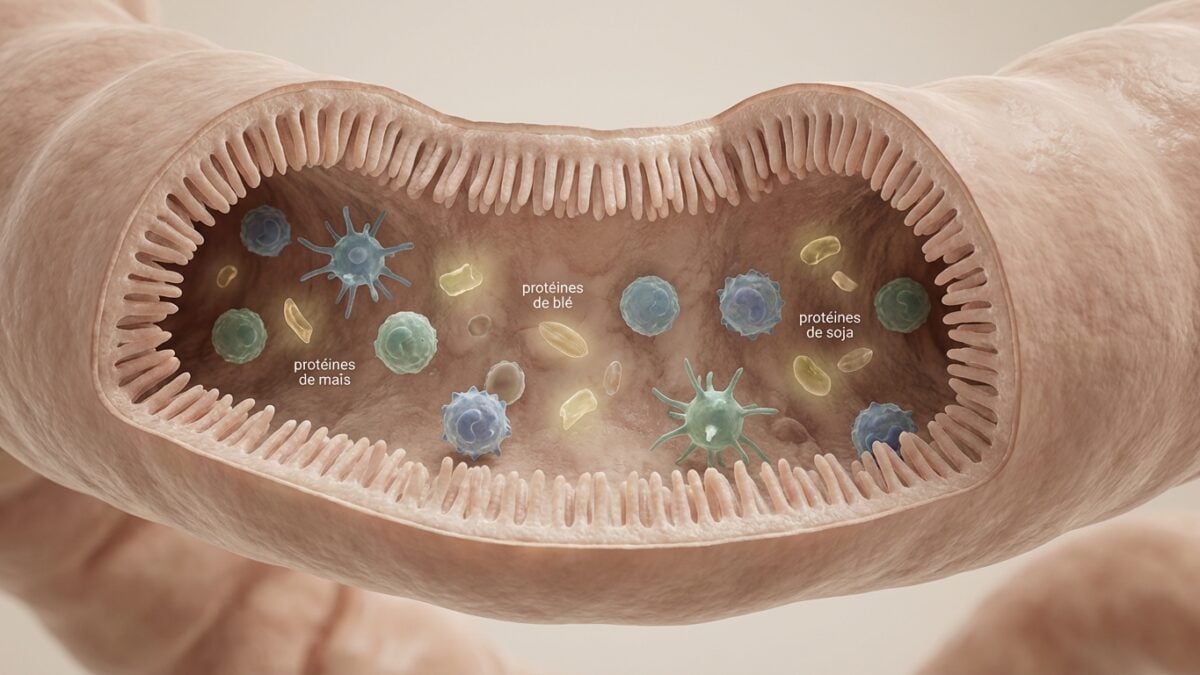
To understand why most foods pass smoothly, Stanford researchers mapped what our gut considers “safe.” Their study describes three fragments of seed proteins – soy, corn and wheat – capable of causing tolerance.
Oral tolerance: how the gut defuses most foods
The real ones
food allergies remain a minority: around 6% of young children and 3 to 4% of adults. In these cases, specific antibodies suddenly trigger mast cells and basophils, causing hives, vomiting, or even anaphylactic shock after a single bite.
The rest of the time, the body on the contrary activates a
oral tolerance : the food is classified as “friendly”, digested without lasting inflammation. At the heart of this sorting,
regulatory T cells act as brakes on excessive reactions of the immune system and prevent an ordinary meal from turning into a general alarm.
Three seed proteins that train the immune system
To find out what these cells actually recognize, the team studied mice fed a standard diet. The researchers isolated the intestinal regulatory T cells, observed which protein fragments they bound to, and then traced them back to the food. They discovered three such protein segments, called epitopes, from corn, wheat and soybean seed storage proteins.
These fragments are all found in seed storage proteins, which are very abundant in the diet. In mice, regulatory T cells reacted mainly to the corn epitope, a rarely allergenic food, while the soy epitope, although a major allergen in humans, shared a receptor with sesame, which sheds light on cross-tolerance phenomena. “Food is our most direct interaction with our environment“, explains Jamie Blum in a press release relayed by the Salk Institute.
“Properly identifying foods as safe creates an anti-inflammatory environment conducive to nutrient assimilation and allergy prevention. Our research advances the scientific understanding of major food allergens and points us toward future therapeutic interventions that may modify allergic and autoimmune conditions.“.
These findings represent a significant advance in the understanding of food tolerance and could guide the development of new immunotherapies for individuals with food allergies.
Why most foods remain tolerated and future directions
After identifying the new epitopes, the researchers explored several questions: where are the regulatory T cells located? And how do they function in an inflammatory environment compared to a healthy environment? Using mouse and cell models, they discovered that these regulatory T cells are primarily located in the intestine. Their activity differs depending on the environment, working either to reduce inflammation or to preserve its absence.
In summary, this discovery impressively illustrates how the immune system adapts its reactions to the numerous proteins encountered every day, favoring tolerance over inflammation. By precisely determining the protein fragments that influence this immune acceptance, these results allow us to better understand food immunity and could tomorrow lead to potential treatments for millions of people affected by allergies around the world.