
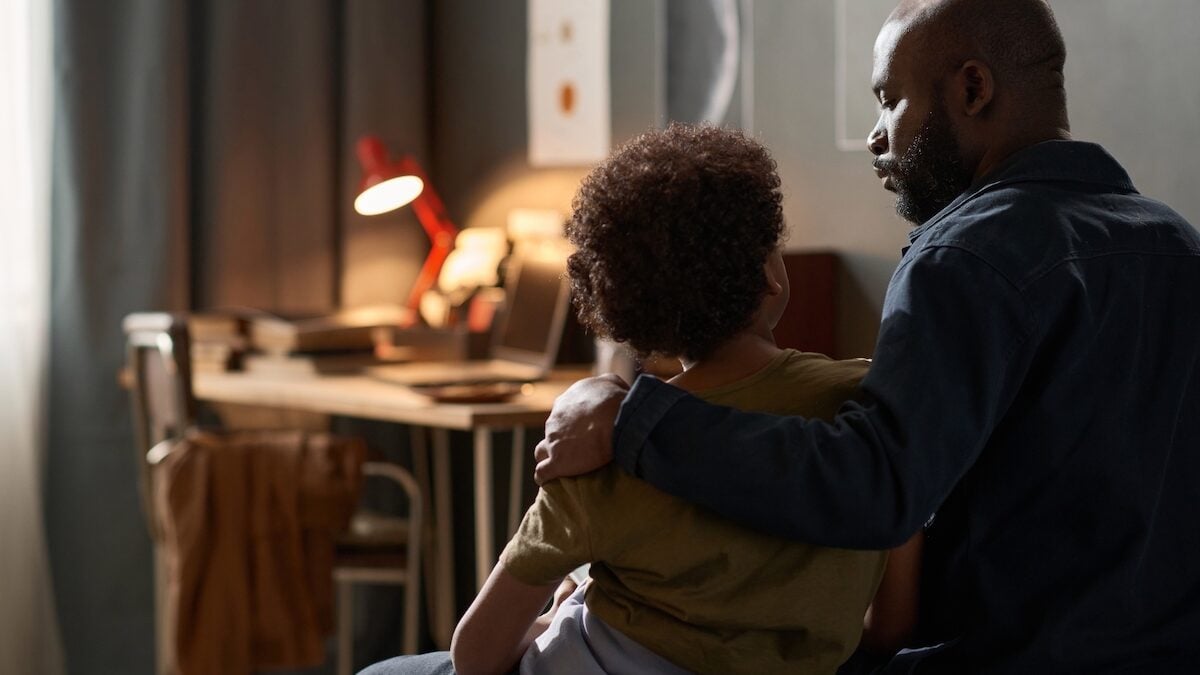
If you are parents of children on the cusp of preadolescence, you have probably already thought about talking with your daughter about her first period. Why does this happen, when, how to protect yourself, is it painful… Essential elements for getting through this stage as best as possible and without fear. And that seems normal to you.
However, as Joana Romba, founder and educator at
Childhood preservedon Instagram, things are different with our boys. While they are also facing changes, few parents discuss with them the arrival of nocturnal ejaculations, a more taboo subject. A lack of information which can also be distressing.
A normal moment… but often experienced in incomprehension
As Joana Romba explains in her post, “More people today talk about the first period, but almost no one talks with the boy about his first ejaculation. And yet, this is a mistake.”
Because the first ejaculation, also called spermarchusually occurs between the ages of 11 and 15, during puberty. And it frequently occurs during sleep. A moment which, without preparation, can be confusing.
“The problem is that many boys experience this moment without having been prepared for it. They may not understand what has happened, be afraid, think they are sick or feel ashamed.”she continues.
A simple observation: as with periods, the absence of an explanation transforms a natural phenomenon into a potential source of concern.
Give cues before it happens
For the educator, it is essential to anticipate this discussion, ideally before 11 years old. Not to worry, nor to go into sexual details, but to reassure.
The idea is not to give a long medicalized speech, but to simply explain that:
- This is part of the body’s normal development;
- This can happen during sleep;
- It is neither an illness nor anything abnormal.
And above all, remove all forms of shame: the body changes, grows, and these manifestations are part of it.
“The most important thing is not just to provide information. It is to open a space for questions and dialogue,” insists Joana Romba.
Because a boy, like a girl, needs to feel that he can talk about his body without embarrassment or mockery.
A less expressed concern… but very real
On the professional side, the observation is more nuanced. The sexologist and psychotherapist Wilfrid Pavageau, contacted by True Medical, observes that these first experiences are not often mentioned as major traumas by adult men.
“I’ve never had a man say to me: ‘I had a problem at that time’ he says, surprised.
According to him, several factors can explain this. Ejaculation is sometimes associated with a feeling of pleasure, which can reduce anxiety, especially during the first bodily discoveries.
But he underlines an important point: nocturnal emissions can raise more questions.
“We don’t always remember our dreams… What’s happening? Why does it happen by itself? What is it that comes out? The worry is more in the novelty.”
Break the taboo, without dramatizing
For Wilfrid Pavageau, however, it is not necessary to make it a heavy or anxiety-provoking subject. A simple sentence can be enough to prepare the child:
“If ever something happens at night, know that it’s totally normal.”
The challenge is therefore less to go into details than to establish a reassuring framework. Saying that it happens to everyone, that it’s part of puberty, and that the child can ask questions if he feels the need, is often enough.
Prevent the child from searching for answers alone
Are you not comfortable with the subject? You should still try an approach. Because not broaching the subject at all also means taking the risk that the child will turn to other sources of information, particularly on the internet.
However, without support, these searches can expose them to unsuitable or confusing, or even anxiety-provoking, content.
Speaking simply, early and without taboo, therefore helps to avoid many misunderstandings.
Equal education
Basically, the message is the same for girls as for boys: their bodies are changing, and they deserve to be supported with clarity, kindness and honesty.
Talking about your first period should be no more natural than talking about your first ejaculations. In both cases, it is about helping your child understand what he or she is experiencing, not being ashamed of it and growing in confidence.
Because well informed, a child does not have fewer questions. But he is better prepared. As Joana Romba says:
“Preparing a child to understand their body is not sexualizing them. It is protecting them from silence, confusion and taboo”.