
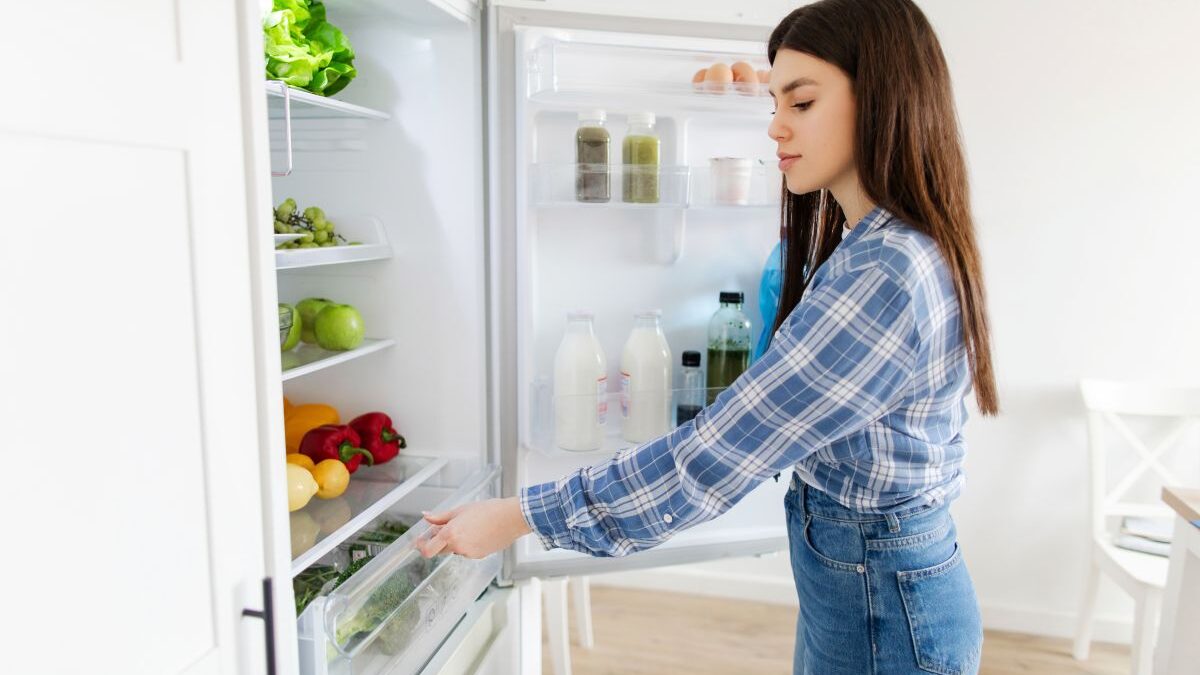
When returning from shopping, many French households make the same gesture without thinking about it, with consequences for food safety and the lifespan of the refrigerator.
We unpack, open the door and pile up everything that needs to stay cool, until every corner is occupied, telling ourselves that it’s more practical.
However, this overfilled fridge reflex should be avoided. Food safety experts point out that an overloaded refrigerator no longer cools properly. He can even freeze vegetables or let leftovers go bad too quickly.
Bryan Quoc Le, food scientist and author of “150 Food Science Questions Answered,” summarizes: “When a refrigerator is overloaded, the vents become blocked, restricting airflow and causing the internal temperature to rise and become uneven.. However, the Ministry of Agriculture recommends a cold zone between 0 and 4°C to maintain control of the cold chain.
Overfilled fridge: what happens when the air no longer circulates
When food blocks the vents, cold air no longer circulates. Some areas become icy, to the point of freezing a salad or tomatoes, while others remain lukewarm.
Manufacturers like Bosch or Liebherr describe the same technical scenario: the compressor runs almost continuously to try to catch up with the temperature, which tires the motor and increases electricity consumption.
Concrete signs must alert. Ice forms near the vents, damp areas appear, products spoil before their due date or an unpleasant odor is released.
In practice, you should not exceed two-thirds of the refrigerator’s capacity. A nearly empty unit isn’t ideal either, because the motor needs to cool more air, but an overloaded refrigerator blocks cold circulation.
Above 4°C: when the overloaded refrigerator becomes a health risk
As soon as the interior temperature exceeds 4°C, food enters a danger zone where microbes and germs multiply. Bacteria like Salmonella,
Listeria Or Escherichia coli can then develop.
Eggs, dairy products and leftovers stuck in a corner or in the door, which are very rich in protein, deteriorate particularly quickly and increase the risk of food poisoning.
The Ministry of Agriculture recommends using a refrigerator thermometer. And experts recommend placing the most sensitive foods in the middle, where the temperature is most stable, and avoiding the door for milk or eggs.
Finally, the FIFO method, “first in, first out”, limits omissions at the bottom and reduces losses.
Returning from shopping: how to fill your fridge without overloading it
When storing the bags, the idea is to leave “useful space” for air. It is better to distribute the products without sticking them to the back wall, clear the vents, slide the leftovers tightly closed in the center and keep the door for less fragile drinks and condiments.
If a stubborn smell appears, if frost forms in front of the vents or if the compressor never stops, that’s the signal that it’s time to empty out a little, reorganize and give space back to the cold.