
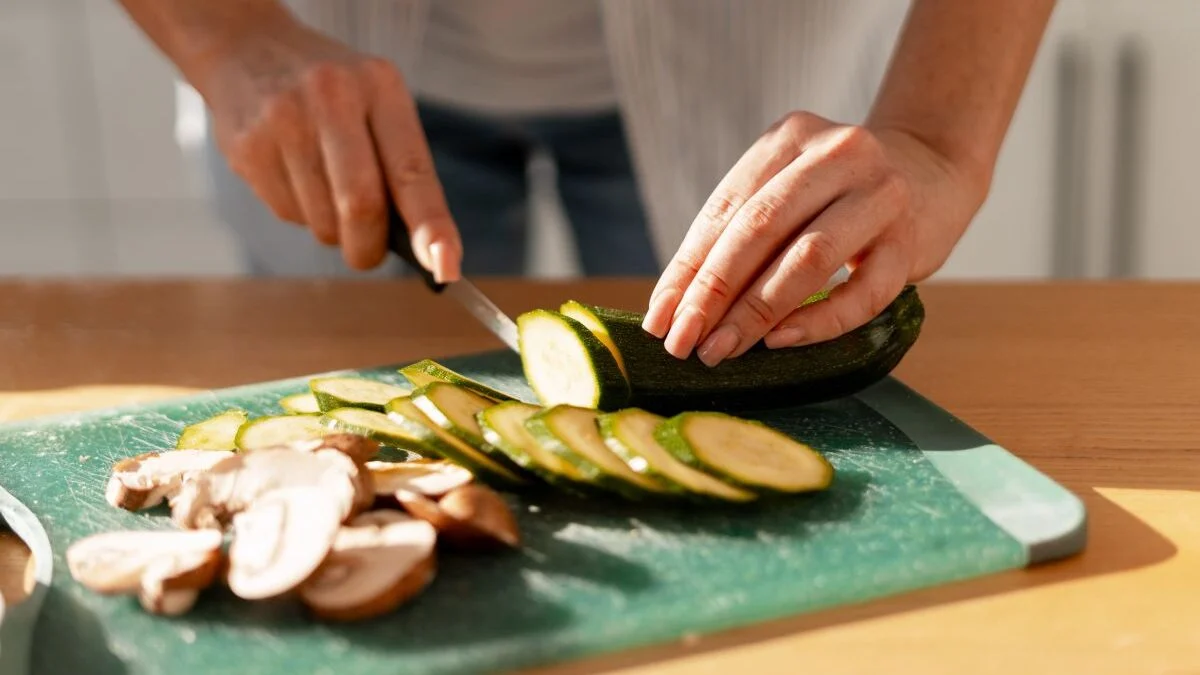
In the summer, zucchini is used in pan-fried dishes, gratins and salads. And yet, one gesture remains well anchored in cooking: removing the skin before cutting it. This reflex is not necessarily necessary, because this thin envelope concentrates an interesting part of its fibers, vitamins and antioxidants.
Keeping it also allows the zucchini to hold together better when cooked and retain more texture. There remains a question that often arises: what about pesticides and people who digest fiber poorly? In these specific cases, peeling can be useful.
Zucchini skin, nutrients concentrated on the surface
The skin of the zucchini is not just a colorful covering that is removed before serving. It concentrates a significant part of the vegetable fibers, which participate in transit, satiety and the functioning of the microbiota.
It also provides carotenoids, including lutein and beta-carotene, as well as polyphenols and antioxidants. Vitamins A and C are also well represented. Dietitian Julie Boët confirms this: “Very fine, its skin is rich in chlorophyll and lutein, an antioxidant that protects eyesight.
Zucchini also remains a low-calorie vegetable, with an interesting content of vitamin C and vitamin B6. Vitamin C being sensitive to heat, consuming it raw, for example in salad or carpaccio, helps to further preserve this micronutrient.
Systematically removing the skin therefore amounts to depriving yourself of part of these contributions. For a young zucchini, its fine and tender texture makes its removal not very useful.
Keeping the zucchini skin also changes the texture
The benefit of preserving skin is not limited to nutrition. It also helps hold the zucchini together while cooking. Its flesh, very rich in water, can quickly become soft or disintegrate when heated for a long time.
With the skin, the slices maintain more hold and offer a slightly firmer texture. Quick cooking in a pan allows you to preserve this contrast between a lightly seared surface and more tender flesh.
For people who don’t really like the skin, young zucchini is an interesting option. Their shell is particularly thin and tender, which makes it less perceptible in the mouth.
Another solution is to peel every other strip. The zucchini then retains part of its skin, its nutrients and its structure, while presenting a softer texture for palates which prefer almost entirely peeled flesh.
Pesticides, digestion, pregnancy: when to peel zucchini?
The main question concerns pesticide residues. These can be found on the surface of vegetables. Careful washing in clean water, rubbing the zucchini well, helps reduce some of these residues. Choosing an organically grown zucchini is another option for those who wish to limit their exposure.
However, washing does not necessarily remove all residue. For this reason, certain situations call for greater caution. This is particularly the case when zucchini is eaten raw by a pregnant woman: peeling can then be preferred, in addition to careful washing.
The question also arises for babies and people with fragile digestive systems. Skin rich in fiber may be less well tolerated in certain situations. For a puree intended for a toddler, peeling can also provide a smoother texture.
Finally, very bitter zucchini should not be eaten. This bitterness can signal an excessive concentration of cucurbitacins, substances naturally present in certain cucurbits and potentially toxic. In this case, it is better not to try to save the vegetable by simply removing its skin.