

The result of research carried out at the University of Nottingham and published in Nature Communicationsthis biomimetic gel reproduces the natural formation of human enamel. Researchers see this as a major advance for regenerative, gentler and more sustainable dentistry.
Dental enamel, a precious but fragile shield
Tooth enamel is the hardest substance in the human body. It covers each tooth like a thin translucent shell, protecting the most sensitive layers from thermal, mechanical and chemical attacks. But once damaged, it does not regenerate. Wear and tear linked to diet, acidity, friction from brushing or even bruxism (grinding of teeth) leads to microcracks and a progressive loss of minerals. This demineralization, often silent, exposes dentin and causes pain, sensitivity or cavities.
Until now, dentistry only offered solutions for
artificial repair : composites, fluoride varnishes, glues and fillings. Effective techniques, but incapable of restoring the natural structure and original resistance of the enamel.
A biomimetic gel that regenerates cracked enamel
This is precisely what the team of Professor Alvaro Mata and Dr Abshar Hasan, at the University of Nottingham, wanted to change. Their study, published in Nature Communicationsdescribes a
innovative protein gel capable of regenerating a layer of enamel on partially damaged teeth.
This gel, composed of proteins called elastin-like recombinamers (ELR), mimics biological processes at work during the natural development of enamel. Applied to an eroded tooth surface, it forms a thin film that attracts calcium and phosphate ions present in saliva, triggering the growth of apatite crystals aligned as in healthy enamel. The result: a hard, shiny surface structurally close to that of an intact tooth.
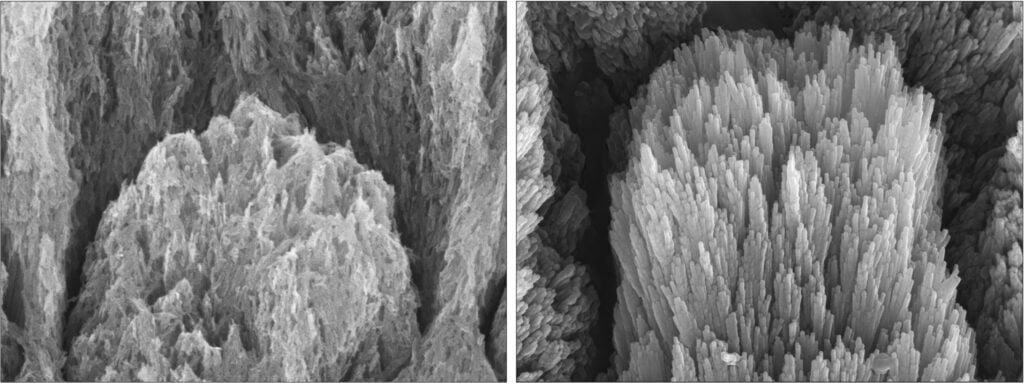 © University of Nottingham
Electron microscopy images of a tooth with demineralized enamel showing eroded apatite crystals (left) and a similar demineralized tooth after a 2-week treatment showing regenerated enamel crystals (right).
The Dr. Abshar Hasan explain :
“Dental enamel has a unique structure, which gives it remarkable properties to protect our teeth throughout life against physical, chemical and thermal attacks. When our material is applied to demineralized or eroded enamel, or exposed dentin, it promotes crystal growth in an integrated and organized manner, restoring the architecture of our natural, healthy enamel.”.
In tests conducted on extracted human teeth, researchers observed mineral regeneration visible from ten dayswith hardness and resistance comparable to those of the original enamel. The material was stable to acidity and brushing tests, confirming its clinical potential.
The professor Álvaro Mata underlines the pragmatic approach of the project:
“We are very excited because the technology was designed with the clinician and patient in mind. It is safe, easy and quick to apply, and it can be produced on a large scale.”.
Towards treatment against cavities next year?
Researchers are now considering a rapid release to market freezing, via a start-up derived from the project,
Mintech-Bio. Clinical trials on patients should begin in the coming months to confirm the effectiveness and tolerance of the product in real conditions.
According to the team’s estimates, the first dental applications could see the light of day as early as next yearinitially in the form of professional in-office care before possible adaptation for domestic use.
However, experts remain cautious: reconstructed enamel remains thinner than natural tissue for the moment, and the studies were carried out on teeth in the laboratory. But the way is open towards regenerative dentistry, less invasive and more respectful of biological tissues.
In the meantime, hygiene practices remain essential: regular brushing, limiting acidic and sugary foods, frequent dental check-ups. This gel is not intended to replace these habits, but to offer an additional solution to patients suffering from wear or sensitivity.