
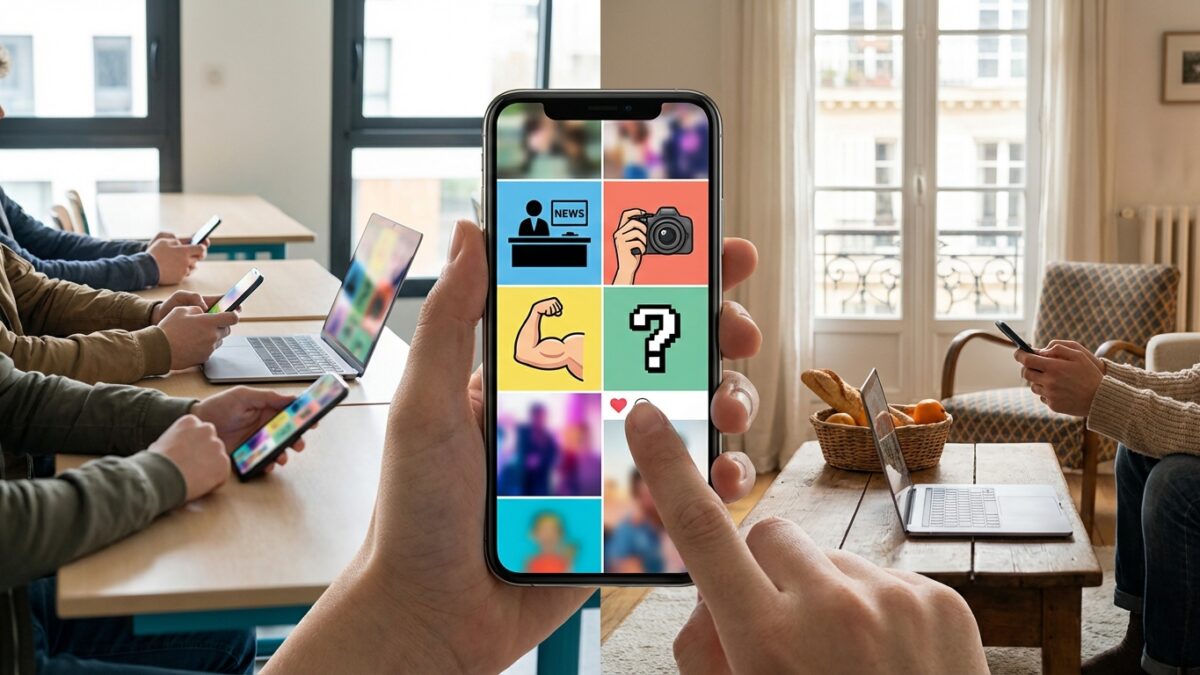
On TikTok, Instagram or YouTube, teenagers are constantly scrolling, liking and commenting. Between dance videos, beauty tips and news clips, it’s difficult to distinguish what’s true from what’s completely fabricated, especially when everything arrives in the same personalized feed. New research shows that misinformation among young people is not limited to spectacular conspiracy theories or big online scams. It also slips into everyday content, even though adolescents are convinced that they have little exposure to it. This gap between reality and perception intrigues researchers.
Teenagers and online misinformation: what the Glasgow study reveals
Psychologist Yvonne Skipper, from the University of Glasgow, conducted focus groups with 37 middle school students aged 11 to 14 to understand how they define
online disinformation. For many, fake news boils down to major international affairs or scams. Hence an impression of being quite spared. “My Instagram isn’t really like ‘this is what’s happening in the world’ or anything, it’s just life“, says an adolescent in this study.
An Ofcom report cited by the researcher, however, recalled that only 11% of 11 to 17 year olds in the United Kingdom can reliably recognize the signs of an authentic post. Despite this, some say they are very sure of themselves: “I’m not stupid enough to believe it“, as one of them puts it. Many explain that they do not verify the information, trusting their intuition – “You see it, you know” – or to the comments under the posts. They also judge their grandparents to be particularly vulnerable, while “Parents see this as fake news, so they don’t believe it and they don’t need to worry about it“, estimates another. Intervening themselves seems risky or useless to them; they rather wait for the State to act,”because they are aware of the ongoing wars“, although some fear that if the government goes too far, “there would be protests”, because this would be seen as censorship.
An environment saturated with false information that young people do not see
The figures collected by Science Feedback as part of the SIMODS project, between March and April 2025, tell a different story. Nearly one in five pieces of content posted on TikTok contains false or misleading information. The proportion reaches around 13% on Facebook, 11% on X, and 8% on YouTube and Instagram, compared to only 2% on LinkedIn. Including abusive content bordering on disinformation, TikTok and
The study also shows that accounts that regularly spread disinformation generate much more engagement than reliable sources, up to seven or eight times more interactions on Facebook and YouTube, and five times more views on Instagram and X. On YouTube, 76% of channels deemed less credible remain eligible for monetization. Algorithms, designed to retain attention, therefore highlight the most viral content, even misleading content. When a teen feels like their feed is “just life,” they’re actually navigating a space where fake news has a real visibility premium.
Strengthening the critical thinking of young people in the face of fake news
The work of LaPsyDÉ (Child Development and Educational Psychology Laboratory), carried out with 432 adolescents aged 11 to 14, sheds light on this discrepancy. The researchers presented them with 56 news stories formatted like social media posts, half real, half fake news, asking them to estimate their accuracy. The older the students are, the better they are at spotting false information; at 11, they do little better than chance. A cognitive reflection test* shows that those who best resist intuitive responses are also those who best distinguish truth from falsehood. In other words, thecritical thinking about misinformation on social media depends in part on the ability to slow down and reason.
There remains one trap that no one really avoids: repetition. “Familiar information, seen twice, is perceived as more true than that newly presented to participants“, indicates Marine Lemaire, doctoral student in psychology at LaPsyDÉ and first author of the study. “The more we see information, the more we tend to believe that it is true. It’s a very robust bias, detected from the age of 5.”. To answer this, his team co-constructed with teachers, on the Lea.fr platform, sessions explaining cognitive biases and the functioning of our brain in the face of news, tested in more than 100 classes, or more than 3,000 middle school students. The first results suggest better detection of fake news than in traditional media education, even if the effect seems to fade over time. Grégoire Borst, director of LaPsyDÉ and co-author of the study, summarizes the issue: “The real difficulty is to develop critical thinking in adolescents, while preventing them from starting to doubt all the information.”.