
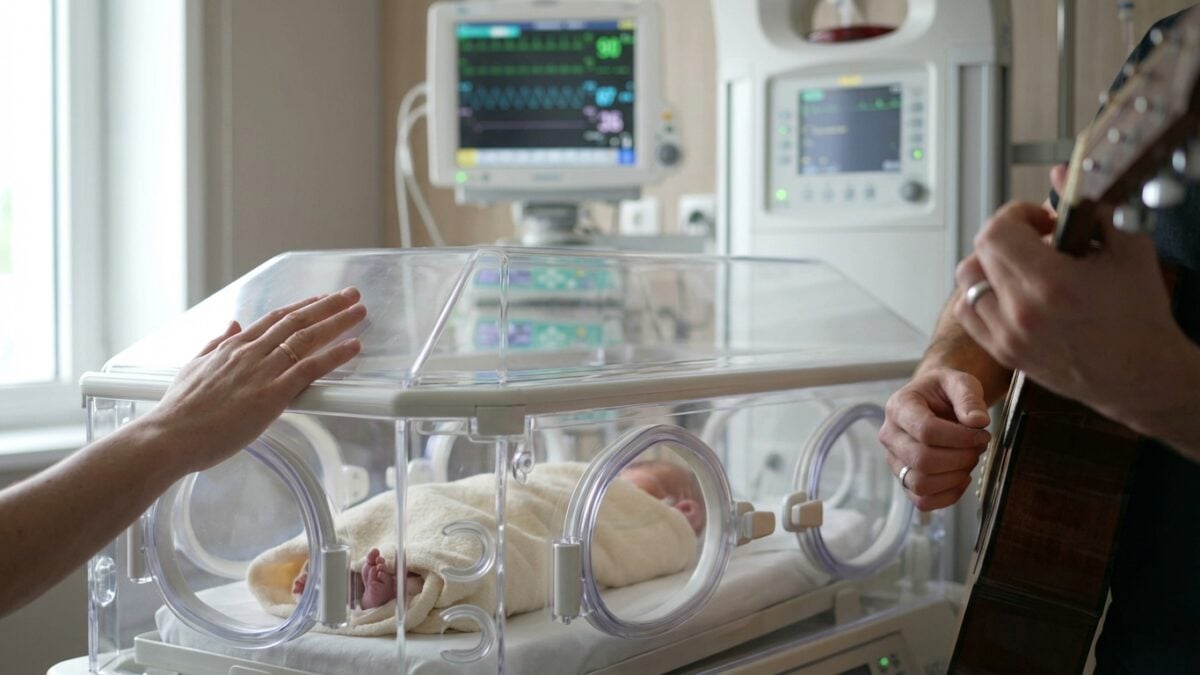
In a neonatal intensive care unit, the beeps of the machines usually punctuate the days. Then a guitar is heard, a voice whispers a lullaby, and on the monitor the heart rate of a premature baby stabilizes. For some parents, this is the first time they have seen their child calm without medical intervention.
In the United Kingdom, the charity Music in Hospitals & Care has already offered more than 90 hours of live music in 2025 in NICUs, to more than 1,000 seriously ill babies. Its “Lullaby Hour” sessions are part of a broader movement: that of music therapy for premature babies, where the lullaby becomes a treatment in its own right, alongside respirators and infusions. What happens when medicine leaves room for melody at the bedside of the most fragile?
Lullabies in intensive care: an ancestral gesture that enters the hospital
Ethnomusicologists have shown that all cultures have invented lullabies to welcome the newborn. A meta-analysis from the University of Auckland, compiling 21 studies on parental singing, indicates that infants exposed to these songs regulate their emotions better, can relax, pay attention, feel happy or prepare for sleep. The authors summarize: “Ultimately, lullabies sung by parents communicate social and emotional information that teaches infants about themselves, their families, and the world around them.“, they write.
In the NICU, this ritual takes a very concrete turn. Since 2017, Lullaby Hour musicians have traveled between incubators with a booklet of songs that parents choose. “One couple, who were pregnant on their wedding day, told me that the song for their first dance was ‘The Book of Love’ (by the Magnetic Fields). So, they asked me to learn it because they were kind of threesome dancing that day, and they wanted it as their special threesome song now“, tells singer and guitarist Mica Bernard to The BMJ. For Vicky Daborn Tedder, head of impact within the organization, “we really see that music makes such a difference, and it becomes a necessity, not just an amenity“, she confides to The BMJ.
What music changes in the bodies and brains of premature babies
Several studies carried out in neonatal intensive care have observed, in premature babies exposed to musical interventions, a drop in heart and respiratory rate as well as an increase in feeding volumes. “When I sing to the baby, I can literally see their heart rate calm down or their oxygen increase. I think it shows how integrated music is into human beings“, describes Mica Bernard to The BMJ. Research cited in The BMJ point out that babies often fall asleep, or stay asleep, during these times, including during unpleasant care such as diaper changes.
The studies do not stop at vital constants. European teams used MRI to compare premature babies exposed to music in the NICU to those who were not. They report more advanced maturation of white matter in the auditory pathways and socio-emotional brain networks closer to those of full-term newborns. In 2019, a team found, at 12 and 24 months, what were considered promising effects of music therapy in the NICU on the emotional development of children. Recent meta-analyses distinguish background music (“music medicine”) from structured music therapy led by a professional, the latter showing clearer effects. Other summaries, published between 2021 and 2023, however speak of mixed results, due to the great diversity of the protocols studied.
When lullabies also soothe parents in intensive care
For families, music is not just another clinical parameter. “Having a baby in a neonatal intensive care unit is a difficult and traumatic time for babies and their families, so being able to provide some quiet time through Lullaby Hour is something we are extremely proud of. These music sessions not only help parents bond with their baby, but also provide a moment of respite from an uncertain and stressful situation. The feedback from families and the clinical team here has been unanimously positive.“, testifies neonatologist Jay Banerjee to
The BMJ. For parents who cannot hold their child, singing sometimes becomes the only way to create this bond.
Studies from the University of Auckland show that mothers who sing to their babies gain confidence, see improvements in their well-being and self-esteem, with reduced signs of depression, stress and anxiety. On the ground, Mica Bernard observes the same thing: “Often, if it’s the first time I’m singing for a parent, it’s the perfect way for them to cry. Sometimes, when a traumatic situation arises, it can be really difficult to let go of those emotions, so much so that I often feel like I’m walking into a room where there’s so much tension, with parents trying to be strong for their baby. Music helps them reconnect with what they feel,” she explains. Gail Scott-Spicer, chief executive of Imperial Health Charity, sums up the impact on the service: “The environment of a neonatal intensive care unit is, of course, quite overwhelming. It is intense – not only the situation parents and babies find themselves in, but also the environment. There are a lot of machines, it can be quite noisy, and I know the services work really hard to keep noise levels down, but ultimately it’s a very clinical environment. Being able to bring some ‘normalcy’ to this situation begins to explain the truly positive health outcomes for babies, and it reduces stress and anxiety for families“, she confides to The BMJ. Singing softly, even at the foot of an incubator, then becomes a gesture of care shared between medicine and melody.