
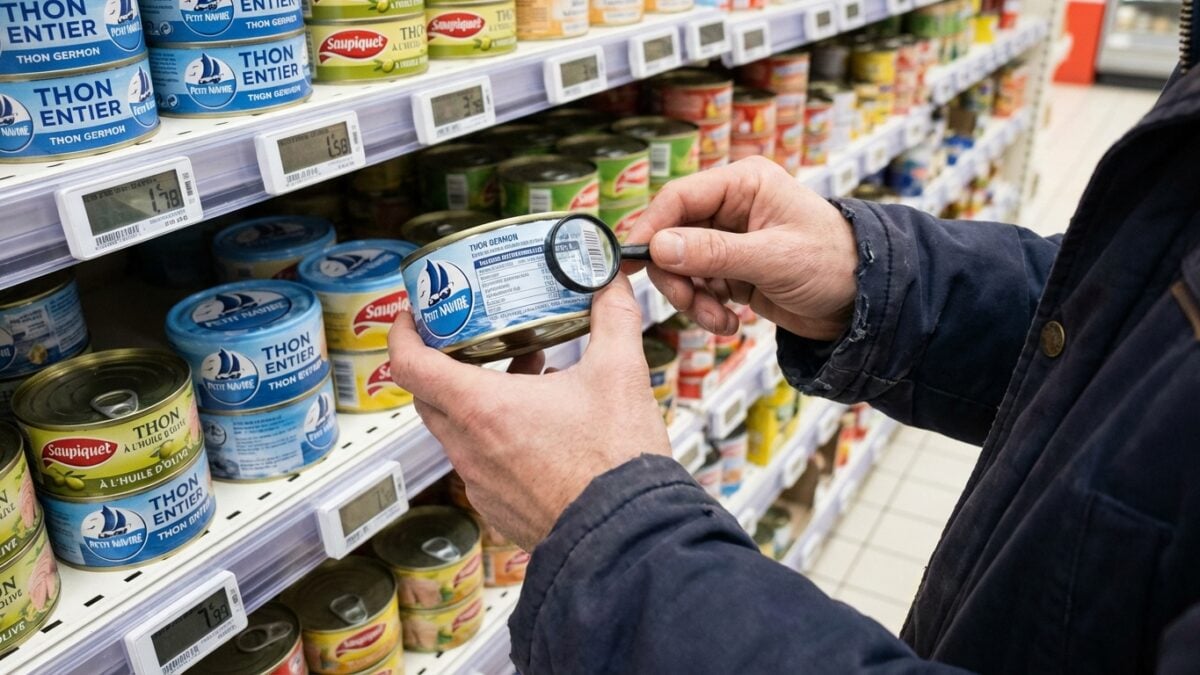
In your cupboard, a simple can of tuna can hide much more than proteins: a survey by the NGO Bloom and Foodwatch on 148 cans in Europe found mercury in each of them, with a record of 3.9 mg/kg, very far from the expected values. Something to worry about for anyone who opens tuna several times a week.
A nutritionist, Blanca García, does not recommend banning this practical product, but choosing it better. It relies on a very simple trick, based on the exact variety of tuna indicated on the label, which makes it possible to limit exposure to
heavy metals without giving up the box that helps.
Why canned tuna concentrates mercury
Mercury transforms in water into a toxic form which concentrates along the food chain. “As you move up the food chain, more mercury accumulates. This is why we always recommend eating more small-sized oily fish.“, explained nutritionist Rocío Maraver. Tuna, a large predator, arrives at the very top of this chain.
The regulatory framework remains permissive for this fish: the legal limit of mercury is 1 mg/kg for tuna, compared to 0.3 mg/kg for most other species. The Bloom study showed that 57% of the 148 boxes exceeded 0.3 mg/kg and around one in ten went above 1 mg/kg. Each serving also provides almost 1.5 g of salt per 100 g of tuna, a point to keep in mind.
Skipjack tuna, yellowfin tuna, albacore: variety makes the difference
Not all tuna is equal. Analyzes show that skipjack tuna, also called bonito or skipjack, smaller and short-lived, is around 0.2 mg/kg of mercury, while yellowfin tuna or white tuna (albacore), larger and older, often display values two to three times higher. For regular consumers, this choice weighs heavily on the cumulative dose.
Nutritionist Blanca García recalls that the boxes always contain mercury, even if they are controlled. She sums up her advice this way: “At the supermarket, choose cans of tuna that bear the name tuna and not light tuna, it is the species that contains the fewest heavy metals and, in this sense, the healthiest for tuna lovers in this form of food“, advised Blanca García, cited by Men’s Health Spain. In France, this amounts to looking for the mention skipjack tuna rather than yellowfin tuna or white tuna.
How to apply the trick and limit tuna in practice
In the canned goods section, the key reflex therefore remains to identify the species: favor skipjack tuna and vary with other small fatty fish such as sardines or mackerel. Health authorities urge us to limit large predators.
Taking into account the nutritional benefits linked to the consumption of fish, such as essential fatty acids, proteins, vitamins, minerals and trace elements, ANSES advises eating fish twice a week, combining an oily fish rich in omega-3 fatty acids (such as salmon, sardine, mackerel or herring) with another type of fish (such as hake, hake, cod or sole) and varying the species of fish consumed as well. as the sources of supply (wild fishing, breeding, different fishing grounds, etc.).
For pregnant women, those who are breastfeeding, and young children (under 3 years old), the Agency recommends specific precautions:
- Reduce the consumption of wild predatory fish, which can be heavily contaminated, such as tuna, bonito, skate, sea bream, sea bass, monkfish, emperor, grenadier, halibut, scabbardfish and pike;
- Avoid consuming the most contaminated “large predatory” fish, such as sharks, lampreys, swordfish, marlins (close to swordfish) and sikis (a variety of shark).