
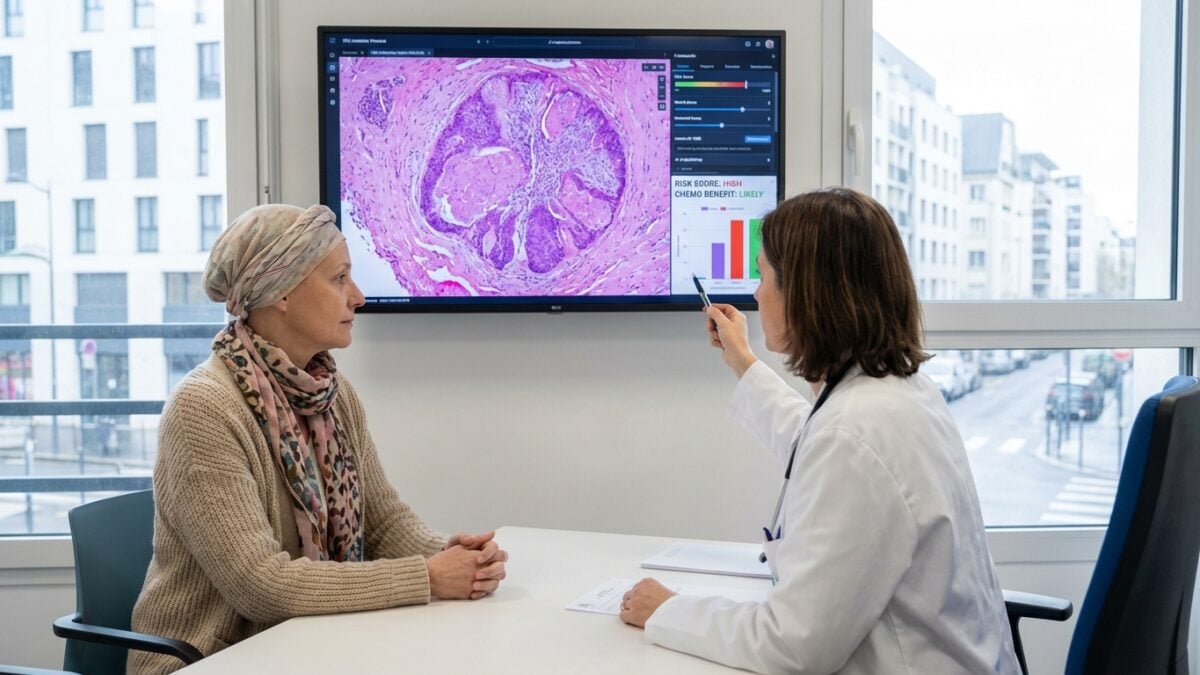
Whether or not to receive chemotherapy after surgery breast cancer remains one of the most delicate questions for doctors. In HER2 negative hormone-dependent forms, which represent approximately 70% of the 2.3 million annual cases worldwide, many patients are treated without any real benefit, while others may miss out on useful treatment.
To refine this decision, genomic tests like
Oncotype DX already exist, but they cost nearly $3,500 (around €3,200) per analysis, require several days and remain inaccessible in many countries. A team from Technion – Israel Institute of Technology now offers an artificial intelligence model capable of changing the game.
Why predicting the benefit of chemotherapy is so difficult
The therapeutic decision is based on the size and grade of the tumor, lymph node involvement, hormonal receptors and HER2 status, sometimes supplemented by genomic signatures such as Oncotype DX. The goal is to estimate the risk of recurrence to know for whom chemotherapy will really benefit.
But these tests remain reserved for a minority: their cost, reimbursement procedures and the delivery of samples hinder their use, especially outside rich countries. The authors of the study published in The Lancet Oncology point out that Oncotype DX costs around $3,500 (nearly €3,200), while a simple slide scan costs less than a dollar (around €1).
How an AI reads slides to predict the benefit of chemo
The Technion model analyzes pathology slides stained with hematoxylin-eosin, already made for diagnosis, which are digitized and then passed through a deep learning algorithm. This identifies patterns in the tumor and its immediate environment. These biological signals are complex and cannot be reliably quantified by the human eye. The model takes into account many subtle cues to produce a score from 0 to 100 reflecting the risk of recurrence and expected gain with chemotherapy.
“Instead of testing genes, we look directly at the tissue. In the same way that eye color can be determined by looking at the eyes rather than analyzing DNA, our system extracts a visual signature from pathology images that informs optimal treatment“, indicated Professor Ron Kimmel, quoted by MedicalXpress.
To evaluate this tool, researchers used data from the randomized trial TAILORxwhich followed 10,273 patients; 8,284 were retained for analysis. The scores provided by the AI were close to those of Oncotype DX and identified most tumors at high genomic risk. “Using data from a randomized trial allowed us to verify that the model actually predicts the benefit of chemotherapy, and not just the risk of recurrence.“, explained Dr. Gil Shamai, from the Geometric Image Processing Laboratory at the Technion.
Towards less unnecessary chemotherapy
According to the researchers, this score could help avoid unnecessary chemotherapy for many low-risk patients, particularly those in postmenopause, while identifying some younger women who are not receiving enough treatment. It is the first artificial intelligence model capable of predicting the benefits of breast cancer treatment based directly on pathology samples. This model has been validated on thousands of patients in hospitals located in Israel, the United States and Australia, including Carmel, Emek and Sheba Medical Centers, showing consistent performance across diverse populations, equipment and health systems.
This still “black box” algorithm must be validated prospectively in trials planned in Brazil and India, before wider use. But it a priori presents several advantages compared to the tests currently available. Unlike genomic tests, artificial intelligence analysis does not require additional tissue samples, laboratory processing or waiting time. It can be performed in a few minutes in any pathology laboratory with a digital scanner and an Internet connection. This accessibility would make personalized care possible in developing countries, and potentially significant savings and a shortening of the time for therapeutic decisions in developed countries.