
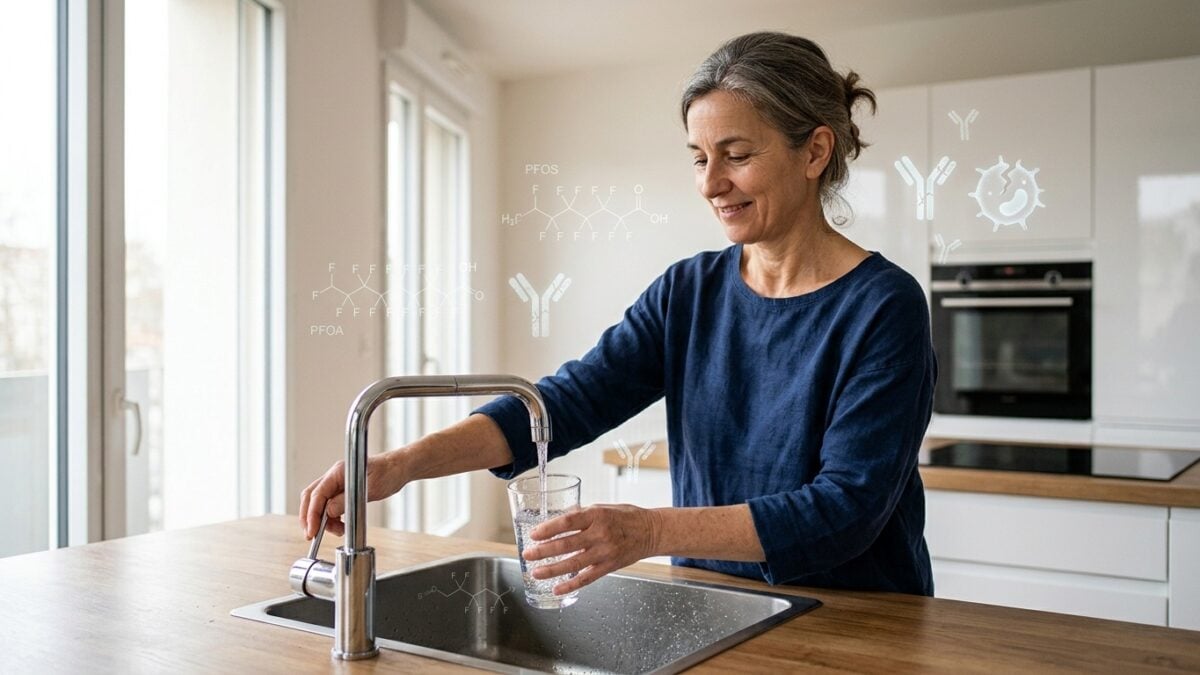
In the United States, a Michigan mother discovered that her son’s vaccines did not work as expected after years of drinking water contaminated with PFAS. His story today intersects with a new scientific study which focuses on a very concrete subject: can exposure to these “eternal pollutants” weaken our immune defenses against viruses?
PFAS, used in non-stick pans, stain-resistant textiles or fire-fighting foams, degrade very little and accumulate in the body. It is found in drinking water, in the United States and in Europe. A team from Michigan State University has just published in Environmental Research
results which directly question the quality of tap water and the strength of our immune system.
PFAS and vaccines: what the Michigan State University study shows
Researchers followed 74 adults fully vaccinated against COVID-19 between one and six months before a blood test, all from a Michigan town supplied with previously highly contaminated water (around 1,600 ng/L PFAS). They measured nine PFAS in serum, including PFHxScapable of remaining in the body for almost ten years, and the levels of IgG antibodies directed against the Spike protein of the virus.
Result: the higher the blood level of PFAS, the lower the quantity of anti-Spike antibodies. For PFHxS, the most exposed people had on average about 40% fewer antibodies than those in the least exposed group. Negative associations were also observed for PFOS, PFHpS and the sum of nine PFAS, with stronger effects in older adults, men and overweight people.
“Antibodies act like little soldiers, helping the body recognize and fight viruses“, explained Courtney Carignan, an environmental health researcher at Michigan State University and lead author of the study. “These findings raise important concerns about how prolonged exposure to PFAS reduces the body’s ability to fight infections, even in adulthood” said Courtney Carignan.
“Eternal pollutants” in drinking water, from the United States to France
For several years, work in children had already linked PFAS to a weaker response to vaccines against tetanus, diphtheria or measles. The new study provides an additional piece in adults, in real conditions of water contamination. For some families, the impact is already very concrete. “When you discover that your family has been exposed, everything changes, especially the way you think about the health of your children“, said Tobyn McNaughton, mother of Belmont, Michigan. “We are poisoned. We learned that some vaccines given to my son during his childhood were not fully effective due to his weakened immune system, and this is something no parent expects“.
In France, investigations are increasing into PFAS in tap water. A Radio France / France Bleu investigation found these compounds in 43% of 89 samples. A study by UFC-Que Choisir and Générations Futures detected PFAS in 96% of the samples analyzed, with very high concentrations of certain derivatives such as TFA. European directive 2020/2184 now sets a threshold of 0.1 µg/L for the sum of 20 PFAS in drinking water, which France must systematically monitor via the Regional Health Agencies from 2026.
Protecting water to protect the immune system
Official reports already mention immune system disorders and reduced effectiveness of certain vaccines among the possible effects of PFAS. The Michigan State University study numerically shows that a mixture of PFAS linked to drinking water can be accompanied by lower antibody levels after vaccination against COVID-19. Enough to bring the question of water quality standards closer to that of the quality of our immune response.
In Europe and France, the new limits and reinforced surveillance mark a step, but researchers insist on the challenge of decontamination. “Exposure to PFAS is widespread, but it’s also preventable,” recalled Courtney Carignan.Reducing levels in drinking water is one of the most effective ways to reduce exposure and protect public health.”.