
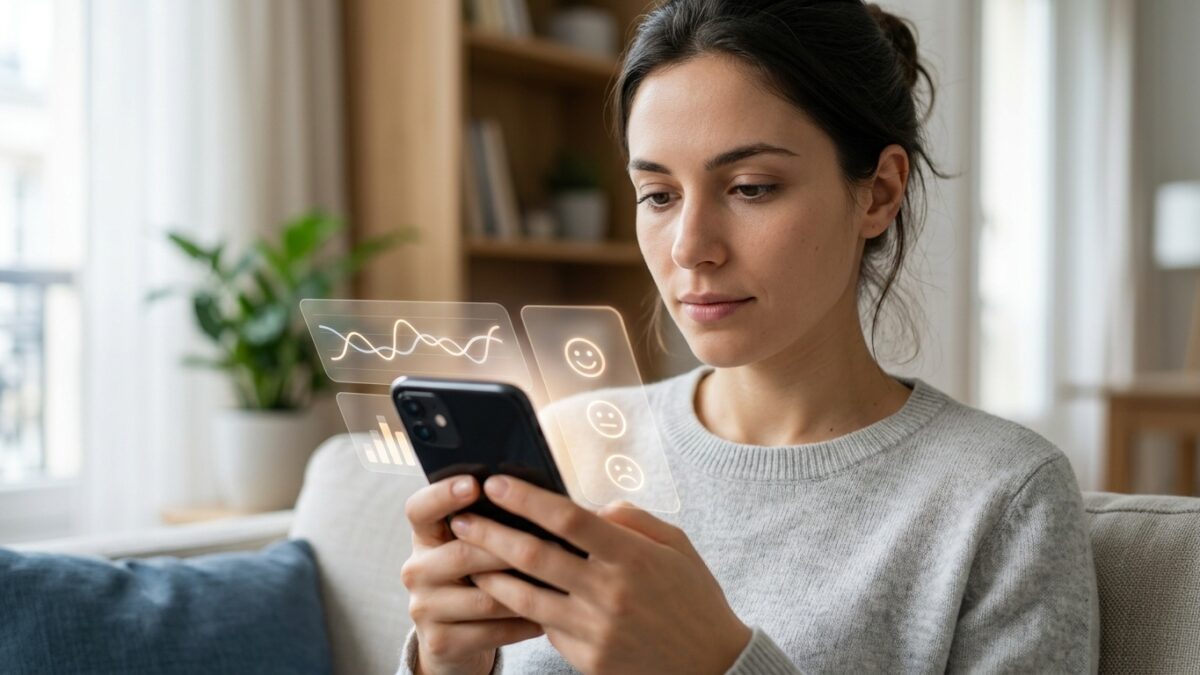
Your smartphone already knows what time you go to bed, how much you walk during the day and when you stay stuck at home for several days in a row. Sometimes linked to a watch or a bracelet, it tracks your restless nights, your heartbeat, your bouts of fatigue. This data seemed especially useful for sport or sleep.
However, a team from Ghent University shows that they could be used to spot signs of
depressiona disorder that affects about 1 in 20 people worldwide. In an article published in the journal
Nature Mental Healthresearchers screened 52 studies using phones and connected objects to track the evolution of depressive symptoms. Enough to transform a simple telephone into a discreet radar of emerging unease.
When early detection of depression involves the telephone
The authors summarize their objective in one sentence: “Early detection of changes in depressive symptoms is vital for timely interventions“, write Yannick Vander Zwalmen and Matthias Maerevoet. “Mobile and wearable technologies enable continuous and unobtrusive monitoring of behavioral, psychological and physiological data, providing new possibilities for digital phenotyping and just-in-time prediction of depression. This scoping review synthesized findings from 52 studies to identify commonly used characteristics, assess their predictive value, and examine methodological approaches“, they detail in Nature Mental Health.
Concretely, the work examined uses information already present on numerous devices: location (time spent at home or on the move), sleep
(duration, regularity), physical activityfrequency of calls and messages, but also heart rate variability and questionnairesmood
completed on mobile. The idea is not to read your conversations, but to observe how your rhythms of life change over the days.
Irregular sleep, reduced mobility: the weak signals your mobile sees
The researchers note that “Characteristics like time spent at home, sleep variability, and reduced mobility were strongly associated with depressive symptoms“, write the authors. “Combining physiological, behavioral and self-report data improved predictive performance. Personalized models and anomaly detection approaches outperformed generalized models in predicting individual symptom changes“. In other words, a phone that suddenly sees your nights are disrupted and your movements drop may see this as a warning signal.
The studies reviewed often find the same combination in people in a depressive phase: very irregular sleep, reduced movement, almost no physical activity and mood self-reported as poor in the applications. The most effective models compare each person to themselves rather than to an average: the important thing is not to take 10,000 steps, but to spot a break from your usual pace.
Towards apps that warn at the right time, without replacing caregivers
Ultimately, the review concludes that “data from mobile and wearable devices shows strong potential for just-in-time prediction of depression“, write Yannick Vander Zwalmen, Matthias Maerevoet and their colleagues. “Future research should focus on novel features, diverse populations, and personalized models to improve accuracy and real-world applicability“. The authors imagine tools capable of sending resources or contact details for mental health services at the right time.
Prototypes already go further, such as experimental applications that analyze selfies or voice to track mood or prevent relapse. For the moment, these systems remain possible complements: they do not provide any diagnosis on their own, but they can help identify changes in
sleepofactivity ormood which healthcare professionals can then assess.