
A frozen body waiting for a better future, that sounds like a movie scenario. Cryonics, supported by a few companies in the United States and Russia, is already selling the idea of preserving human bodies at very low temperatures in the hope of a later resurrection. The reality in laboratories has, until now, progressed much more slowly.
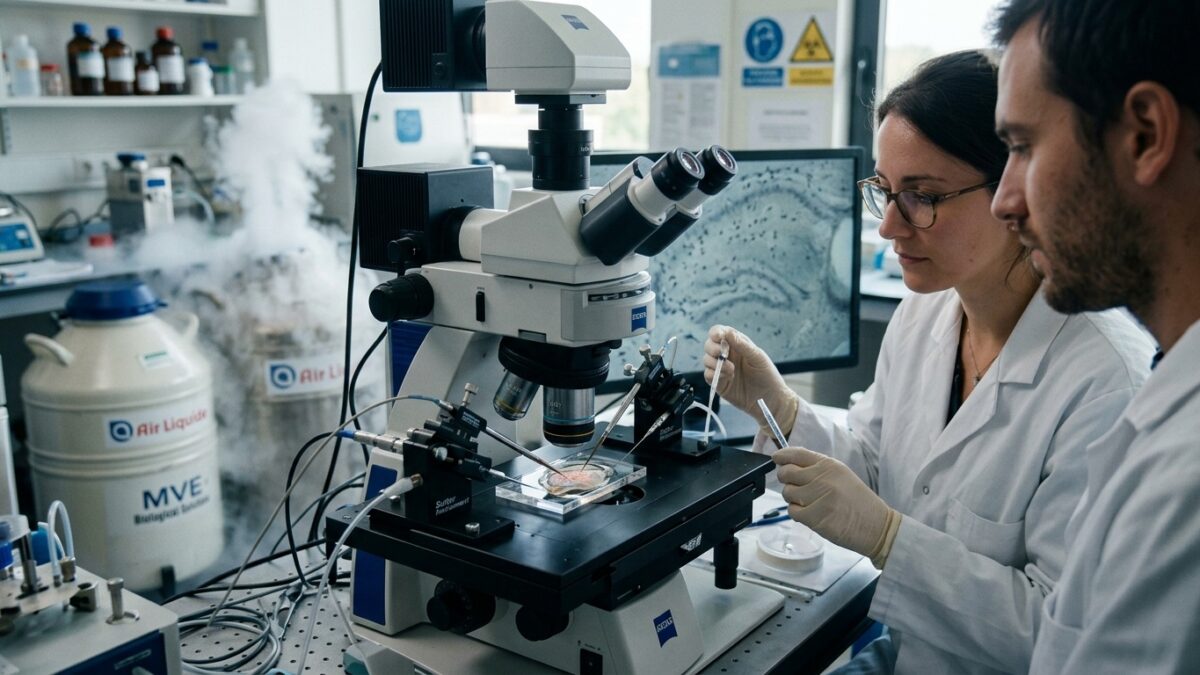
A team from the Friedrich-Alexander University of Erlangen-Nuremberg has just reached a milestone described in the journal Proceedings of the National Academy of Sciences : restart the activity of brain tissue from a mouse brain frozen at -196°C after vitrification. At the heart of the experience, a small piece of seahorse which, once warmed, began to function again.
A frozen mouse brain that turns back on, what exactly is it?
The researchers did not resuscitate a whole mouse but worked on thin slices of the hippocampus, a key region for memory and orientation. These slices were immersed in liquid nitrogen at -196°C, in the presence of a cocktail of protective substances, to pass into a state known as vitrification: the water no longer forms ice, it becomes an amorphous solid, a bit like glass, which prevents crystals from tearing the neurons.
Once warmed up, the neurons began sending electrical signals and communicating with each other again. “However, we have optimized the composition of the preservatives and the cooling process so that the nervous tissue remains intact.“, explains Alexander German, one of the authors of the study. Better yet, the researchers observed long-term potentiation, a sign of brain plasticity: “after thawing, electrical signals spontaneously reformed in the hippocampus and propagated normally through neuronal networks“.
A dizzying step, but very far from a human resurrection
This result remains a proof of concept carried out on fragments a few hundred micrometers thick, not on a complete organ. The lifespan of these tissues after awakening remains limited and not all tests give the same success. Above all, there is no indication that a personal memory, identity or consciousness can be preserved and then restored from such tissue.
Between these pieces of mouse hippocampus and an entire human brain, the gap is immense. We would have to succeed in diffusing cryoprotectants in a much larger volume, without toxicity, and control the cooling and warming rates down to the millimeter. The commercial promises of cryonics, with bodies or heads preserved in liquid nitrogen, therefore remain disconnected for the moment from what this experiment shows.
From the laboratory to the operating theaters, what this advance could change
The medical applications envisaged are much closer than “immortality”: functional cryopreservation of entire organs would make it possible to create real graft banks. Today, the time between collection and transplantation is very short, which complicates compatibility between donors and recipients. Extending these deadlines would transform the organization of transplants.
In neuroscience, being able to keep human brain tissue taken during interventions for a long time would open up a new field of study for epilepsy or neurodegenerative diseases. The next step, according to the researchers, will be to apply this strategy to thicker tissues, or even to entire brains of small mammals. For now, it’s a thin fragment of frozen mouse brain that tells this puzzling scientific story.