
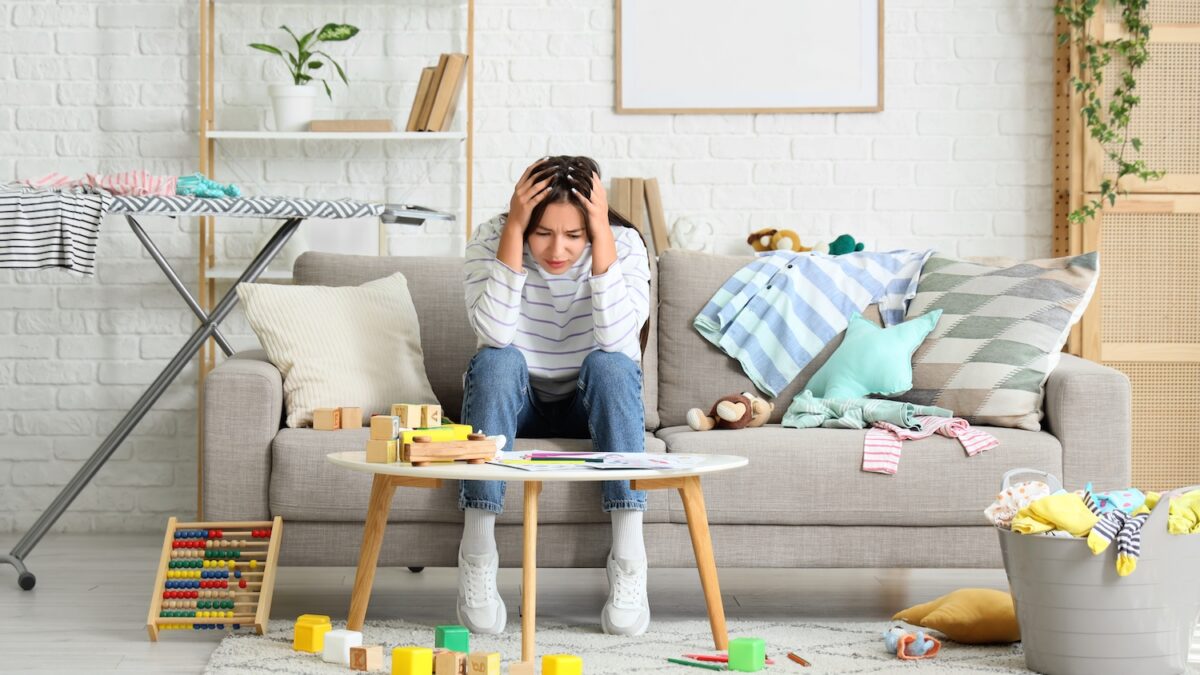
According to a survey conducted by YouGov for Wecasa among more than 1,000 French people, the organization of housing profoundly influences mental well-being. But this domestic pressure, often invisible, turns out to be far from being equitably shared.
A refuge that is cracking: when home becomes a source of tension
In the collective imagination, the home remains a sanctuary. A place where we retreat, where we find ourselves. The study confirms this:
35% of French people describe it as “a space of protection and withdrawal”while 34% see it as a place of sharing and reunion .
But behind this reassuring image, another reality emerges, more nuanced, almost paradoxical. Because housing is no longer content to provide shelter: it requires. Organization, maintenance, anticipation… so many responsibilities that accumulate and weigh on daily life.
The figures are clear: 79% of French people say that the state of their housing impacts their mental workload, and 83% their ability to relax. A gradual intrusion of stress into the intimate, where it was previously kept at bay.
This tension varies according to life paths. The youngest, in particular, seem particularly exposed: 84% of students say that the order of accommodation impacts their mental loadagainst 71% of retirees . Among 18-24 year olds, the home remains permeated with reminders related to work or studies, a sign of a space that is struggling to fully become a place of rest again.
Thus, the home becomes ambivalent. Protective in appearance, demanding in reality. And it is precisely in this ambivalence that deep inequalities emerge.
Women on the front line: domestic mental burden, persistent inequality
If home weighs on everyone, it does not weigh in the same way. The study highlights a striking imbalance: nearly one in two women say their housing has a strong impact on their mental workload, compared to 26% of men .
A gap which is not a matter of chance, but of a still largely gendered organization of everyday life.
Beyond the numbers, a different experience of home is emerging. Women appear more involved in domestic tasks, both as a place of refuge and as a source of constraints. Visual clutter, for example, affects their well-being more (37% versus 28% among men), just like the lack of time for oneself (31% versus 26%) .
Behind these data, a more diffuse but essential reality: the mental load is not limited to visible tasks. It also encompasses the anticipation, organization, and invisible planning of daily life.
As Antoine Chatelain, co-founder of Wecasa, points out:
“The study shows that the question of home remains closely linked to the organization of daily life. Despite changes in lifestyles, household management still largely falls on women. This charge is not limited to visible tasks: it also includes everything related to anticipation and organization..
A silent mechanism, often imperceptible, but deeply exhausting. And this pressure, already unequal, intensifies further at a key moment in life: that of parenthood.
When the family grows, the pressure builds
The arrival of a child transforms the home. It is no longer just a place to live, but a real logistics center where tasks, unforeseen events and decisions come together.
The numbers reflect this shift: 44% of parents say that the mental burden linked to their housing degrades their well-being, compared to 32% in households without children .
Between the ages of 25 and 44 — a pivotal period when professional life and family responsibilities combine — the pressure reaches its peak, with up to 46% of respondents reporting high mental workload .
In these homes, disorder becomes more difficult to contain, and the sources of discomfort are often immaterial: mental load and lack of time for oneself alone account for 64% of sources of discomfort .
And, once again, women are on the front lines. Already more exposed, they see this pressure intensify with the daily coordination imposed by family life, having less time for themselves (31% versus 26%) .
The home then becomes a space under tension. Not because of what he is, but because of all that he requires.
Rethinking the home: a silent emergency
This study does not only tell a statistical reality. It highlights a profound transformation in our relationship with the intimate. The home, once an uncontested refuge, becomes a space to reinvent.
Faced with this pressure, some aspire to concrete solutions: 24% of French people prefer a “liberated home”, designed to make everyday life easier . A way of restoring the home to its primary function: that of a place where we breathe.
But beyond material arrangements, collective reflection is required. On the distribution of tasks, on the recognition of the mental load, on the place given to time for oneself. Because behind these numbers, there are lives. Invisible fatigue. And a question, implicitly: how to make home a real refuge, for everyone?