
In the
pancreatic cancermore than 85% of patients are diagnosed at an already metastatic stage and five-year survival remains below 15%, according to the National Cancer Institute cited by the Mayo Clinic. Projections make it the second leading cause of cancer death in the United States by 2030. In this gloomy context, American researchers show that a model ofartificial intelligence applied to simple abdominal scans can identify the disease up to three years before diagnosis, on images that are nevertheless described as normal.
Mayo Clinic’s REDMOD AI deciphers an apparently “normal” pancreas
“The biggest obstacle to saving lives from pancreatic cancer has been our inability to see the disease when it is still curable“, explains Dr. Ajit Goenka, radiologist at the Mayo Clinic, in the Mayo Clinic press release. And to overcome this obstacle, the researchers developed an artificial intelligence model. This system, called
REDMOD for Radiomics-based Early Detection Model, automatically analyzes the texture of the pancreas on scans taken for other reasons and assigns a risk score, well before a mass is visible.
REDMOD evaluates hundreds of quantitative imaging parameters that describe tissue texture and structure, allowing the detection of slight biological changes in the early stages of cancer. This model is designed to review CT scans already performed for other reasons, particularly in high-risk patients, such as those recently diagnosed with diabetes, to identify increased risk even before a mass is visible.
 © gut / BMJ
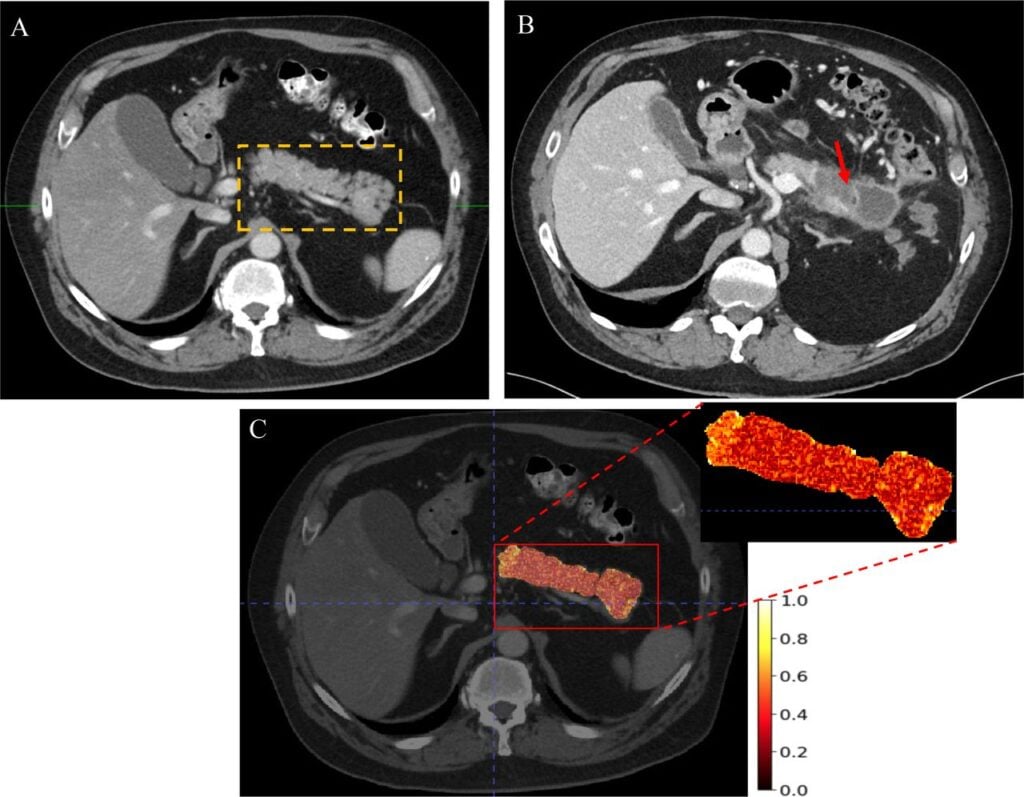
Identification of occult radiomic signatures by REDMOD on a pre-diagnostic CT scan performed 2.4 years before clinical diagnosis.
The researchers applied this AI model to examine approximately 2,000 scans, including those of patients later diagnosed with pancreatic cancer. Initially, these scans were considered normal. Thanks to this system, 73% of cancers were detected at an early stage, on average 16 months before official diagnosis, almost double the detection rate achieved by specialists without the help of AI (39%). This advantage is even more significant at early stages. For exams performed more than two years before diagnosis, AI was able to identify nearly three times as many early cancers that would have otherwise been missed.
The model works autonomously, without requiring complex manual preparation. Where the human eye sees a homogeneous organ, the algorithm detects a discrete “signature” of stage 0 pancreatic ductal carcinoma. The model’s predictions remained stable over time. In patients who underwent multiple exams, AI produced consistent results several months apart, confirming its utility for longitudinal monitoring and early detection.
AI could detect pancreatic cancer up to 3 years before diagnosis
The model doesn’t just catch tumors “a little earlier.” On a median, REDMOD detects the signature of the disease 475 days before diagnosis, or around 16 months, and in a quarter of cases up to almost three years, according to the authors of Gut.
“This time window is of profound significance, as achieving such early detection would significantly increase the likelihood of cure and improved survival.“, emphasize the authors in the article.
In scans taken more than two years before diagnosis, the team reports that REDMOD detected 68% of cancers, compared to 23% for radiologists. The model’s performance remained stable on repeated scans in the same patients and on external databases, with specificity above 80%, according to the British Medical Journal.
Towards a change for patients at risk of pancreatic cancer
For the moment, researchers are not aiming for widespread screening of the population. REDMOD is intended as a triage tool in high-risk patients, for example those with new-onset diabetes associated with unexplained weight loss, where the risk of pancreatic ductal carcinoma at three years is significantly higher than in the general population, according to work cited by the Mayo Clinic. A prospective trial, AI-PACED, is now to test this approach in clinical practice.