
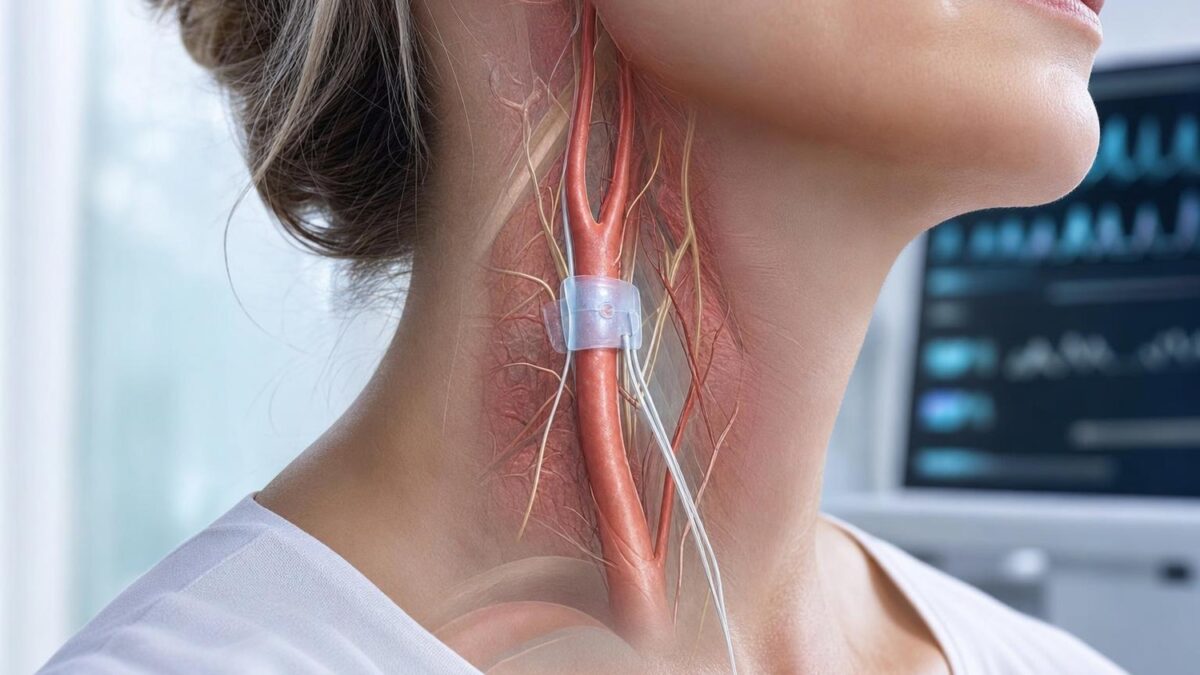
Faced with resistant hypertension, Penn State engineers are banking on CaroFlex, a flexible implant glued to the carotid sinus. This tiny electrical patch on the artery could shake up treatment, if it confirms its promises beyond the first animal tests.
A lead for drug-resistant hypertension
Nearly half of American adults live with a
high blood pressureand around one in ten has a drug-resistant form, which is difficult to control despite prescriptions. For these patients who are already taking pills, the solutions remain limited.
“For many patients, even taking three to five medications together fails to relieve their hypertension.”explains Professor Tao Zhou, assistant professor of mechanical engineering and engineering sciences at Penn State. “In these cases, bioelectronic devices that use electrical signals to modulate the body’s natural response systems represent a promising form of alternative treatment.“.
THE baroreceptor reflexor baroreflex, is a mechanism where the walls of arteries, which carry blood throughout the body, contract and expand to adjust for fluctuations in blood pressure. This process is initiated by specialized nerve endings, called
baroreceptorswhich are distributed throughout the body and monitor changes in artery dilation. Many baroreceptors are found in the carotid sinus, a small region where the carotid artery, essential for carrying oxygenated blood from the lungs to the hands, face, and neck, divides into several branches.
According to Professor Zhou, bioelectronic devices placed on this sinus can use various electrical frequencies to stimulate baroreceptors, thereby safely modulating the reflex and reducing hypertension. Although some bioelectronic devices are already available on the market, they are often made from rigid metals and plastics, making them poorly compatible with the body’s soft tissues, among other significant problems. “These devices are usually held in place with stitches.”Zhou explained. “These points can damage the devices and, more importantly, the tissues they are embedded in over time, as arteries expand and contract to allow blood flow throughout the body.”.
CaroFlex, an expandable implant printed in 3D and bonded to the carotid sinus
The team sought to address these issues by 3D printing CaroFlex primarily from hydrogel, a soft, gelatinous material. Instead of metal plates, CaroFlex relies on a gelatinous network that mimics the flexibility of living tissue. Made primarily from conductive and adhesive hydrogels, it clings to carotid sinus – a key area where the carotid artery continuously measures blood pressure – and stimulates the nerves that control blood pressure. Mechanical tests show that the implant can be stretched to more than twice its original size before rupturing, while its adhesive film maintains strong grip even after six months of storage. The goal is to replace the stitches that attach the current devices to the vessel. And researchers found that CaroFlex adhered better to tissue and provided a more reliable electrical connection than traditional electrodes.
In rodents equipped with external sensors, the researchers observed this drop during ten-minute sessions, with the interface remaining clean and stable in contact with living tissue. In rats, CaroFlex reduced active blood pressure by more than 15% on average for four of the five electrical settings, without injury or immune reaction in tissues in contact with CaroFlex after two weeks of implantation.
From rats to patients: the next steps
A tiny soft implantprinted in 3D, which sticks directly to an artery in the neck and sends slight electrical impulses to lower blood pressure, without sutures or rigid metal parts… Will this therapy located on the artery be able, in the long term, to complement the tablets rather than replace them? Currently, CaroFlex has only been tested in rats. Researchers still need to demonstrate its long-term safety before considering human trials, although the lead researcher is optimistic:
“Our laboratory is at the forefront of developing 3D printed bioelectronic devices for use throughout the body, which is very promising.”said Professor Zhou. “This manufacturing approach allows us to design, manufacture and scale bioelectronic devices for potential clinical trials and commercialization much more efficiently than traditional manufacturing methods.”.
Still far from clinical use, CaroFlex will now have to prove its long-term reliability before being tested in humans. But by focusing on bioelectronic implants that are flexible, customizable and better tolerated by living tissues, researchers are already hoping to transform the care of millions of patients for whom current treatments are no longer sufficient.