
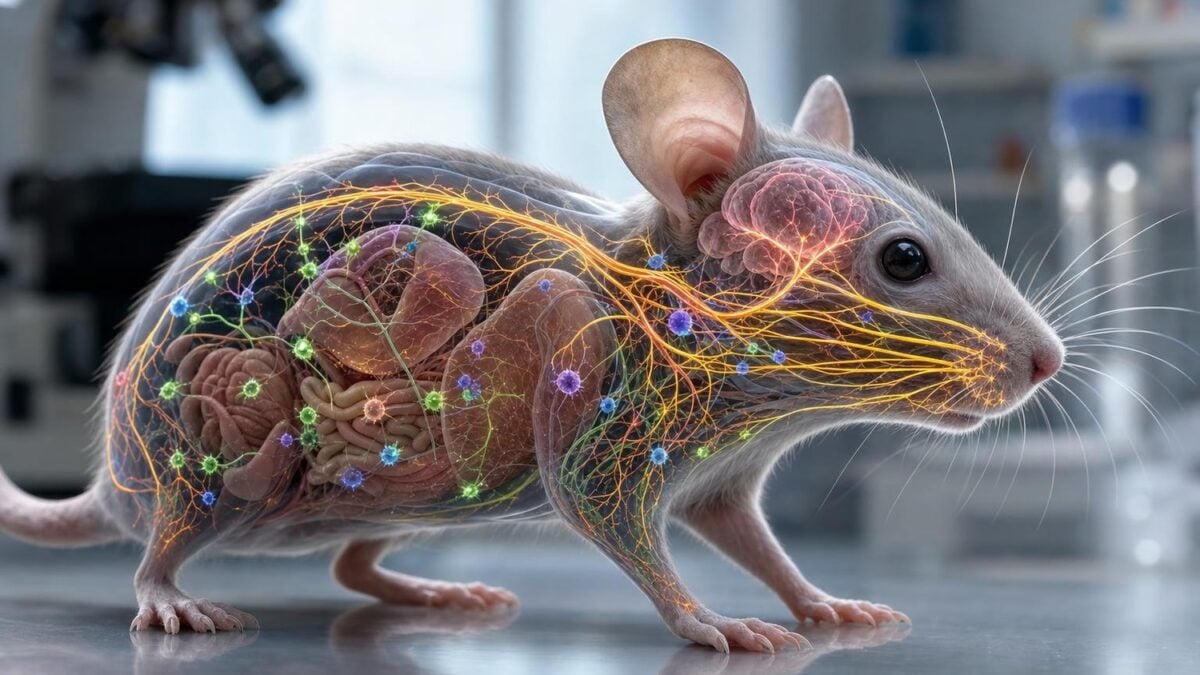
Published in Nature in May 2026, this work carried out by Professor Ali Ertürk’s team could transform our understanding of obesity. Thanks to an artificial intelligence atlas called MouseMapper, scientists are now able to visualize the body as an entire system, where inflammation, nerve damage and metabolic disturbances interact silently.
When artificial intelligence makes the body almost transparent
For a long time, obesity has been studied organ by organ. The liver on one side, abdominal fat on the other, sometimes the heart or muscles. But the human body does not operate in silos. This is precisely what this team from Helmholtz Munich wanted to demonstrate.
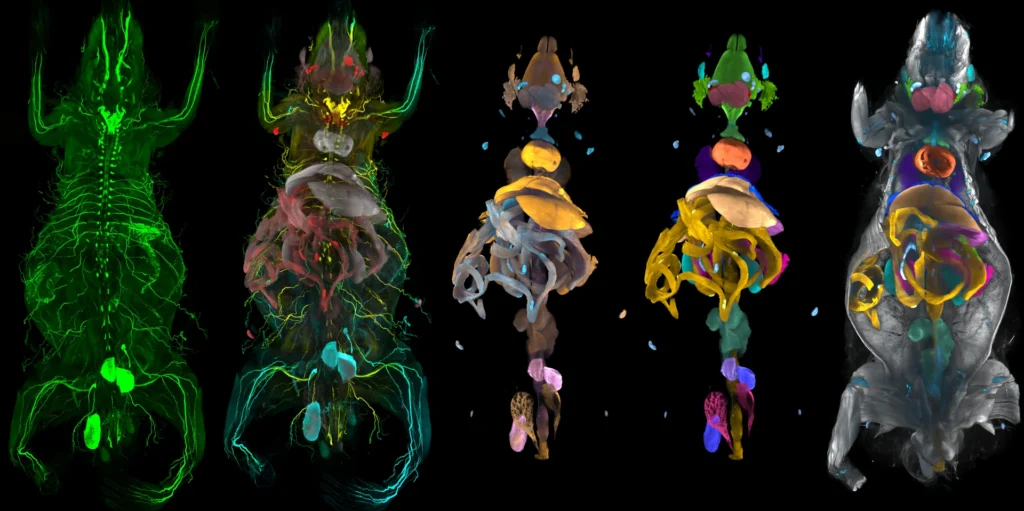
To achieve this, the researchers first carried out a spectacular manipulation: making mice almost transparent. Immune cells and nerves were fluorescently labeled, then the tissues were “brightened” to allow light to pass through. Using light-sheet microscopy, scientists obtained extremely detailed three-dimensional images of entire animals, containing tens of millions of cellular structures.
But faced with this dizzying mass of data – several dozen terabytes of images – the human eye was no longer enough. That’s where MouseMapper comes in, an artificial intelligence-powered atlas that can automatically identify 31 organs and tissue types, as well as map nerves and immune cells throughout the body.
“MouseMapper is built on a fundamental model, which means it generalizes well beyond the data it was initially trained on.”explains Ying Chen, co-first author of the study, in a press release from Helmholtz Munich.
In other words, the algorithm does not just analyze an area chosen in advance: it explores the body as a whole and detects anomalies on its own. An approach that profoundly changes the way we observe chronic diseases.
Facial nerves silently damaged by obesity
When the researchers compared 10 mice fed a high-fat diet to 9 mice fed a standard diet, the findings appeared much broader than simple fat accumulation.
MouseMapper reveals foci of inflammation disseminated in several tissues: fat, liver, muscles, but also peripheral nervous system. Little by little, the fine architecture of the nerve fibers seems to become disorganized. Immune cells migrate and colonize certain territories. The entire body appears remodeled by low-level chronic inflammation.
 © Helmholtz Munich
The most striking finding concerns the trigeminal nerve, the large sensory nerve in the face. In obese mice, researchers observed “many fewer endings and branches,” a sign of a loss of nerve complexity.
This phenomenon is not only visible under a microscope. The animals also reacted less to stimulation of their whiskers, a classic test for assessing facial sensitivity in mice. For researchers, these results establish a concrete link between nerve damage and functional impairment.
This attack is far from trivial. The trigeminal nerve is involved in facial sensitivity, tactile perception, but also certain pain mechanisms. Until now, these damages have largely flown under the radar of obesity research.
And this is perhaps where this study marks a turning point: it reminds us that obesity is not only a question of fat storage or disturbed metabolism. It is a systemic disease, capable of discreetly affecting tissues that were not spontaneously associated with it.
In humans too, the same biological signatures emerge
To understand what causes this nerve damage, scientists studied the trigeminal ganglion, the structure where the cell bodies of facial sensory neurons reside.
Using spatial proteomics — a technique for mapping proteins directly in tissues — they identified molecular changes associated with inflammation and nerve remodeling in obese mice.
But the most decisive step came next.
The researchers compared this data to human samples from obese donors. And the similarities stood out in a striking way.
“We have demonstrated previously unknown structural and molecular modifications in the trigeminal ganglion and its facial branches, and this same molecular signature has been found in human tissues. This type of discovery cannot be obtained by studying a single organ at a time.”emphasizes Dr. Doris Kaltenecker, senior researcher at the Diabetes and Cancer Institute (IDC) at Helmholtz Hospital in Munich and first author of the study.
The protein profiles observed in the trigeminal ganglia of obese people differ markedly from those of lean donors, and closely resemble those identified in mice.
For Professor Ali Ertürk, the ambition now goes beyond the sole framework of obesity. “Our goal is to create a comprehensive framework for understanding how diseases affect the body as an interconnected system.”he explains.
Ultimately, his team hopes to develop true “digital twins” of mice: virtual models capable of simulating the evolution of diseases, identifying the earliest lesions and testing interventions before the damage becomes irreversible.
This work does not promise a miracle treatment. Above all, they remind us of an often invisible reality: obesity leaves deep, sometimes silent traces throughout the body. Finally seeing them with precision could change the way the disease is diagnosed, but also the way we look at the people who live with it.