
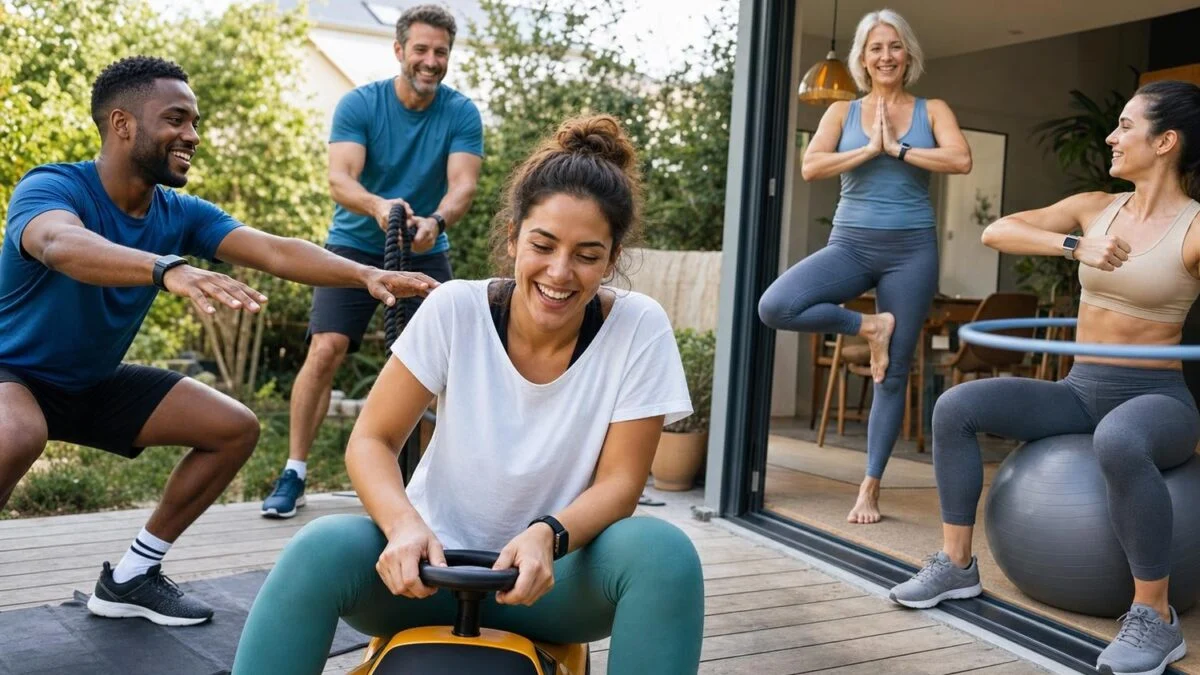
Every year, the same resolutions come up. Getting back into sport. Move more. Take care of your health. And every year, for many, motivation runs out of steam after a few days or weeks. But what if the problem wasn’t a lack of will? New research suggests that our relationship with physical activity is much more complex than we imagine, between the pressure of applications, brain mechanisms and sometimes discouraging personal experiences.
British researchers analyzed tens of thousands of messages posted on social networks and highlighted the sometimes demoralizing effect of fitness applications. Other work even shows that certain intestinal bacteria could influence our desire to move. Enough to change our outlook on those who struggle to put on their sneakers.
When motivation clashes with reality
On paper, the benefits of physical activity are indisputable. Regular practice reduces the risk of cardiovascular disease, improves sleep, contributes to mental health and promotes healthier aging. However, between official recommendations and everyday reality, a gap persists.
Many people experience a form of discouragement when it comes to sport. A feeling often reinforced by the digital tools supposed to help them. In a study published on October 22, 2025 in the British Journal of Health Psychologyresearchers from University College London analyzed nearly 60,000 messages published on the social network X about five sports and nutritional monitoring applications.
The finding is revealing: 13,799 publications expressed negative feelings related to these tools. Behind the numbers lie sometimes painful human experiences. Some users say they gave up when faced with goals that were deemed unrealistic or guilt-inducing. One of them testifies thus: “My fitness app tells me that to reach my ideal weight, I need to consume less than 700 calories per day.”.
When an algorithm turns every missed meal or session into a potential failure, motivation quickly gives way to frustration. Sport then ceases to be a space of well-being to become an additional source of pressure. But the difficulty in enjoying effort is not explained solely by our digital environment.
What if your brain — or your microbiota — had a say?
For several years, researchers have discovered that our desire to move could also be influenced by biological mechanisms of which we are not aware. A study published in the journal Nature in December 2022 thus highlighted a surprising link between certain intestinal bacteria and the motivation to practice physical activity.
In mice, researchers observed that certain microorganisms in the microbiota promoted the production of dopamine during exercise. This molecule plays a central role in the brain circuits of reward and pleasure. The more the brain perceives a reward after an effort, the more likely it is to want to reproduce this behavior.
These results do not mean that the microbiota alone determines our relationship to sport. But they are a reminder of an essential reality: motivation is not just a matter of character or discipline.
Our personal history, our environment, our psychological state, but also certain biological mechanisms can influence our relationship to movement. This more nuanced understanding allows us to escape from an often guilt-inducing discourse. Not liking running, hating gyms or abandoning a program after a few weeks does not necessarily mean lacking willpower.
This may simply reflect the fact that the chosen activity is not suitable for the person practicing it.
Forget performance to rediscover the pleasure of moving
This is precisely where physical and mental health specialists invite a change of perspective. Rather than trying to love sport as it is traditionally presented to us, why not look for forms of movement that provide pleasure?
Some people find balance by walking while listening to a podcast. Others discover rollerblading, dancing, trampoline, aquagym or even active video games. A participant named Lindsay describes her experience after trying an aquagym class attended mainly by older women: “I fell in love. I felt it was for me.”.
Others turn their running sessions into fun times, running to the rhythm of their favorite songs or musical theater soundtracks.
The key seems to lie in a change of outlook: no longer considering physical activity as a punitive obligation, but as a pleasant experience adapted to one’s tastes.
Digital tools can also become allies when used flexibly. Some studies show that seeing the progress of loved ones or participating in friendly challenges can encourage physical activity without generating undue pressure.
Kimberly, a New Yorker interviewed as part of this work, explains using a simple star system on a calendar: “Kinda makes me feel like I’m back at school“.
Behind this observation lies an important lesson: lasting motivation often comes from small, rewarding rituals rather than spectacular goals.
Five minutes of walking is better than an ideal session that is constantly postponed. Ten minutes of movement is still beneficial even when it seems modest.
Ultimately, the question may not be how to force yourself to exercise when you hate it. Rather, it consists of discovering what form of movement can naturally find its place in one’s life. Because for health, the best exercise is not necessarily the most intense. It’s often the one we want to do again tomorrow.