
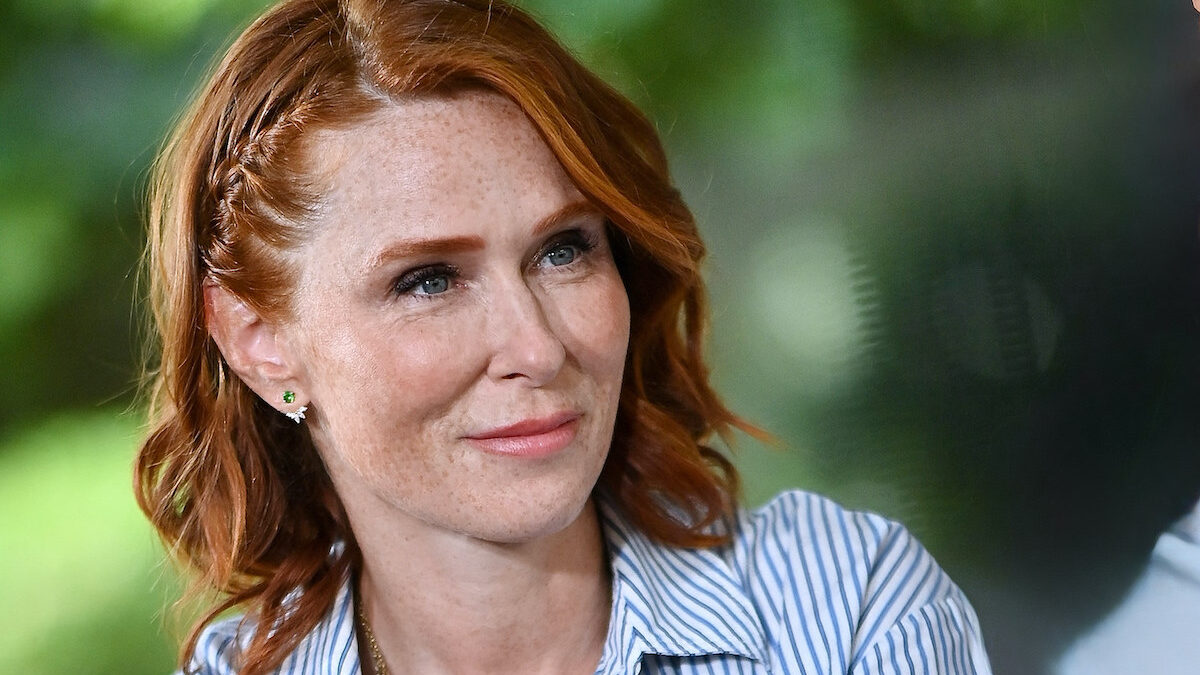
We know her for her ease on screen, her humor and her charisma. However, in daily life, Audrey Fleurot has long been confronted with difficulties that she was unable to explain. Guest this June 11 on the show As an asidethe actress confided that she had recently been diagnosed with dyspraxia. A discovery that changed her outlook on herself.
“I just learned it, and it did me a lot of good”
On the occasion of the release of the film La Perfect(e): family scamsin theaters on June 24, Audrey Fleurot opened up about a more intimate aspect of her life. The actress revealed that she was diagnosed with dyspraxia as an adult.
“I just learned it, and it did me a lot of good.“, she explained on the Canal+ set.
This diagnosis notably allowed the star to better understand certain persistent difficulties, particularly when she drives. “The car is something that is not easy for me and has always been a big complex“, she admitted.
The actress says she has always had difficulty finding her way in space: “I’m completely bad at niche. I can take you from point A to point B, but when you have to park, there have to be three spaces… Really, there is a relationship with space.”
Orientation problems that are not limited to driving. Audrey Fleurot also claims to understand better today why she continues to get lost in her own street.
Receiving a medical explanation for these difficulties was experienced as a real relief. “It really relieved me to say to myself: “Oh yes, okay… These are things you can’t necessarily work on”.“
Dyspraxia, a common but still little-known coordination disorder
Dyspraxia, also called developmental coordination disorder, belongs to the DYS family of disorders, such as dyslexia or dyscalculia.
It results from a dysfunction in the planning and automation of gestures. The muscles function normally, intelligence is preserved, but the brain struggles to organize certain daily actions.
According to estimates, this disorder affects around 5% of children, with more or less marked manifestations. If the diagnosis is now often made during childhood, some adults, like Audrey Fleurot, discover their disorder much later.
What are the symptoms of dyspraxia?
Dyspraxia can take different forms and affect several areas.
Visuospatial disorders are among the most common. They can cause difficulty organizing your gaze, locating objects in space or even distinguishing your right from your left. Some people also have difficulty judging distances, following a path or finding their way.
On a motor level, those affected often have difficulty performing certain complex movements in a fluid and automatic manner. They may appear clumsy, have difficulty writing, handling objects or coordinating their movements.
In adults, these difficulties can persist and result in problems with parking, spatial organization or even finding their way in familiar places, as Audrey Fleurot has illustrated.
How is dyspraxia diagnosed and treated?
The diagnosis is generally based on several assessments carried out by different healthcare professionals. Motor skills assessments can be carried out by a psychomotor therapist or an occupational therapist. Psychometric tests also make it possible to assess certain cognitive functions, while neurovisual examinations can be carried out by specialized orthoptists.
Dyspraxia cannot be cured, strictly speaking. On the other hand, appropriate treatment helps to develop compensation strategies and reduce the impact of the disorder on daily life.
The support is often multidisciplinary and can combine occupational therapy, psychomotor skills, speech therapy and psychological support when the disorder leads to a loss of self-confidence or a feeling of worthlessness.
Furthermore, dyspraxia can sometimes be associated with other disorders, such as attention deficit disorder with or without hyperactivity (ADHD), dyslexia, certain autism spectrum disorders or even anxiety and depressive disorders.
Professional success despite the disorder
Audrey Fleurot’s testimony reminds us that a DYS disorder does not prevent you from having a brilliant career. Many personalities have spoken publicly about their dyspraxia over the years.
This is particularly the case of actors Jean Dujardin and Daniel Auteuil, Hollywood star Tom Cruise and director Steven Spielberg.
So many journeys which show that, despite the difficulties it can cause on a daily basis, dyspraxia prevents neither personal development nor professional success. For some, like Audrey Fleurot, finally putting a name to these difficulties can even constitute an essential step towards better understanding and accepting oneself.