
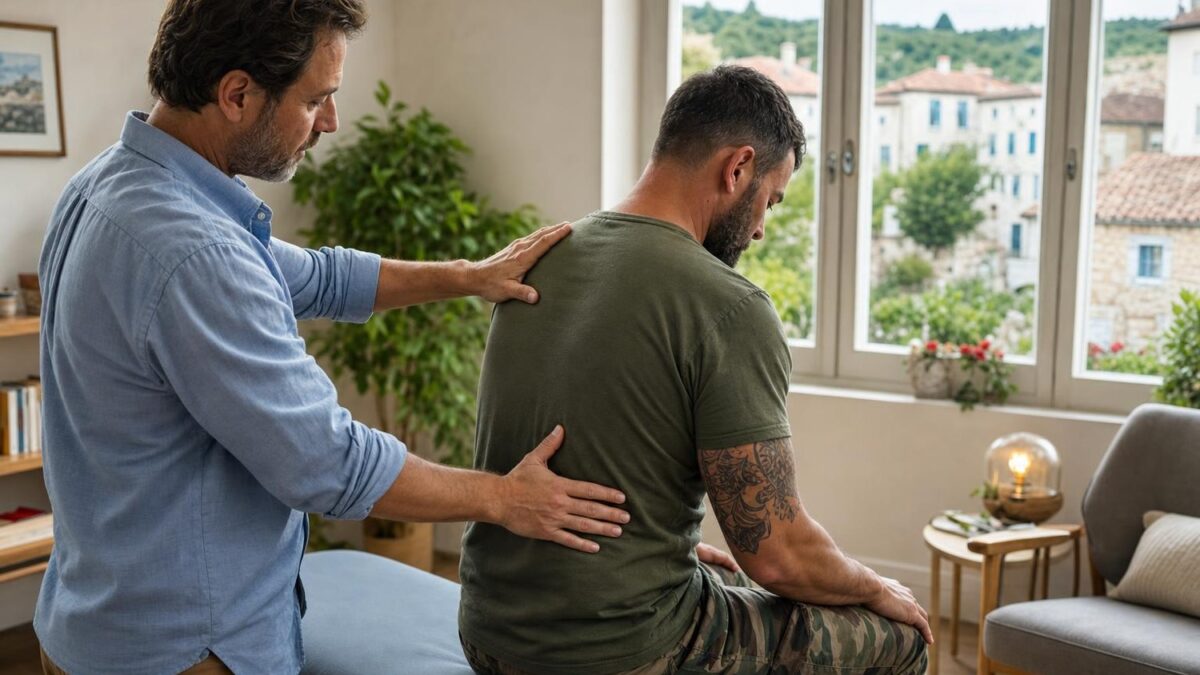
In a village in the Var, a new approach to post-traumatic stress intrigues veterans, firefighters and caregivers. Developed three years ago, this therapy is based on precise palpations of the skin, targeting the fascia to soothe memories of war, accidents or dramatic interventions. Still exploratory and confidential, it has already been used with mentally injured people in collaboration with the Association Les InvaincuS, engaged since 2017 with injured soldiers, gendarmes and firefighters.
At the origin of this method, we find Pierre Letzkus, psychologist in Vinon-sur-Verdon (Var) and practitioner of Traditional Chinese Medicine. He named his therapy NBQZ, for “Nao Bu Qi Zhi”, an expression that he links to the idea of Qi stasis in the brain, therefore blocked energy. Its ambition is to offer an alternative to EMDR, which has been widely used for thirty years, by combining neurophysiology, Chinese medicine and work on emotional memory.
How does Pierre Letzkus’ NBQZ therapy work?
NBQZ is described as an “exploratory method” which starts from a series of palpations of multiple areas of the skin. Pierre Letzkus is particularly interested in fascia, which he presents as “areas rich in nerve endings, which, due to their interconnection with different brain areas, can account for the affects that the patient is experiencing. On which we can then act via stimulation of these same areas.”
The idea is to identify and then modulate the bodily traces left by the shock.
The psychologist explains that he has long practiced EMDR, a therapy based on eye movements.
“We know today that these movements observed in particular during sleep phases correspond to moments of emotional assimilation, explains the practitioner. It is a method that has been used for thirty years in therapies…” By creating NBQZ, he seeks a bodily approach that he presents as gentler, without prolonged exposure to traumatic memories, while aiming for the same objective: to defuse the emotional charge of trauma.
Between psychology, Traditional Chinese Medicine and psychologically injured
Trained in psychology and Chinese medicine, Pierre Letzkus places NBQZ at the crossroads of these two universes. Practitioners who have been inspired by his method describe brief work, centered on the manual stimulation of points, often on the back area, to remove Qi stagnation. They present it as a complement to classic psychotherapy, and not as a psychology session in its own right nor as a substitute for medical treatment.
The collaboration with the Association Les InvaincuS provides a first very concrete field of application: that of veterans and firefighters affected by psychological injuries. The association, created in 2017, organizes stays and reconstruction courses involving psychologists, physical trainers and external speakers. It is in this context that NBQZ was offered to certain injured people, in addition to the support already in place.
Try NBQZ: for whom, at what price and with what precautions?
On his professional page, Pierre Letzkus indicates using NBQZ for fears, phobias, anxieties, emotional blockages or bereavement aids, in particular when a specific event has “blocked” the person. A session costs €70, with a reduced rate of €50 for students, retirees, the unemployed or people on RSA.
The method is not included in the Mon Psy system and has not demonstrated its effectiveness in a randomized placebo-controlled study. The practitioners who relay it point out that it does not replace but adds to medical or psychotherapeutic monitoring, especially in cases of severe post-traumatic stress.