

Burning when urinating, urgent urges, pulling in the lower abdomen: for hundreds of millions of people each year, cystitis is synonymous with pain. Urinary infections are among the most common bacterial infections in the world, with more than 400 million cases per year and nearly one in three women affected before the age of 24. A study published in 2026 in the
Proceedings of the National Academy of Sciences shows, however, that this pain and this urgency to urinate are part of a real defense system, orchestrated by a small network of bladder nerves that has long been underestimated.
Leading this work on mice, Luke Grundy and Cindy Tay were interested in sensory fibers nestled just under the inner lining of the bladder, called
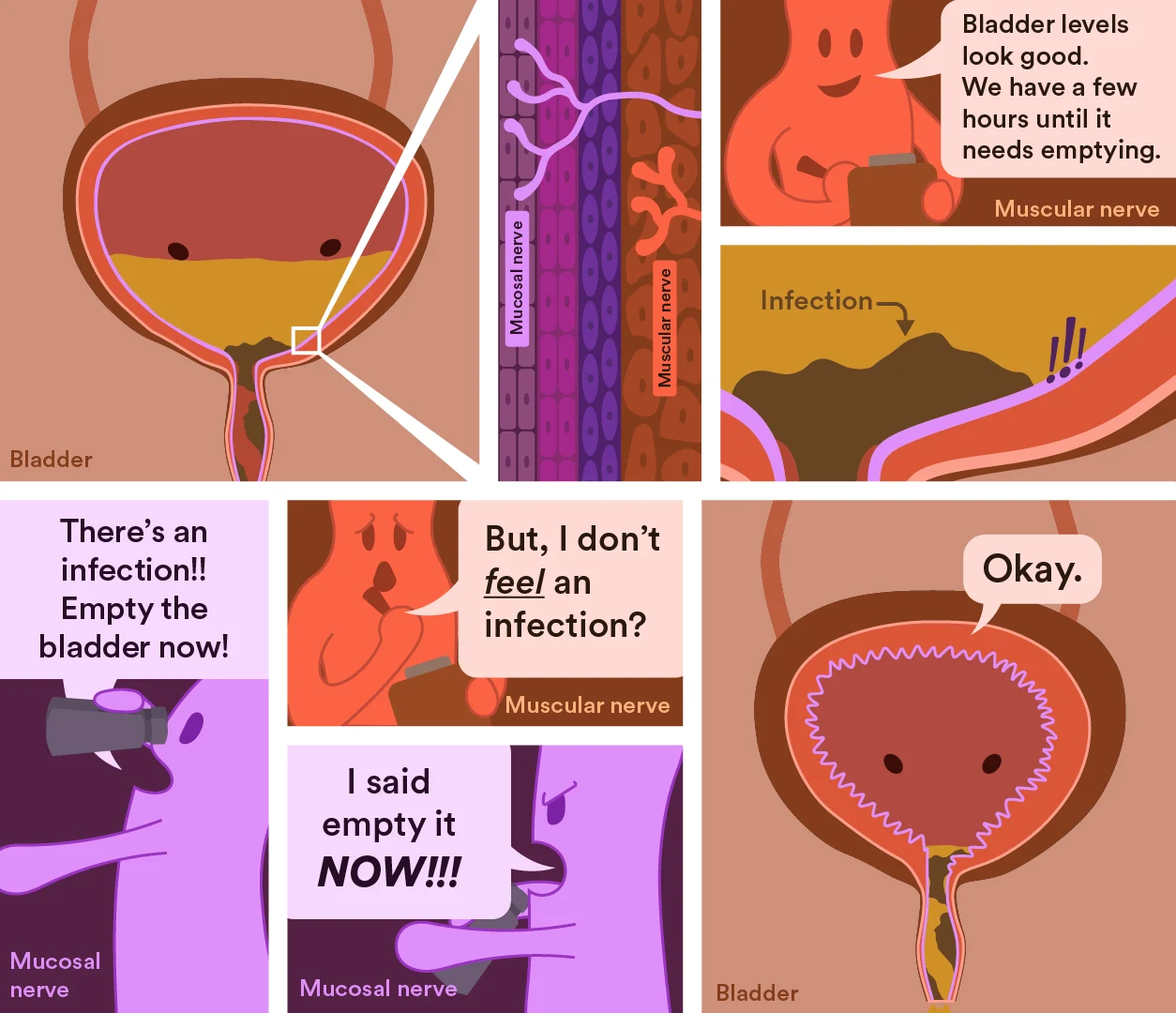
mucosal afferents. “These mucosal nerves have intrigued scientists for almost two decades because they remain silent while the bladder fills and empties, which is the bladder’s primary role.“, observes Cindy Tay. “What we discovered is that they have a hidden job: to act as an early warning system that springs into action the moment the infection takes hold.“, she adds. In other words, the pain we feel signals both a problem and a response from the body to deal with it.
Sentinel nerves that make the bladder speak during urinary tract infection
“Most bladder nerves act as a fuel gauge, telling the brain when the bladder is filling and needs to be emptied“, explains Luke Grundy, head of the NeuroUrology Research Group at Flinders University. “The nerves we studied in this research are different. They lie close to the lining of the bladder and appear to act more as an early warning system, detecting infection and inflammation“, he explains. In their study, the team shows that these fibers remain almost silent in normal times, but become hyperreactive as soon as a urinary infection by
Escherichia coli settles down.
“When the bladder is healthy, these nerves are relatively calm, but during a UTI they become very sensitive and react to the presence of bacteria and inflammation.“, explains Luke Grundy. “They don’t just detect the infection. They help coordinate the body’s response by triggering pain and urinary frequency, behaviors that appear to help clear bacteria from the bladder as part of the body’s defense system“, he continues. This is what makes the urges so disproportionate to the actual volume of urine during cystitis.
Why pain and urges can help drive away bacteria
In their experiments, the researchers showed that these mucosal afferents trigger both pelvic pain and an increase in the number of urinations during a urinary infection. “It may not feel good, but urinating more frequently actually helps clear the infection by flushing out harmful bacteria“, explains Luke Grundy. When scientists used resiniferatoxin to selectively deactivate these nerves in mice, the animals had less pain and urinated less often, but the bacterial load in the bladder and kidneys increased and infections spread more easily.
 © Flinders University
“If the nerves that detect infection are not working properly, the body may not respond as effectively“, he warns. The authors note that this could shed light on the increased vulnerability to severe or recurrent urinary infections in certain people whose nerves are altered, for example after damage to the spinal cord. They also compare this mechanism to what happens in other organs: sensory nerves trigger cough in the bronchi or diarrhea in the intestine to expel infectious agents more quickly.
Towards treatments for urinary infections that provide relief without disarming the defense
For patients, the priority remains to calm the pain and burning quickly, while treating the infection with antibiotics when they are prescribed. “Our findings shed new light on how the bladder detects and responds to infection, helping to explain the biological processes behind the pain, urgency and discomfort commonly experienced during UTIs.“, summarizes Luke Grundy. “Researchers say the next challenge is developing therapies that ease the pain and urgency associated with UTIs while preserving the protective role these nerves play in fighting infection“, indicate the authors.
The objective would therefore be, ultimately, to silence the suffering without turning off the alarm which helps the bladder to defend itself.