
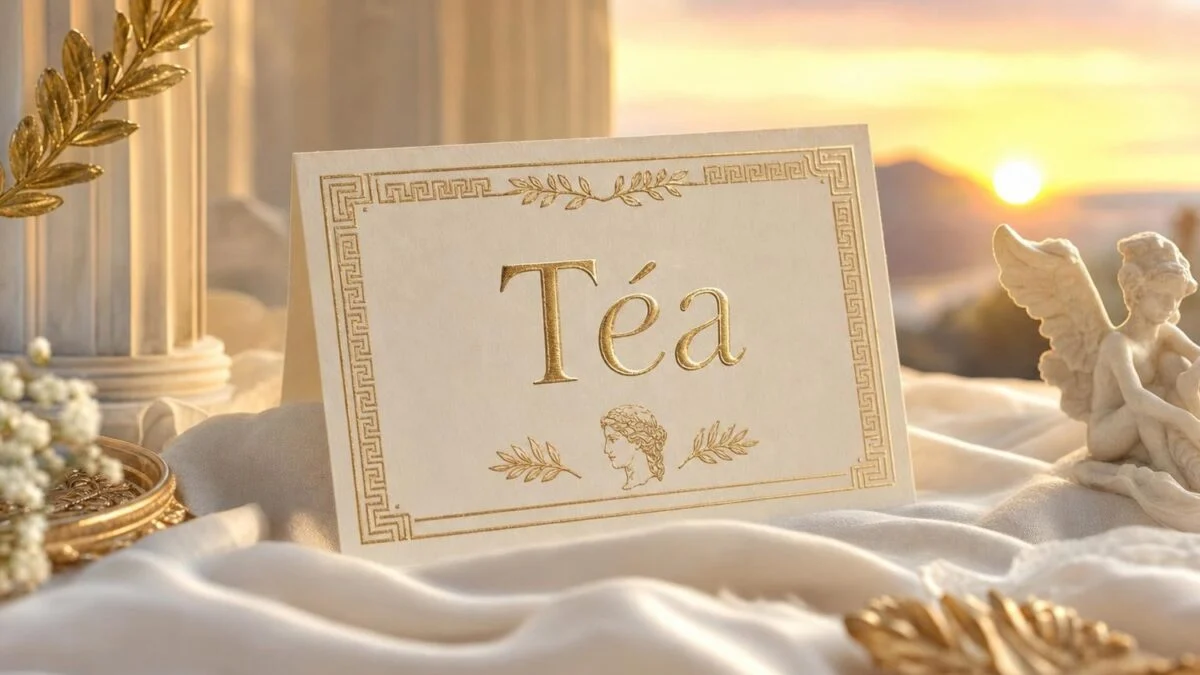
In France, around 10,000 people today have a three-letter Greek female first name, both luminous and discreet, which promises a baby an almost sacred aura. Only three letters, but a long story and a very strong meaning, between reference to divinity and the idea of a gift from above. For parents looking for accessible rarity, this first name quickly slips onto the short list.
This first name is Teasometimes written
Tea without accent, described in Greek as “the divine touch”, “goddess” or “divinity”, and which derives from
Thea while serving as a diminutive for Dorothée or Théodora. Thanks to these roots, this media also associates Téa with expressions like “gift of God”, “gift of God” or even “divine gift”. In a word, a short first name full of spirituality, but easy to wear every day.
Meaning of the first name Téa: light, goddess and divine gift
In practice, the most common meaning of Tea
remains that of a first name directly linked to a goddess. Thea (Θέα) designates the divinity in ancient Greek, and in mythology, Theia is among the Titanides, goddess of light and mother of the Sun, the Moon and the Dawn. To have this first name is therefore to be spontaneously associated with the idea of radiance, clarity and a gaze turned towards the sky, without the name appearing complicated or old-fashioned.
Cultural origin of Téa: from ancient Greece to Polynesia
This root also explains the variants that we come across around Tea : Tea without accent in several countries, or Thea with an h which further emphasizes the Greek heritage. In Tahitian, the first name Tea changes register again and evokes “white”, “clarity” or “the day that dawns”. In the Polynesian islands, it is worn in both feminine and masculine forms and refers to dawn, to new light, which connects in another way with the universe of the goddess Theia.
Popularity of the first name Téa in France: around 10,000 carriers
In terms of popularity, it is estimated that between 10,000 and 11,000 people today have the first name Tea In France. It peaked in 2010, with just over 700 births that year, before stabilizing around 200 to 250 little girls per year. As a result, the first name remains rare enough for each child to feel unique, while being common enough not to confuse those around them.
For parents, it’s an interesting compromise:
Tea is as short as Léa or Mia, but much less heard, and it is easily pronounced in many languages. Between the Greek reference to the goddess and the gentler reading of a gift from God, this little three-letter first name offers a child a beautiful story to tell, without ever seeming extravagant.