
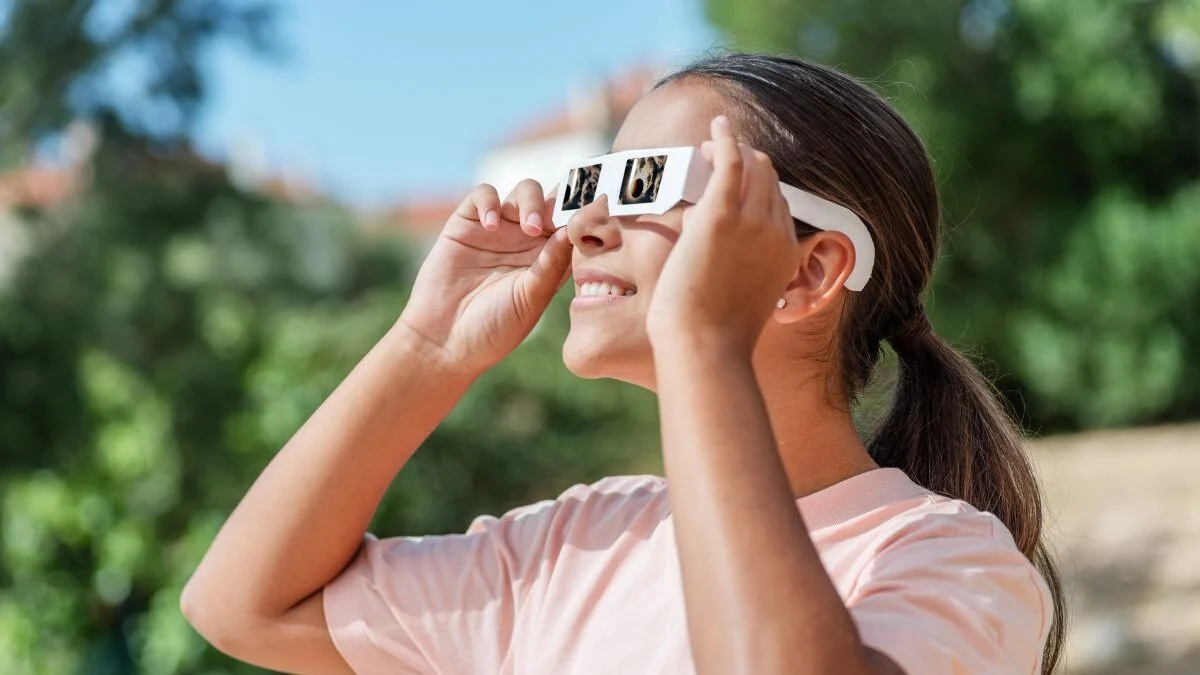
The observation of a solar eclipse, whether total or partial, always attracts thousands of curious people. This is a fascinating astronomical event, but one that carries a major risk to our visual health.
Staring at the sun without proper precautions can cause serious and irreversible damage. To enjoy the show without compromising your eyesight, it is essential to know the real dangers and to adopt good prevention reflexes.
Solar retinopathy: irreversible damage in seconds
Looking directly at the sun poses extreme danger to the retina, the sensitive membrane at the back of the eye. According to the National Union of Ophthalmologists of France (SNOF), a few seconds of direct exposure are enough to cause irreversible damage.
“Looking at the sun, even partially eclipsed, without appropriate protection can cause burns to the retina, called solar retinopathy, which are sometimes irreversible. These lesions can occur in just a few seconds of direct observation, even though 99% of the sun is obscured by the moon” confirms Dr. Gérald Kierzek, emergency physician and medical director of True Medical.
The trap often lies in the drop in ambient light during the phenomenon. Dr. Kierzek emphasizes that “the drop in brightness during the eclipse removes the sensation of dazzle, which encourages you to stare at the sun longer, while ultraviolet and infrared radiation remains just as dangerous. The consequences can be serious: reduced visual acuity, black spots in the center of the visual field called scotomas, or even permanent loss of central vision.
CDs, x-rays, sunglasses: “wacky” equipment to ban
Faced with general enthusiasm, the temptation is great to use makeshift equipment kept at home. This is a mistake that can be costly to your eyesight. The SNOF is categorical: you should never use sunglasses, x-rays, CDs, smoked glass or any other non-approved device.
Dr. Gérald Kierzek strongly insists on false protections to be absolutely avoided.
“Above all, you should not use ‘eccentric’ equipment such as classic sunglasses, even very dark or polarized ones, photo negatives, slides or x-ray films. CDs, DVDs, vinyl records, smoked glasses, tinted mirrors or homemade filters offer no safety. 3D cinema glasses, uncertified welding masks and unapproved camera filters should also be avoided. The only safe protection is glasses eclipse devices certified ISO 12312-2, bearing the CE mark and purchased from reliable suppliers.
SNOF recommendations for safe observation
To experience this event without taking the slightest risk, the National Union of Ophthalmologists of France recommends scrupulously following the following instructions:
- Never look at the sun with the naked eye, regardless of the duration of observation;
- Only use glasses specifically certified for observing eclipses (ISO 12312-2 standard);
- Check the integrity of the filters before each use: make sure they have no scratches, holes or defects;
- Never observe the sun through binoculars, a telescope or a camera without a suitable solar filter, even if you are wearing your eclipse glasses;
- Accompany children: ensure that the youngest are supervised by a responsible adult and properly equipped throughout the observation.
Loss of vision or black spot: what to do after the eclipse?
The danger of retinal burns is that they are completely painless at the time they occur. The absence of immediate pain therefore does not guarantee the absence of lesion.
Dr. Gérald Kierzek warns of the symptoms that should alert you in the hours or days following the event.
“If you notice blurred central vision, a decrease in visual acuity, the appearance of a dark or black spot in the center of the field of vision, distorted images or a change in color perception, you must react. Even if we sometimes observe simple eye pain or a feeling of sand in the eyes, the presence of a visual disturbance requires medical advice.
In case of doubt or abnormal symptoms after observation, the SNOF and Dr Kierzek recommend quickly consulting an ophthalmologist or going to an ophthalmological emergency service. Remember to specify the conditions of your exposure (duration, time, type of protection used).
A fundus examination or additional tests such as an OCT will allow the damage to be assessed. Remember that there is no miracle treatment: while some lesions partially regress over time, others leave permanent visual after-effects.
In short, a solar eclipse remains a magnificent celestial event to contemplate, provided you never neglect its visual safety. Strict compliance with SNOF recommendations and the choice of ISO 12312-2 approved glasses constitute your only protection against permanent damage. Remember: a few seconds of caution are enough to preserve a lifetime of vision!