
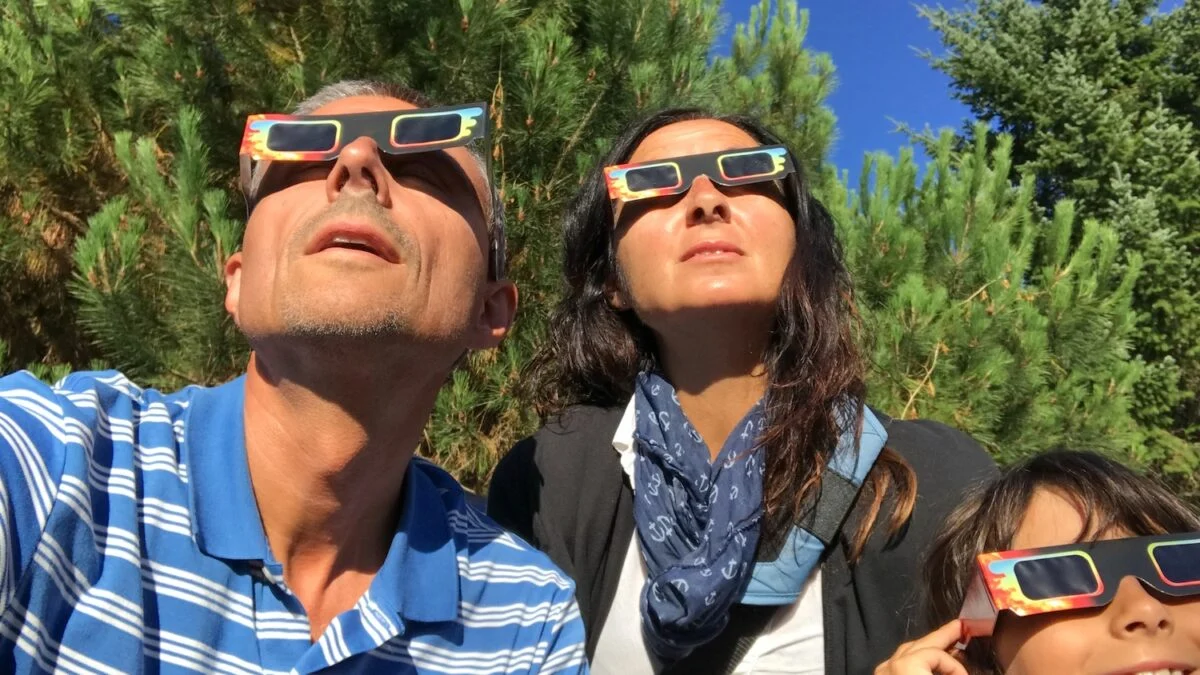
An eclipse can leave a spectacular memory… but also, in certain cases, a lesion of the retina which is not immediately visible and does not cause any pain. After direct observation of the Sun, certain visual disorders therefore deserve special attention, particularly in children. Spot in the center of the field of vision, distorted lines or loss of sharpness: these are the signs that should not be ignored.
Understanding the risks of directly observing the eclipse
After the solar eclipse, many wake up with the same worry: have their eyes suffered? The French Society of Ophthalmology recalls that direct observation of the Sun can cause
solar retinopathyburning of the macula responsible for central vision. In 1999, 253 eye injuries were confirmed in France after an eclipse, including 147 retinal injuries and 17 serious cases.
For Dr. Maxime Delbarre, ophthalmic surgeon, the right strategy is not to repeat yourself.Do my eyes hurt?“, but rather “Do I see exactly like before?” (West France). The pain mainly reflects surface irritation, whereas a damaged retina may not make you feel anything at the moment.
Solar retinopathy: symptoms that should alert you after the eclipse
A quick glance at the sun, generally, does not cause immediate damage. However, it is the prolonged fixation that poses significant risks. On August 12, 2026, Dr. Ygal Boujnah, an ophthalmologist, published an explanatory video detailing the reflex gestures during unprotected observation and reassuring viewers about the possible effects. “A very brief glance, followed by the reflex to look away, rarely causes lasting damage.he explains.
On the other hand, a persistent central spot or a drop in sharpness should lead to consultation: if in the central area, a sort of black spot, an area which is not clear or a grayish area, always remains in the same place. Sometimes these symptoms do not appear within a few hours, but the next day or two days later.
“What should alert you is different: a spot in the center, fixed when you move your eyes, which doesn’t go away – or straight lines which become wavy. specifies Dr Ygal Boujnah. These signals could indicate maculopathy, a type of retinal damage that requires medical attention.
Tingling, redness, fear of children: not everything is necessarily serious
The French Society of Ophthalmology describes a
photokeratitisa sort of “sunburn” of the cornea, which causes red eyes, tearing and strong sensitivity to light. These pains remain on the surface, whereas, as Dr Laura Sararols, ophthalmologist, points out, “When we look at the light, we don’t notice anything. There is no pain, we don’t feel anything“(Euronews).
She insists on the youngest: “Kids aren’t going to tell us they watched the eclipse and did what they were told not to do“.
When and how to react in case of concern?
If worrying symptoms appear after direct observation of the sun, it is advisable to carry out a simple test the day after the eclipse. The process involves alternately covering each eye and looking at a uniform surface, such as a white wall or door frame. If a persistent black spot or distorted lines are visible, it is recommended to consult an ophthalmologist promptly.
The treatment remains above all supervisory. Dr Maxime Delbarre summarizes: “When photoreceptors are damaged, we do not have a miracle treatment to rebuild them instantly. In many cases, vision improves. But not always completely“. The ophthalmologist then monitors the lesion, often using OCT imaging of the retina.
Observing an eclipse is a captivating phenomenon, but eye safety should always take precedence. If you observed an eclipse without adequate protection, stay alert for signs of a possible problem and consult a professional if necessary. The health of your eyes is essential.
What to remember
After an eclipse, the absence of pain is therefore not necessarily synonymous with the absence of lesions. A simple eye-by-eye check can help spot an anomaly that has gone unnoticed, especially if a stain persists or if straight lines appear distorted. If in doubt, it is better to seek ophthalmological advice quickly. Because when it comes to the retina, caution remains in order: some damage can improve over time, but complete recovery is not always guaranteed.